
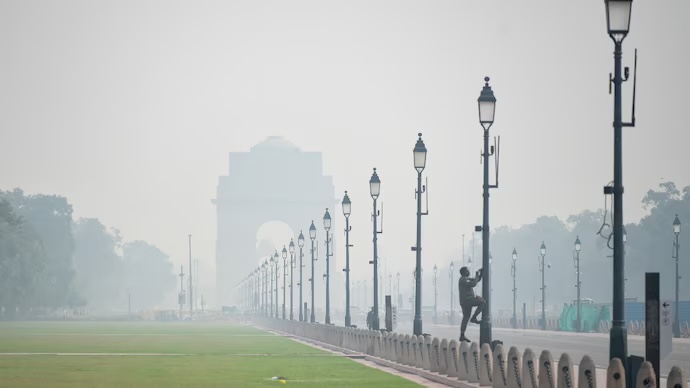
Delhi's air quality has slid sharply in a matter of days. The city's 24-hour average Air Quality Index rose from 117 on 31 October to 261 on 1 November, 324 on 2 November and 350 on 3 November, the worst reading in 287 days and the highest since 20 January, when it stood at 378. The Commission for Air Quality Management responded on 2 November by invoking Stage II of the Graded Response Action Plan across Delhi-NCR, on top of the Stage I measures that have been in place since 21 October. Under national standards, a reading between 301 and 400 is classed as "very poor" and anything from 401 to 500 as "severe".
The case for the tougher curbs rests on the readings themselves. Of the 57 monitoring stations reporting on 3 November, 10 recorded severe air, 35 were very poor and 12 were poor. Jahangirpuri was the worst affected area at 462, while Rohini, Punjabi Bagh and several other hotspots crossed 400. PM2.5, the fine particle most harmful to the lungs, was the dominant pollutant, which raises concern for children, older people and anyone with a respiratory illness. The outlook adds urgency. Stubble burning's estimated share of Delhi's PM2.5 rose from 8.58 percent on 2 November to 15.3 percent on 3 November, and is forecast to reach 20.1 percent on 4 November and 22.2 percent on 5 November. The IITM early warning system expects "very poor" air from 4 to 6 November, followed by six days that could swing between very poor and severe, with Diwali firecracker emissions still to come.
The case for restraint is that some measures show a milder season than recent years. Satellite data recorded 3,535 farm fire incidents between 15 September and 2 November this year, against 4,993 in the same period of 2025, 9,668 in 2024 and 51,822 in 2020. Punjab logged 1,612 incidents this season against 2,262 last year and 41,176 in 2020, and Haryana logged 44 against 122 last year. The citywide index also stayed inside the Stage II range, which is why Stage III was not imposed. Vehicles, estimated at 15.8 percent of Delhi's PM2.5, contribute about as much as stubble burning at 15.3 percent, so the burden of higher parking charges, border checks on certain non-BS-VI vehicles registered outside the capital and staggered office hours falls mainly on commuters, while the jump this week was also linked to unfavourable weather that limited the dispersal of pollutants.
The episode matters well beyond Delhi because GRAP applies across the whole National Capital Region, so the curbs reach residents, drivers and workers in the neighbouring states as well. Stage II adds more road sweeping, water sprinkling and dust control, more inspections of construction sites, stepped-up checks on polluting vehicles and 20 additional weekday Delhi Metro trips, bringing the total extra trips to 40. With the air forecast to stay poor for at least the next week, authorities have said they will keep watching air quality and weather to decide whether further restrictions are needed, and that decision will test how quickly the capital can act before conditions worsen.
Delhi has reached the part of the year when every day's reading counts. Fewer farm fires than in earlier years are a real improvement, but an index of 350 and a forecast of more bad days show that the problem is far from solved.


Leave a Reply