
Between 1775 and 1818 the East India Company fought three wars against the Maratha confederacy, the last great Indian power that could have stopped it. The first ended in a draw, the second cost the Marathas Delhi and much of the west, and the third ended the Peshwa’s rule altogether. By 1819 the Company was the paramount power in India.
Quick Facts
| Conflict | First (1775–82), Second (1803–05), Third (1817–19) |
| Sides | East India Company vs the Maratha confederacy (Peshwa, Scindia, Holkar, Bhonsle, Gaekwad) |
| Key treaties | Surat (1775), Salbai (1782), Bassein (1802), Deogaon (1803), Rajghat (1805) |
| Key battles | Wadgaon, Assaye, Laswari, Khadki, Sitabuldi, Mahidpur |
| Outcome | End of Peshwa rule; Company paramount in India |
The First War (1775–82)
After the death of Peshwa Narayanrao in 1773, his uncle Raghunathrao seized the office, but a council led by Nana Phadnavis ruled in the name of the infant heir, Sawai Madhavrao. Raghunathrao turned to the British at Bombay and signed the Treaty of Surat on 6 March 1775, ceding Salsette and Bassein in return for 2,500 soldiers. The Calcutta Council condemned the treaty, but the war went on. Years of inconclusive fighting followed, in which the Company could not catch the highly mobile Marathas. It ended with the Treaty of Salbai in 1782: each side returned captured territory, and the British dropped Raghunathrao.
The Second War (1803–05)
Peace lasted twenty years. In October 1802 Yashwantrao Holkar defeated the combined armies of Peshwa Baji Rao II and Daulatrao Scindia at Poona. Baji Rao fled to the British and signed the Treaty of Bassein in December 1802, accepting a subsidiary force and agreeing to deal with no other power. The Maratha chiefs saw it as a surrender of sovereignty, and the treaty has been called the death knell of the Maratha Empire. Scindia and the Bhonsle of Nagpur went to war.
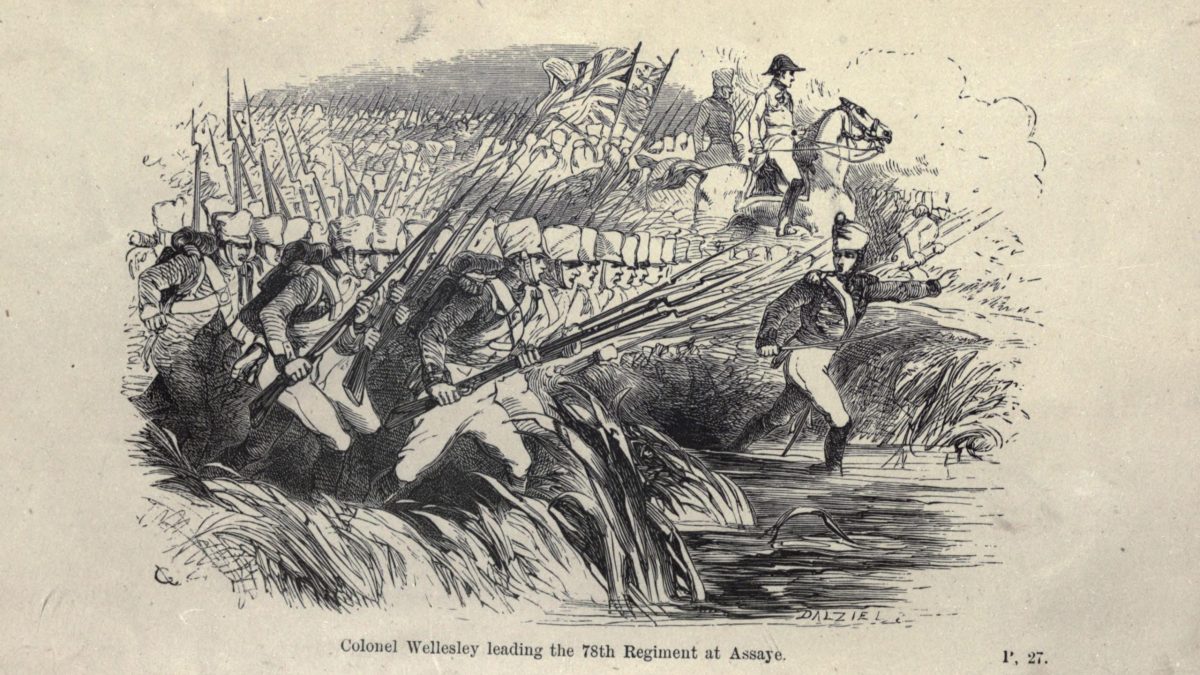
- **Assaye (23 September 1803):** Arthur Wellesley, the future Duke of Wellington, defeated a larger Scindia army
- **Delhi and Laswari:** General Gerard Lake took Delhi in September 1803 and won at Laswari in November
- **Treaties:** by the Treaty of Deogaon (December 1803) the Bhonsle gave up Cuttack, and Scindia lost the Delhi region and territory elsewhere in his own settlement a few days later
- **Holkar:** he fought on with guerrilla tactics in 1804 before making terms in the Treaty of Rajghat in December 1805
The Third War (1817–19)
Governor-General Lord Hastings moved against the Pindaris, bands of irregular horsemen, and in doing so surrounded the Maratha courts. The Peshwa, the Bhonsle and Holkar rose against the Company in 1817, but the Company won quickly.
- **Khadki (November 1817):** the Peshwa’s army was defeated near Pune
- **Sitabuldi (November 1817):** the Bhonsle’s forces were beaten at Nagpur
- **Mahidpur (December 1817):** Holkar lost to a Company army
- **Koregaon (1 January 1818):** a small Company force held off the Peshwa’s troops in a famous stand
Baji Rao II surrendered in June 1818. He was pensioned at Bithur near Kanpur, and the Peshwa’s territories were annexed to the Bombay Presidency. A small Satara state was kept for the descendants of Shivaji until it was annexed in 1848 under the Doctrine of Lapse.
Why the Marathas Lost
The confederacy was divided: Peshwa, Scindia, Holkar and Bhonsle often fought one another, and the Company’s diplomacy exploited every quarrel. The Company also had a steady revenue base from Bengal, a disciplined army and a willingness to use subsidiary treaties that turned rulers into dependants. The Marathas had fought the Mughals as raiders and fighters, but they could not match the financial strength behind the Company’s troops.
Legacy
With the Marathas gone, no Indian state could challenge the Company by force. The way was open for the annexation of Punjab and Sindh, and the next large rising came only in 1857. For the earlier history of the confederacy, see the Third Battle of Panipat and Shivaji.
Featured image: Colonel Arthur Wellesley leading the 78th Regiment at the Battle of Assaye, 23 September 1803 (painting). Photo by AnonymousUnknown author, in the public domain, via Wikimedia Commons.

Leave a Reply