Ustad Vilayat Khan (28 August 1928 – 13 March 2004) was an Indian sitar player, one of the two or three greatest instrumentalists of Hindustani classical music in the twentieth century. He developed the gayaki ang, a way of playing in which the sitar reproduces the nuances of the singing voice, and altered the instrument itself to make it possible. Proud and uncompromising, he refused the Padma Shri, the Padma Bhushan and the Padma Vibhushan.
Quick Facts
| Full name | Vilayat Hussain Khan |
| Born | 28 August 1928, Gouripur, Mymensingh, Bengal (now Bangladesh) |
| Died | 13 March 2004, Mumbai (aged 75) |
| Instrument | Sitar |
| Tradition | Imdadkhani (Etawah) gharana |
| Occupation | Classical musician, composer |
| Titles | Aftab-e-Sitar; Bharat Sitar Samrat |
| Film music | Jalsaghar (1958), The Guru (1969), Kadambari (1976) |
| Children | Shujaat Khan, Hidayat Khan and two daughters |
Early Life
He was born at Gouripur in East Bengal, where his father, Enayat Khan, was court musician to a landowning family. He belonged to a line of sitar and surbahar players going back several generations; his grandfather, Imdad Khan, gave the family’s style its name. He made his first gramophone record at the age of eight.
His father died in 1938, when Vilayat was ten, before he had passed on most of what he knew. The boy was taught by his mother’s family, who were singers, by an uncle, the surbahar player Wahid Khan, and by other elders. He practised, by his own account, for most of every day for years. The vocal training of his mother’s side was to shape everything he did.
Arrival
In 1944, at sixteen, he played at a music conference in Bombay and was recalled to the stage again and again. Within a few years he was acknowledged as a master.
The Singing Sitar
The sitar had been played largely as a plucked, rhythmic instrument. Vilayat Khan wanted it to sing the khayal, the principal vocal form, with its long glides and ornaments.
- he had the instrument rebuilt, with a heavier neck and bridge and without the lowest bass strings, to sustain the note longer
- he developed the technique of pulling the string sideways across the fret so far that five or more notes could be drawn from a single stroke
- he changed the tuning of the drone strings so that they could be struck as a chord
In performance he would often sing a phrase and then play it, to show that they were the same. His slow expositions of ragas such as Yaman, Darbari and Bhairavi are among the classic recordings of Indian music. He composed under the pen name Nath Piya.
Rivalry
He and Ravi Shankar, eight years older, were the two giants of the sitar and were compared all their lives. Their styles and their views of what the music should be were entirely different, and Vilayat Khan did not hide his opinion that the other man’s fame abroad had been bought at a price. Admirers of each still argue the point.
Films
He composed the score of Satyajit Ray‘s Jalsaghar (1958), a film about a decaying landowner whose last passion is music, and those of the Merchant Ivory production The Guru and the Hindi film Kadambari.
The Honours He Refused
He turned down the Padma Shri in 1964 and the Padma Bhushan in 1968, saying that the committees were not competent to judge his music. In 2000 he refused the Padma Vibhushan, calling it an insult to be offered an award that had already gone to musicians junior to him. He also declined the Sangeet Natak Akademi Award, and for years refused to play on All India Radio.
He accepted two titles: Bharat Sitar Samrat, from a body of artists, and Aftab-e-Sitar, “sun of the sitar”, from the President, Fakhruddin Ali Ahmed.
Personal Life
He loved fine clothes, horses, cars and ballroom dancing, and lived at various times in Calcutta, Shimla and Dehradun, and in his last decades partly in the United States. He married twice. His elder son, Shujaat Khan, is a leading sitar player; his younger son, Hidayat, also plays. His brother Imrat Khan was a celebrated player of the surbahar, and the two performed duets in their youth.
Death
He died of lung cancer in Mumbai on 13 March 2004 and was buried beside his father in Calcutta.
Legacy
Most sitar players today, whatever their lineage, use techniques he introduced. His tradition is carried on by his sons and his nephews and by many pupils.
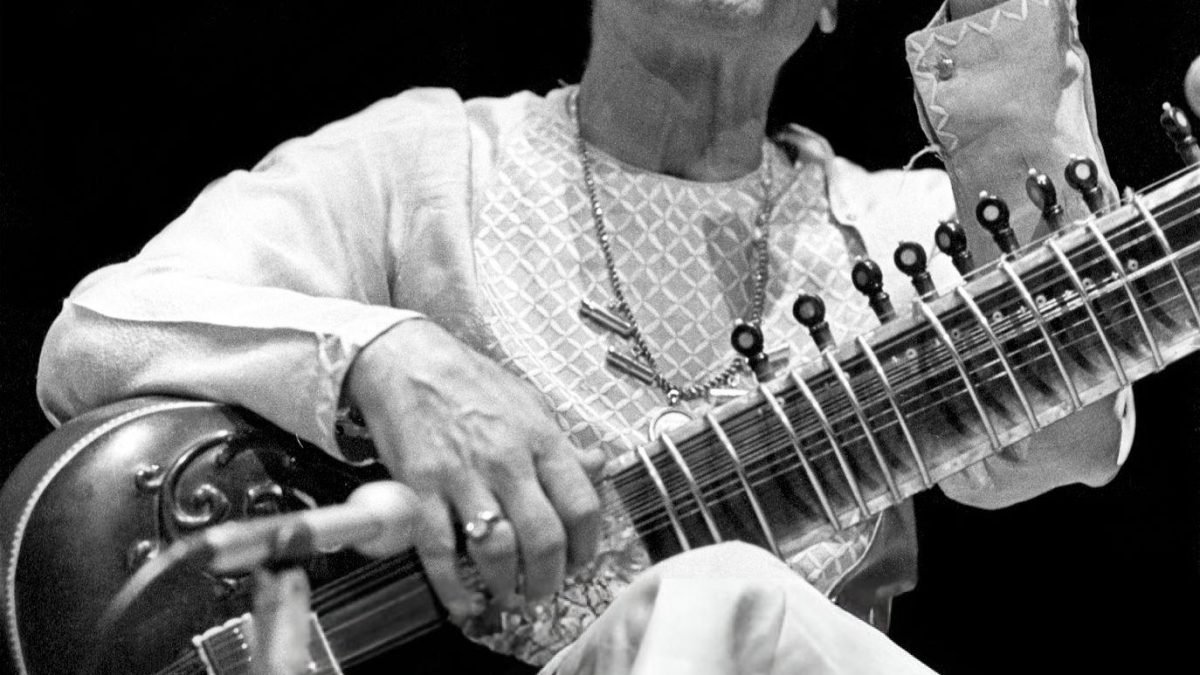
Featured image: Vilayat Khan in performance, 1989. Photo by an unknown photographer, in the public domain, via Wikimedia Commons.