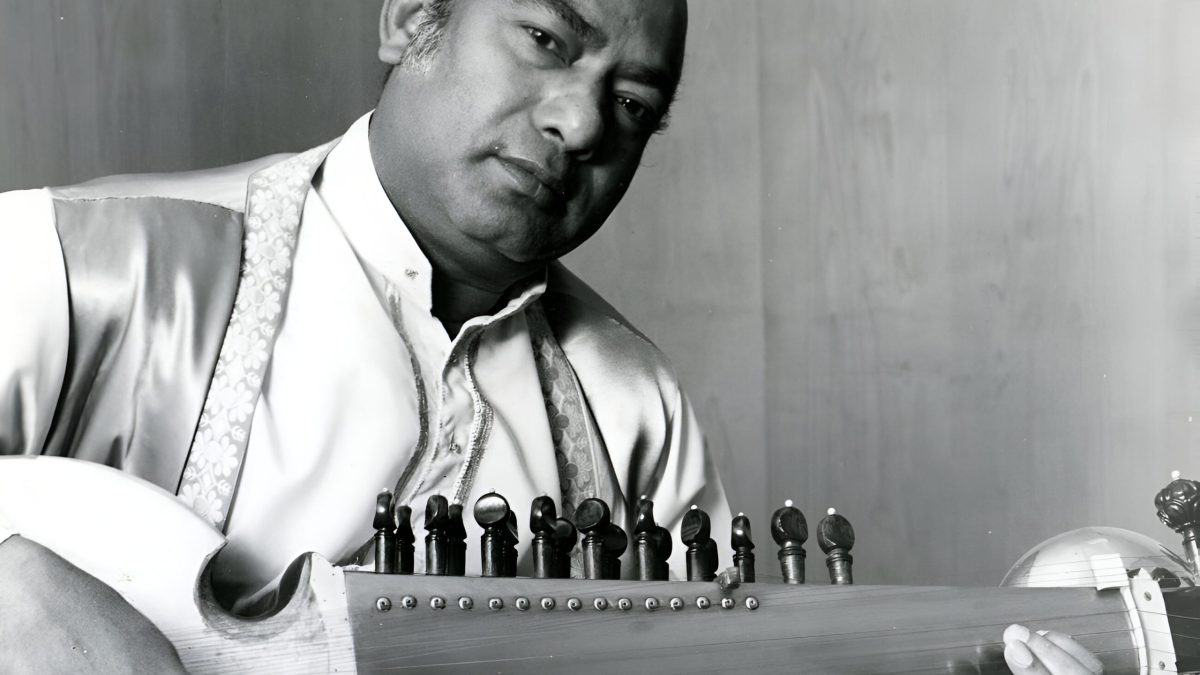
Ustad Ali Akbar Khan (14 April 1922 – 18 June 2009) was an Indian classical musician, the greatest sarod player of his century. The son and pupil of the legendary Allauddin Khan, he was among the first to present Hindustani music to Western audiences, and he founded a college in California where he taught for more than forty years. The violinist Yehudi Menuhin called him “an absolute genius, perhaps the greatest musician in the world”.
Quick Facts
| Full name | Ali Akbar Khan |
| Born | 14 April 1922, Shibpur, Comilla district, Bengal (now in Bangladesh) |
| Died | 18 June 2009, San Anselmo, California, United States (aged 87) |
| Instrument | Sarod |
| Tradition | Maihar gharana (Senia-Maihar) |
| Guru | Allauddin Khan (his father) |
| Awards | Padma Bhushan (1967), Padma Vibhushan (1989), MacArthur Fellowship (1991), US National Heritage Fellowship (1997) |
| Founded | Ali Akbar College of Music (Calcutta, 1956; California, 1967) |
Early Life
He was born in a village in East Bengal and grew up at Maihar, in what is now Madhya Pradesh, where his father was court musician to the Maharaja. Allauddin Khan, one of the most influential teachers in the history of Indian music, began training him at three. His sister, Annapurna Devi, became a great player of the surbahar.
The training was merciless. He practised up to eighteen hours a day and was beaten for mistakes. He gave his first public performance at thirteen.
Career
In India
In his early twenties he became court musician to the Maharaja of Jodhpur, who gave him the title Ustad. After the Maharaja’s death in an air crash he moved to Bombay and then Calcutta, working for All India Radio and for films. He often played duets with Ravi Shankar, his father’s other great pupil, who was for a time his brother-in-law, and their concerts together became famous.
The West
In 1955 Yehudi Menuhin invited him to New York. He gave a recital at the Museum of Modern Art, recorded the first long-playing record of Indian classical music made in the West, and played the sarod on American television, the first time most viewers had heard such music.
He founded the Ali Akbar College of Music in Calcutta in 1956 and, in 1967, its American branch, which settled at San Rafael near San Francisco. He taught there several days a week for the rest of his life, to thousands of students. In 1971 he played with Ravi Shankar at the Concert for Bangladesh in New York.
Film music
He composed for films including Chetan Anand’s Aandhiyan, Satyajit Ray‘s Devi, Tapan Sinha’s Khudito Pashan and the Merchant Ivory film The Householder.
The musician
His playing was known for its depth of feeling and for long, meditative slow movements in which a raga unfolded with great patience. He created several ragas, among them Chandranandan and Gauri Manjari. He regarded himself as a link in a chain of teachers reaching back to Tansen, the musician of Akbar’s court.
Honours
- Padma Bhushan (1967) and Padma Vibhushan (1989)
- MacArthur Foundation Fellowship (1991), the first given to an Indian musician
- National Heritage Fellowship of the United States (1997)
- Five Grammy nominations
Personal Life
He married three times and had eleven children. Several are musicians, among them the sarod players Aashish Khan and Alam Khan. He suffered from kidney disease in his last years and died at his home in California in 2009.
Featured image: Ali Akbar Khan with his sarod. Photo by an unknown photographer, in the public domain, via Wikimedia Commons.