Talat Mahmood (24 February 1924 – 9 May 1998) was an Indian playback singer and actor, known as the King of Ghazals. His soft, silken voice with its slight quiver was the sound of romantic melancholy in Hindi cinema in the 1950s, in songs such as “Ae dil mujhe aisi jagah le chal” and “Jalte hain jiske liye”. He also made non-film ghazals popular as a recorded form and was the first Indian film singer to give concerts abroad.
Quick Facts
| Full name | Talat Mahmood |
| Born | 24 February 1924, Lucknow, Uttar Pradesh |
| Died | 9 May 1998, Mumbai (aged 74) |
| Occupation | Playback singer, actor |
| Years active | 1939–1986 |
| Known for | Ae Dil Mujhe Aisi Jagah Le Chal; Jalte Hain Jiske Liye; Sham-e-Gham Ki Kasam; Jayen To Jayen Kahan; Phir Wohi Shaam |
| Awards | Padma Bhushan (1992) |
| Spouse | Latika Mullick (Nasreen) |
| Children | 2 |
Early Life
He was born in Lucknow into a conservative, cultured Muslim family in which singing as a profession was thought disreputable. His father told him to choose between music and home. He chose music, and it was some ten years before the family was reconciled, by which time he was famous.
He studied for a few years at the Marris College of Music in Lucknow and, at sixteen, began singing the ghazals of the classical Urdu poets on All India Radio.
Calcutta
A gramophone company signed him in 1941. In 1944 his record of the ghazal “Tasveer teri dil mera behla na sakegi” sold more than a hundred thousand copies, an enormous figure for the time, and made his name across India.
He moved to Calcutta, then a centre of film production, where he sang in Bengali under the name Tapan Kumar and acted in several films. He married Latika Mullick, a Bengali Christian actress, in 1951.
Bombay
He arrived in Bombay in 1949. The composer Anil Biswas gave him “Ae dil mujhe aisi jagah le chal” in Arzoo (1950), filmed on Dilip Kumar, and it was an immediate success. Talat, worried that the tremor in his voice was a defect, had tried to suppress it at the recording; Biswas stopped him and said that the tremor was what he wanted.
For the next ten years he was the first choice for songs of sorrow and tenderness.
- “Sham-e-gham ki kasam” in Footpath (1953)
- “Jayen to jayen kahan” in Taxi Driver (1954)
- “Zindagi dene wale sun” in Dil-e-Nadaan
- “Aansoo samajh ke kyun mujhe” in Chhaya
- “Jalte hain jiske liye” in Sujata (1959), sung in the film over a telephone, for Bimal Roy
- “Phir wohi shaam, wohi gham” in Jahan Ara (1964)
He sang for all the leading composers and for the major stars of the day.
Actor
He was a handsome man, and producers cast him as a hero in about a dozen films, opposite Nutan, Suraiya, Mala Sinha and others. None did very well, and the years he gave to acting cost him ground as a singer.
Decline
In the 1960s film music grew louder and faster, and the gentle style for which he was known went out of favour. The songs of Jahan Ara, which the composer Madan Mohan insisted he sing, were his last great film work. He recorded about eight hundred songs in all, in a dozen languages.
Concerts
In 1956 he toured East Africa, the first Indian playback singer to perform commercially abroad, and later sang to full houses in the United States, Britain, the West Indies and elsewhere, including the Royal Albert Hall in London. He continued to record ghazals outside films, and the later ghazal singers, Jagjit Singh among them, acknowledged him as the one who had shown the way.
Honours
He received the Padma Bhushan in 1992.
Personal Life
He and his wife had a son, Khalid, and a daughter, Sabina. He was a courteous, soft-spoken man, fastidious in dress and in his choice of words, who would not sing lyrics he thought vulgar.
Death
He died in Mumbai on 9 May 1998 after some years of ill health.
He is remembered with Mukesh, Mohammed Rafi and Kishore Kumar among the great male voices of the period.
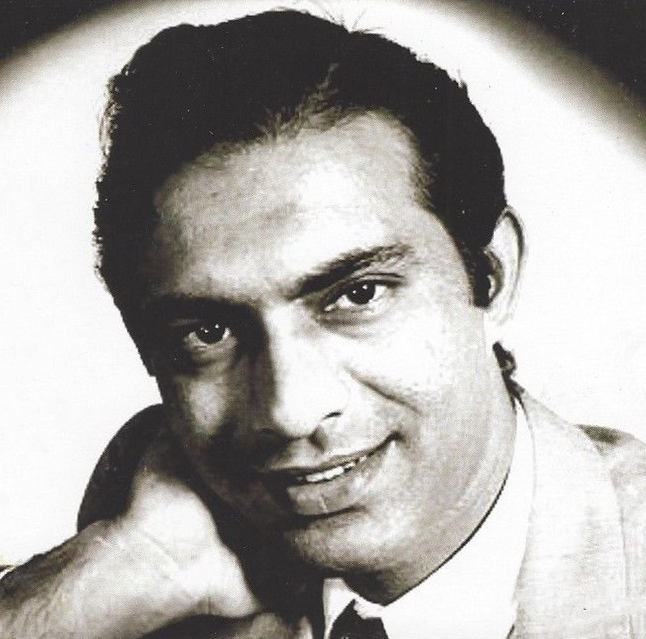
Featured image: Talat Mahmood, from a 2016 postcard issued by India Post. Photo by India Post, Government of India, licensed under Government Open Data License – India, via Wikimedia Commons.