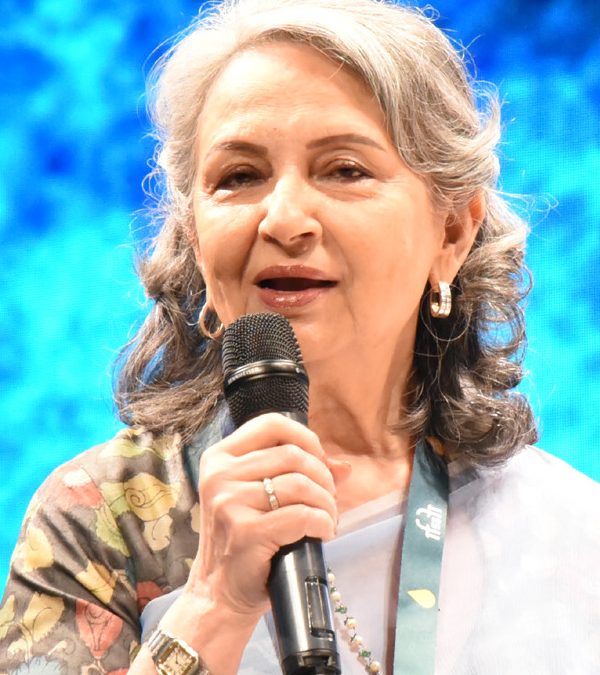
Sharmila Tagore (born 8 December 1944) is an Indian actress who has worked in Bengali and Hindi films for more than six decades. She was discovered at thirteen by Satyajit Ray, for whom she acted in five films, and became one of the leading stars of Hindi cinema in the late 1960s and 1970s, in Aradhana, Amar Prem and Mausam. She has won two National Film Awards, and from 2004 to 2011 was chairperson of the Central Board of Film Certification.
Quick Facts
| Full name | Sharmila Tagore |
| Born | 8 December 1944, Hyderabad |
| Age | 81 |
| Occupation | Actress |
| Years active | 1959–present |
| Notable films | Apur Sansar, Devi, Nayak, Kashmir Ki Kali, An Evening in Paris, Aradhana, Amar Prem, Daag, Chupke Chupke, Mausam, Abar Aranye, Gulmohar |
| Awards | National Film Awards (1976, 2004); Filmfare Award for Best Actress (1970); Padma Bhushan (2013) |
| Spouse | Mansoor Ali Khan Pataudi (m. 1968; d. 2011) |
| Children | Saif Ali Khan, Saba Ali Khan, Soha Ali Khan |
Early Life
She was born in Hyderabad, where her father worked for a British company, into a Bengali family that is a branch of the Tagores; the painter Gaganendranath Tagore was her great-grandfather, and the poet Rabindranath Tagore a distant relation. She grew up in Calcutta and Asansol and went to convent schools.
Ray
In 1958 Satyajit Ray was looking for a girl to play Aparna, the young bride of Apu, in the last film of his trilogy. He saw her dancing at a school function and asked her parents. Apur Sansar (1959) made her famous in Bengal at fourteen; her school, disapproving, asked her to leave.
Ray cast her the next year in Devi, as a girl whose father-in-law declares her a goddess, and later in Nayak, Aranyer Din Ratri and Seemabaddha. She has said that he taught her everything she knew about acting.
Hindi Films
The producer and director Shakti Samanta brought her to Bombay for Kashmir Ki Kali (1964), opposite Shammi Kapoor, and she was a star at once.
She was a new kind of heroine: educated, self-possessed and unembarrassed by glamour. In 1966 she posed in a bikini for the cover of a film magazine, and the next year wore one in An Evening in Paris. Questions were asked in Parliament.
- Aradhana (1969): as a woman who bears a child outside marriage and grows old watching over him; it won her the Filmfare Award and began her celebrated pairing with Rajesh Khanna
- Amar Prem (1972), as a village woman sold into a Calcutta brothel, and Safar, Daag and Aavishkar
- Chupke Chupke (1975), a comedy, with Dharmendra
- Mausam (1975), in a double role as a mother and her prostitute daughter, for Gulzar; it won her the National Film Award for Best Actress
Later Work
She worked less after the 1970s and returned in character roles: Mississippi Masala (1991), the Bengali Abar Aranye (2003), which brought a second National Award, Viruddh and Eklavya. After a gap of more than a decade she played the head of a Delhi family in Gulmohar (2023).
Marriage
In December 1968, at the height of her fame, she married Mansoor Ali Khan Pataudi, the captain of the Indian cricket team and titular Nawab of Pataudi. It was a marriage of a Hindu and a Muslim, and of the two most glamorous worlds in the country; both families had doubts, and there were threats. She converted and took the name Ayesha Sultana, and went on working. They were married for forty-two years, until his death in 2011.
Public Roles
- chairperson of the Central Board of Film Certification, 2004–2011
- goodwill ambassador for UNICEF in India
- member of the jury at the Cannes film festival in 2009
Honours
- Filmfare Award for Best Actress (1970) and a lifetime achievement award
- National Film Awards for Mausam and Abar Aranye
- Padma Bhushan (2013)
- France’s Commander of the Order of Arts and Letters
Family
Her son, Saif Ali Khan, and her younger daughter, Soha, are actors; the elder daughter, Saba, is a jewellery designer. Her grandchildren include the actress Sara Ali Khan. She divides her time between Delhi and the family home at Pataudi in Haryana.
Featured image: Sharmila Tagore at the International Film Festival of India, November 2024. Photo by the Ministry of Information and Broadcasting, licensed under Government Open Data License – India, via Wikimedia Commons.