Sanjeev Kumar (9 July 1938 – 6 November 1985), born Harihar Jethalal Jariwala, was an Indian film actor, widely regarded as one of the finest Hindi cinema has produced. He had no interest in being a conventional hero. He played old men while still young, a deaf-mute, a madman, nine different characters in one film, and the armless Thakur of Sholay. He won the National Film Award for Best Actor twice. A hereditary heart condition killed him at forty-seven.
Quick Facts
| Birth name | Harihar Jethalal Jariwala |
| Born | 9 July 1938, Surat, Gujarat |
| Died | 6 November 1985, Bombay (aged 47) |
| Occupation | Actor |
| Years active | 1960–1985 |
| Notable films | Sunghursh, Khilona, Dastak, Koshish, Parichay, Naya Din Nai Raat, Aandhi, Mausam, Sholay, Shatranj Ke Khilari, Trishul, Angoor |
| Awards | National Film Award for Best Actor (1971, 1973); Filmfare Awards for Best Actor (1976, 1977) |
Early Life
He was born in Surat into a Gujarati family of traders, which moved to Bombay when he was a child. His father died young, as his grandfather had done. He was drawn to acting at school and joined the left-wing people’s theatre and then the Indian National Theatre, the leading Gujarati stage company in the city.
At twenty-two he played an old man in a Gujarati version of a play by Arthur Miller, with such conviction that it became his calling card. He trained at a film acting school run by a studio.
Early Films
He had a small part in Hum Hindustani (1960) and spent years in low-budget action films. His first lead was in Nishan (1965). In Sunghursh (1968) he held his own in his scenes with Dilip Kumar, and the industry took notice.
Khilona (1970), in which he played a man driven insane by grief, made him a star.
The Actor
- Dastak (1970), as a young husband who finds that his rented flat was once a courtesan’s; his first National Award
- Koshish (1972), as a deaf and mute man, from youth to old age, without a word of dialogue; his second National Award
- Naya Din Nai Raat (1974), in which he played nine roles, each expressing one of the nine emotions of classical Indian aesthetics
- Aandhi (1975), as the hotel manager who was once married to a woman now in politics
- Mausam (1975), as an ageing doctor who finds the daughter of the woman he abandoned
- Sholay (1975), as Thakur Baldev Singh, the retired police officer whose arms have been cut off by the bandit Gabbar Singh
- Shatranj Ke Khilari (1977), Satyajit Ray‘s only Hindi feature film, as a nobleman of Lucknow lost in his chess game while the British take his kingdom
- Trishul (1978), as the father of a character played by Amitabh Bachchan, who was four years his junior
- Angoor (1982), a comedy of two sets of twins
He was the favourite actor of the director Gulzar, with whom he made nine films. He was equally at ease in comedies such as Pati Patni Aur Woh and Seeta Aur Geeta.
Method
He did not care how he looked on screen and never minded playing fathers to actors of his own age. He was famously unpunctual, arriving on the set hours late, and then did the scene in a single take. His acting was economical: a look, a pause, a change in the voice. He could suggest a whole life in a few gestures.
Personal Life
He never married. He is said to have proposed to Hema Malini, who refused him, and the singer and actress Sulakshana Pandit, who loved him, never married either. He lived with his mother and his brothers’ families and was known for his love of food and of late evenings with friends.
He believed, with reason, that the men of his family did not live past fifty. A younger brother died before him.
Death
He had a first heart attack in 1976 and a bypass operation in the United States in 1985. He died of a heart attack in Bombay on 6 November 1985, aged forty-seven. About ten films he had been working on were released over the following years, the last as late as 1993.
Legacy
A postage stamp was issued in his honour in 2013, and his home city of Surat has named an auditorium and a road after him. Among actors he remains the standard example of an artist who chose the part over the image.
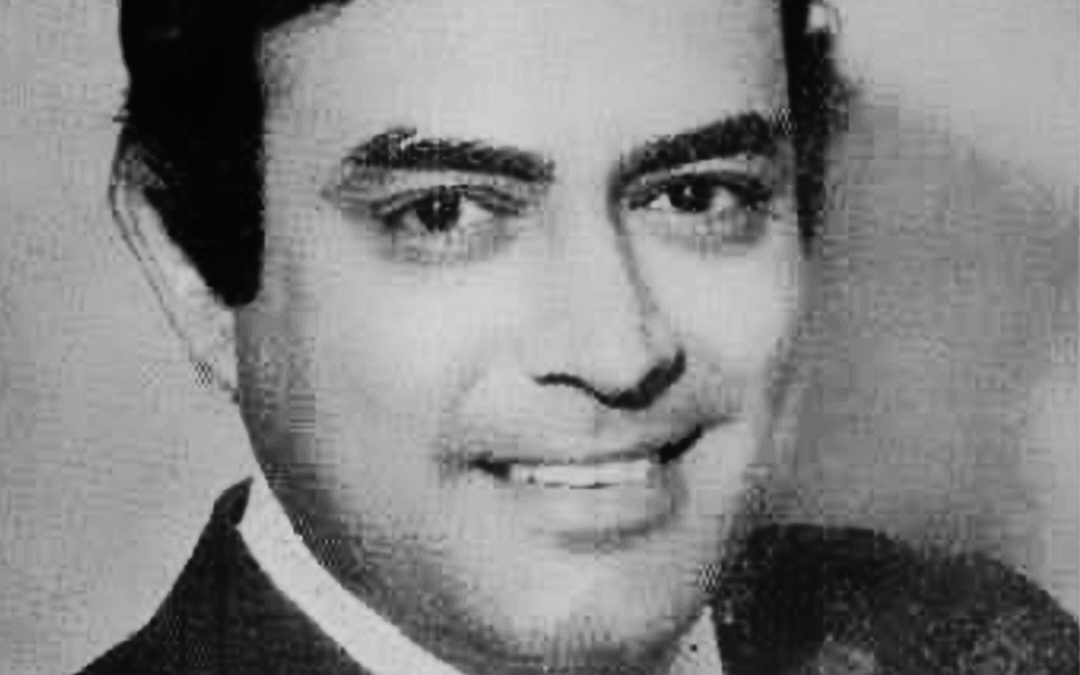
Featured image: Sanjeev Kumar in 1973, the year he won the National Award for Koshish. Photo by the Ministry of Information and Broadcasting, licensed under Government Open Data License – India, via Wikimedia Commons.