Rukmini Devi Arundale (29 February 1904 – 24 February 1986) was an Indian dancer, choreographer, teacher and campaigner for animal welfare. She took the temple dance of the south, then despised and close to being outlawed, learnt it, reshaped it and presented it to the world as Bharatanatyam. The academy she founded in Madras in 1936, Kalakshetra, remains the most influential school of the form. As a member of the Rajya Sabha she secured the passage of India’s law against cruelty to animals.
Quick Facts
| Full name | Rukmini Devi Arundale |
| Born | 29 February 1904, Madurai, Tamil Nadu |
| Died | 24 February 1986, Madras (aged 81) |
| Occupation | Dancer, choreographer, educationist, animal welfare activist |
| Founded | Kalakshetra, Madras (1936) |
| Offices | Nominated member of the Rajya Sabha (1952–1962); Chairman, Animal Welfare Board of India |
| Awards | Padma Bhushan (1956), Sangeet Natak Akademi Award (1957) and Fellowship (1967) |
| Spouse | George Arundale (m. 1920) |
Early Life
She was born at Madurai, one of eight children of Neelakanta Sastri, an engineer and Sanskrit scholar who had joined the Theosophical Society, and his wife Seshammal, a lover of music. On his retirement the family moved to Adyar, in Madras, beside the Society’s headquarters, and she grew up in its international circle under the eye of its president, Annie Besant.
Marriage
In 1920, at sixteen, she married George Arundale, an English Theosophist and educationist twenty-six years her senior. The marriage of a Brahmin girl to a foreigner caused an uproar in Madras. They travelled together across the world on the Society’s work.
Pavlova
On a voyage in 1928 she met the Russian ballerina Anna Pavlova, became her friend and began to learn ballet from a member of her company. Pavlova, it is said, told her that she ought to look for the dance of her own country.
The Dance
The solo dance of south India, called sadir or dasi attam, had been the art of the devadasis, women dedicated to temples. Reformers had campaigned against the devadasi system as a cover for prostitution, patronage had dried up, and respectable families shunned the dance altogether.
In 1933 she saw a performance by two devadasi sisters at the Madras Music Academy and was overwhelmed. She learnt from Mylapore Gowri Amma and then from the great teacher Pandanallur Meenakshisundaram Pillai. In December 1935, at thirty-one, she gave her first public performance, at the Theosophical Society’s convention. For a Brahmin woman to dance in public was unheard of.
She changed what the audience saw. She designed new costumes and jewellery based on temple sculpture, brought the musicians out from behind the dancer to sit at the side, introduced stage lighting and sets, and removed from the repertoire the erotic element she considered unworthy, stressing devotion. Other pioneers, among them E. Krishna Iyer, had prepared the ground, and the hereditary dancer T. Balasaraswati sharply disagreed with her purifying of the tradition. The debate continues, but the dance she presented was the one that conquered the world.
Kalakshetra
In January 1936 she and her husband founded an academy of dance and music at Adyar. It moved in 1962 to its present campus at Tiruvanmiyur by the sea, where classes are held under trees in the manner of the old gurukula. She brought in the finest traditional teachers and musicians of the time.
She composed some twenty-five dance dramas, on the Ramayana in six parts, the Gita Govinda, Kutrala Kuravanji and others, which are still performed. She also revived the weaving of traditional sari designs and the old craft of printing cloth with vegetable dyes. Kalakshetra was declared an institution of national importance in 1993.
Animals and Education
A lifelong vegetarian, she was nominated to the Rajya Sabha in 1952. Her private member’s bill led to the Prevention of Cruelty to Animals Act of 1960 and the Animal Welfare Board, which she chaired until her death. With Maria Montessori, who spent the war years at Adyar, she started Montessori schools in India.
In 1977 the Prime Minister, Morarji Desai, sounded her out about being proposed for President of India. She declined.
Death
She died in Madras on 24 February 1986. Among later dancers who carried classical dance to wide audiences were Birju Maharaj in Kathak and Sonal Mansingh.
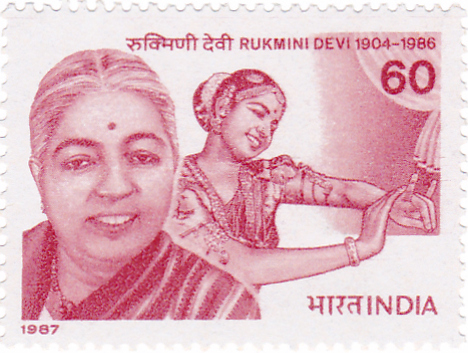
Featured image: Rukmini Devi Arundale, from a 1987 postage stamp of India. Photo by India Post, Government of India, licensed under Government Open Data License – India, via Wikimedia Commons.