Ratan Thiyam (20 January 1948 – 23 July 2025) was an Indian playwright and theatre director from Manipur, one of the most celebrated figures of the modern Indian stage. At his Chorus Repertory Theatre on the outskirts of Imphal he created productions of great visual beauty, drawing on the martial arts, dance and ritual music of Manipur, that toured the world. He was a leader of the movement known as the theatre of roots.
Quick Facts
| Full name | Ratan Thiyam |
| Born | 20 January 1948, Nabadwip, West Bengal |
| Died | 23 July 2025, Imphal (aged 77) |
| State | Manipur |
| Occupation | Theatre director, playwright, designer, composer, poet, painter |
| Education | National School of Drama, New Delhi (1974) |
| Founded | Chorus Repertory Theatre, Imphal (1976) |
| Notable productions | Chakravyuha, Uttar Priyadarshi, Urubhangam, Andha Yug, Nine Hills One Valley, Ritusamharam |
| Awards | Sangeet Natak Akademi Award (1987), Padma Shri (1989), Kalidas Samman, Sangeet Natak Akademi Fellowship (2012) |
Early Life
He was born at Nabadwip in Bengal, the centre of the Vaishnava faith to which the Meiteis of Manipur belong, while his parents were on tour. His father, Thiyam Tarunkumar, was a respected teacher of Manipuri classical dance, and his mother a dancer. He grew up in Imphal among rehearsals and had, by his own account, a lonely childhood in which he turned to painting and writing. He published stories, poems and a novel while young.
Training
He went to the National School of Drama in New Delhi, where he studied under Ebrahim Alkazi and graduated in 1974. He acted for a time with the school’s repertory company, then went home.
The Chorus Repertory Theatre
In 1976 he founded the Chorus Repertory Theatre. Its members lived and worked together on a piece of land outside Imphal, where they built their own theatre, grew their own food and trained every day in thang-ta, the Manipuri art of sword and spear, in the drumming and singing of the Nata Sankirtana tradition, and in dance. Thiyam wrote or adapted the plays, directed them, and designed the sets, costumes, lighting and music himself.
Productions
- Chakravyuha (1984): the death of the boy warrior Abhimanyu in the Mahabharata, staged as a protest against the sacrifice of the young to the ambitions of their elders. It won the Fringe Firsts award at the Edinburgh festival in 1987.
- Urubhangam and Karnabharam, from the Sanskrit plays of Bhasa
- Andha Yug, Dharamvir Bharati’s play on the aftermath of the Mahabharata war, performed in Japan in 1994 on the anniversary of Hiroshima
- Uttar Priyadarshi (1996): the emperor Ashoka’s passage from conquest to remorse
- Ritusamharam, after Kalidasa
- Nine Hills One Valley (2005), on the troubles of his own state
- versions of Ibsen’s When We Dead Awaken and Shakespeare’s Macbeth
The plays were performed in Manipuri wherever they went, to audiences who did not know the language, and held them by image, movement and sound. War and its waste was his constant theme, the response of an artist living in a state under insurgency and military law.
Institutions
He was director of the National School of Drama in 1987–88 and its chairman from 2013 to 2017.
Honours
- Sangeet Natak Akademi Award for direction (1987) and Fellowship (2012)
- Padma Shri (1989)
- Kalidas Samman
- John D. Rockefeller Award and other international honours
In 2001 he returned the Padma Shri in protest when the Government of India extended its ceasefire with a Naga insurgent group to areas of Manipur, a decision that set off violent protests in the valley.
Death
He died in Imphal on 23 July 2025 after a long illness and was cremated with state honours.
Legacy
His company continues at its campus, which he called the Shrine. He showed that a theatre based in a small and troubled state at the edge of the country, working in its own language and forms, could speak to the whole world. Manipur’s other well-known names include the boxer Mary Kom and the freedom fighter Rani Gaidinliu.
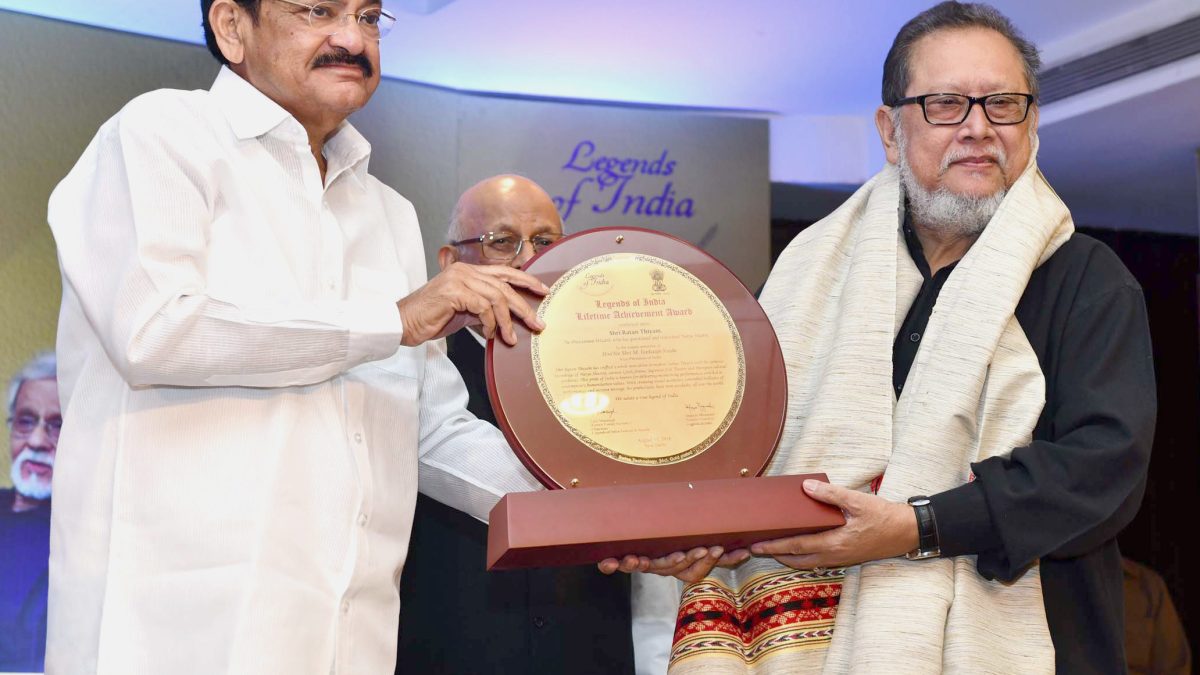
Featured image: Ratan Thiyam receiving a lifetime achievement award from the Vice President in New Delhi, August 2018. Photo by the Vice President’s Secretariat, licensed under Government Open Data License – India, via Wikimedia Commons.