
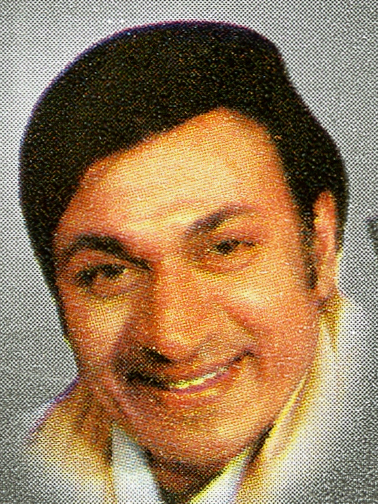
Singanalluru Puttaswamaiah Muthuraj (24 April 1929 – 12 April 2006), known as Dr. Rajkumar, was an Indian actor and singer who was the dominant figure of Kannada cinema for nearly five decades and the most revered cultural personality of Karnataka. He acted in more than two hundred films, all in Kannada, and never appeared in any other language. He was also a fine singer who won the National Film Award for playback singing. Kannadigas called him Annavru, elder brother.
Quick Facts
| Birth name | Singanalluru Puttaswamaiah Muthuraj |
| Born | 24 April 1929, Gajanur, near the border of the old Mysore state (now in Tamil Nadu) |
| Died | 12 April 2006, Bangalore (aged 76) |
| Occupation | Actor, singer |
| Years active | 1954–2000 |
| Notable films | Bedara Kannappa, Ranadheera Kanteerava, Satya Harishchandra, Kasturi Nivasa, Bangarada Manushya, Gandhada Gudi, Mayura, Babruvahana, Kaviratna Kalidasa, Jeevana Chaitra |
| Awards | Padma Bhushan (1983), Karnataka Ratna (1992), National Film Award for playback singing (1992), Dadasaheb Phalke Award (1995) |
| Spouse | Parvathamma Rajkumar |
| Children | Shiva Rajkumar, Raghavendra Rajkumar, Puneeth Rajkumar and two daughters |
Early Life
He was born at Gajanur, a village in the hills on the border of the Kannada and Tamil countries. His father, Puttaswamaiah, was an actor with the leading Kannada professional theatre company, celebrated for his roles as demons and kings; the family was poor. The boy left school after the third or fourth class and joined the company, where he learnt acting and classical singing.
Films
He was chosen for the title role of Bedara Kannappa (1954), the story of a hunter who becomes a great devotee of Shiva, and was given the screen name Rajkumar. The film was a great success.
For the next two decades he was the industry’s mainstay, in mythological, historical and social films: Ranadheera Kanteerava, Satya Harishchandra, Bhakta Kanakadasa, Immadi Pulikeshi, Sri Krishnadevaraya. He played the kings, saints and poets of Karnataka’s history and so gave Kannadigas a gallery of their own past.
- Kasturi Nivasa (1971), as a generous man ruined by his own goodness
- Bangarada Manushya (1972), as a city man who returns to work the family’s land; it ran for two years in Bangalore and is said to have sent many educated young men back to their villages
- Gandhada Gudi (1973), an adventure about the protection of forests and wildlife
- Mayura, Babruvahana and Kaviratna Kalidasa
- Jeevana Chaitra (1992), after which, it is reported, villages in the state resolved to close their liquor shops
Principles
On screen he never smoked or drank, and he refused parts that showed a hero behaving basely; he felt that his audience took what he did as an example. He turned down every offer to act in Tamil, Telugu or Hindi. He practised yoga daily and lived simply.
Singer
Trained in Carnatic music, he sang his own songs from 1974 and became one of the most popular singers in the language, recording hundreds of film and devotional songs. He won the National Film Award for Best Male Playback Singer for a classical song in Jeevana Chaitra.
The Gokak Agitation
In the early 1980s a movement arose demanding that Kannada be given first place among the languages taught in the state’s schools, as a committee under the writer V. K. Gokak had recommended. It made little headway until Rajkumar agreed to lead it. He toured the state, drawing enormous crowds, and the government gave way. It was his only venture into public agitation. He refused all invitations to enter politics, though it was generally believed that he could have had any office for the asking.
The Kidnapping
On the night of 30 July 2000 the forest brigand Veerappan abducted him and three others from his farmhouse at Gajanur. He was held in the jungle for a hundred and eight days. Karnataka came to a halt; there were riots, and the governments of two states negotiated through intermediaries. He was released unharmed on 15 November 2000. What was conceded in return has never been fully disclosed.
Honours
- Padma Bhushan (1983)
- Karnataka Ratna, the state’s highest honour (1992)
- Dadasaheb Phalke Award (1995)
- An honorary doctorate from the University of Mysore, from which the “Dr.” comes
Family
He married Parvathamma, a cousin, in 1953. She became the producer of most of his later films and the business head of the family. Their three sons all became actors; the youngest, Puneeth, a major star, died in 2021.
Death
He died of cardiac arrest at his home in Bangalore on 12 April 2006. In the disorder that followed, several people were killed. He had pledged his eyes, and they were donated; an eye bank bears his name, and thousands of his admirers have followed his example.
Featured image: Dr. Rajkumar, from a 2009 postage stamp of India. Photo by India Post, Government of India, licensed under Government Open Data License – India, via Wikimedia Commons.



