Rasipuram Krishnaswami Laxman (24 October 1921 – 26 January 2015) was an Indian cartoonist, illustrator and humorist, the best-known cartoonist the country has produced. For more than half a century his pocket cartoon, You Said It, appeared on the front page of The Times of India, and its silent observer, the Common Man in a checked coat, became a national symbol.
Quick Facts
| Full name | Rasipuram Krishnaswami Laxman |
| Born | 24 October 1921, Mysore, Karnataka |
| Died | 26 January 2015, Pune (aged 93) |
| Education | Maharaja’s College, University of Mysore (B.A.) |
| Occupation | Cartoonist, illustrator, writer |
| Known for | The Common Man; the daily cartoon You Said It |
| Awards | Ramon Magsaysay Award (1984), Padma Bhushan (1973), Padma Vibhushan (2005) |
| Spouse | Kumari Kamala (div.); Kamala Laxman |
| Children | 1 |
Early Life
He was born in Mysore, the youngest of the six sons of a headmaster. He drew before he could read: on the floors, the walls and the doors of the house. He was fascinated by the illustrations in the English magazines that came to the house, Punch and The Strand, and by the cartoons of the British master David Low, whose signature he long misread as “cow”. A schoolteacher who praised his drawing of a leaf made him think of himself as an artist.
His eldest brother was the novelist R. K. Narayan.
Rejection
After school he applied to the Sir J. J. School of Art in Bombay. The dean wrote back that his drawings lacked the kind of talent needed to qualify. He took an arts degree at Mysore instead, and went on drawing. Years later the same school invited him as its chief guest.
Early Work
While still a student he illustrated his brother’s stories in The Hindu and drew political cartoons for local papers and for a Kannada humour magazine. He worked briefly at a film studio in Madras on an animated film. In Bombay, in 1946, he joined The Free Press Journal, where the young man at the next desk was Bal Thackeray, later the founder of the Shiv Sena.
The Times of India
He walked into The Times of India in 1947 and stayed for more than fifty years. Besides large political cartoons he drew, from 1951, a small single-column cartoon each day under the title You Said It.
The Common Man
He began by drawing people from different regions to stand for the Indian public, and found that one figure was enough: an elderly, balding man with a bristling moustache, round glasses, a dhoti and a checked jacket. He is present at every cabinet meeting, airport, flood and inauguration. He never says a word. His wife does the talking. Ministers promise, experts explain, things fall apart, and he looks on, bewildered and unsurprised.
Laxman was not partisan. Every Prime Minister from Nehru onwards was drawn and deflated, and during the Emergency, when censors vetted his work, he took a holiday. He drew in black ink with a brush, alone in his office, and described each morning’s search for an idea as torture.
Other Work
- illustrations for his brother’s Malgudi books and sketches for the television serial Malgudi Days
- Gattu, the boy in the logo of Asian Paints
- the novels The Hotel Riviera and The Messenger, short stories and travel pieces
- an autobiography, The Tunnel of Time
- crows, which he drew and painted all his life and thought the most intelligent of birds
A television serial, Wagle Ki Duniya, was based on his characters.
Honours
- Padma Bhushan (1973) and Padma Vibhushan (2005)
- Ramon Magsaysay Award for journalism, literature and creative communication (1984)
- A postage stamp showing the Common Man, issued in 1988 for the hundred and fiftieth year of The Times of India
- Statues of the Common Man in Pune and Mumbai
Personal Life
His first marriage, to the dancer and actress Kumari Kamala, ended in divorce. He then married Kamala, a writer of children’s books, with whom he had a son. A stroke in 2003 paralysed his left side; he continued to draw for some years.
He died in Pune on 26 January 2015, Republic Day, aged ninety-three, and was cremated with state honours.
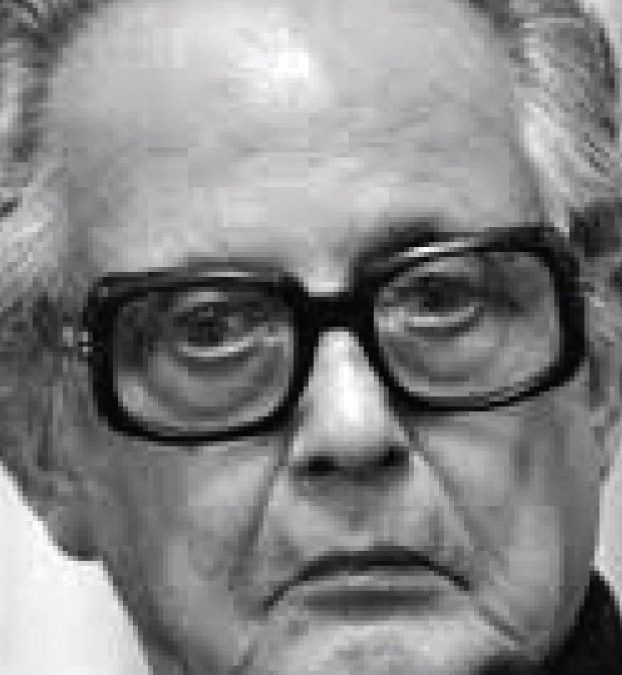
Featured image: R. K. Laxman. Photo by Suhas Bahulkar and Deepak Ghare, licensed under CC BY-SA 4.0, via Wikimedia Commons.