
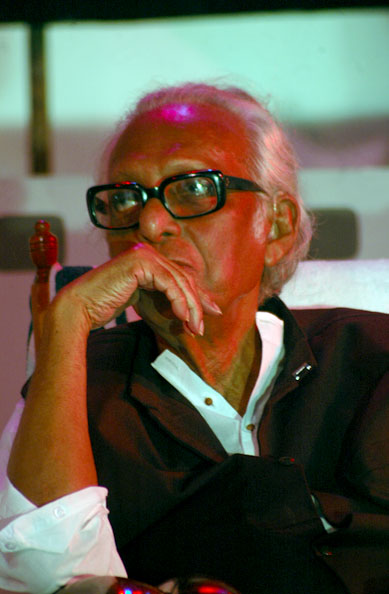
Mrinal Sen (14 May 1923 – 30 December 2018) was an Indian film director, with Satyajit Ray and Ritwik Ghatak one of the three great figures of Bengali cinema. His low-budget comedy Bhuvan Shome (1969) is regarded as the start of the Indian New Wave. A man of the Left, restless in form and argumentative by nature, he made some thirty films in Bengali, Hindi, Odia and Telugu over half a century and won awards at Cannes, Berlin, Venice and Moscow.
Quick Facts
| Full name | Mrinal Sen |
| Born | 14 May 1923, Faridpur, Bengal (now Bangladesh) |
| Died | 30 December 2018, Kolkata (aged 95) |
| Education | Scottish Church College, Calcutta (physics); University of Calcutta |
| Occupation | Film director, screenwriter |
| Years active | 1955–2002 |
| Notable films | Baishey Shravan, Bhuvan Shome, Interview, Calcutta 71, Padatik, Mrigayaa, Ek Din Pratidin, Akaler Sandhane, Kharij, Khandhar |
| Awards | Padma Bhushan (1981), Dadasaheb Phalke Award (2003); Jury Prize, Cannes (1983); Silver Bear, Berlin (1981) |
| Spouse | Gita Sen |
Early Life
He was born at Faridpur in East Bengal, the son of a lawyer who defended nationalists in the courts. He came to Calcutta in 1940 to study physics. The city in those years, of war, famine and communal killing, made him. He was drawn into the cultural wing of the Communist Party, though he never became a member, spent his days reading in the national library, and came upon a book on the aesthetics of film that set his course.
A Slow Start
He worked as a medical representative, a job he hated, and in a sound studio. His first film, Raat Bhore (1955), was, in his own words, a disaster. Neel Akasher Neechey (1959), about a Chinese pedlar in Calcutta in the 1930s, did better and was briefly banned. Baishey Shravan (1960), a harsh study of a marriage during the famine of 1943, first showed his quality.
Bhuvan Shome
In 1969, with a small loan from the government’s new film finance body, he made Bhuvan Shome in Hindi: a stiff, lonely railway official goes duck-shooting in Gujarat and is undone by a village girl. It used freeze frames, animation and a mocking commentary, spoken by the then unknown Amitabh Bachchan. Utpal Dutt played the lead. It cost very little, made money, and showed that a film could be made outside the industry. A wave of such films followed.
The Calcutta Trilogy
The early 1970s in Calcutta were years of unemployment, strikes and the Naxalite rising. Sen answered with three angry, fragmented films, Interview (1971), Calcutta 71 (1972) and Padatik (1973), which mix fiction, newsreel and direct address to the audience. They were argued over in the city’s coffee houses and attacked from both Right and Left.
Later Work
From the mid-1970s his films grew quieter and turned from the enemy outside to the conscience of the middle class.
- Mrigayaa (1976), set among tribal people under British rule, the first film of Mithun Chakraborty
- Oka Oori Katha (1977), in Telugu, from a story by Premchand
- Ek Din Pratidin (1979): a working daughter fails to come home one night, and a family’s respectability is exposed
- Akaler Sandhane (1980): a film unit arrives in a village to make a film about the famine; it won the Silver Bear at Berlin
- Kharij (1982): a servant boy dies in a comfortable household; Jury Prize at Cannes
- Khandhar (1984), with Shabana Azmi and Naseeruddin Shah
- Ek Din Achanak, Mahaprithibi, Antareen and, last, Aamar Bhuvan (2002)
He never repeated a formula, and said that he corrected each film in the next.
Ray and Sen
He and Satyajit Ray were friends and rivals for forty years and conducted a famous dispute in the letters column of a newspaper over a film. Sen was the more experimental and the more openly political; he said that Ray had the surer hand.
Honours
- National Film Awards for best film and best direction, several times
- Padma Bhushan (1981)
- Dadasaheb Phalke Award for 2003
- Nominated member of the Rajya Sabha, 1998–2003
- France’s Commander of the Order of Arts and Letters, and Russia’s Order of Friendship
- Member of the juries at Cannes, Venice, Berlin and other festivals
His memoir is titled Always Being Born.
Personal Life
He married the actress Gita Shome in 1953; she acted in several of his films and died in 2017. Their son, Kunal, lives in the United States.
Death
He died at his home in Kolkata on 30 December 2018, aged ninety-five. By his wish there were no flowers and no public ceremony.
Featured image: Mrinal Sen. Photo by Riyaz Ahamed, licensed under CC BY 3.0, via Wikimedia Commons.



