Manayangath Subramanian Viswanathan (24 June 1928 – 14 July 2015), known as MSV, was an Indian film composer who dominated Tamil film music from the 1950s to the 1970s. First with the violinist T. K. Ramamoorthy and then on his own, he scored well over a thousand films in Tamil, Malayalam and Telugu and created, with the lyricist Kannadasan, a body of songs that remains the best-loved in Tamil cinema. He was known as Mellisai Mannar, the King of Light Music.
Quick Facts
| Full name | Manayangath Subramanian Viswanathan |
| Born | 24 June 1928, Elappully, Palakkad, Kerala |
| Died | 14 July 2015 (aged 87), Chennai, Tamil Nadu |
| Occupation | Film composer, singer, actor |
| Years active | 1945–2015 |
| Known as | Mellisai Mannar |
| Known for | Viswanathan–Ramamoorthy duo; music of the Tamil Nadu state song |
| Notable films | Paasamalar, Paava Mannippu, Kadhalikka Neramillai, Enga Veettu Pillai, Anbe Vaa, Ulagam Sutrum Valiban, Apoorva Raagangal, Ninaithale Inikkum |
| Spouse | Janaki |
| Children | 7 |
Early Life
Viswanathan was born at Elappully, a village near Palakkad. His father died when he was four, and the family was left destitute; he was brought up in his grandfather’s house in Kannur. He could not afford music lessons. He hung about the house of a local teacher, Neelakanta Bhagavathar, running errands and listening from outside, until the teacher, hearing him sing, took him on without fees. He gave a concert at thirteen. He also sold snacks in a cinema to earn a little and to hear the songs.
Career
Apprenticeship
He went to Coimbatore and then Madras hoping to act and sing, and found work as an office boy and harmonium player at Jupiter Pictures. He became an assistant to the composers S. M. Subbaiah Naidu and C. R. Subbaraman. When Subbaraman died suddenly in 1952, leaving several films unfinished, Viswanathan and T. K. Ramamoorthy, a violinist in the same orchestra, completed them.
Viswanathan–Ramamoorthy
The two worked together until 1965, on about a hundred films. They moved Tamil film song away from the heavy classical style of the previous generation towards something lighter and more varied, drawing on Carnatic ragas, folk tunes, Hindustani music, Latin rhythms, jazz and Western orchestration, while keeping the words clear. With Kannadasan writing the lyrics and T. M. Soundararajan and P. Susheela singing, they produced the songs of Paasamalar, Paava Mannippu, Nenjil Or Aalayam, Kadhalikka Neramillai, Server Sundaram and Enga Veettu Pillai. At a public function in 1963 they were given the title Mellisai Mannargal. They parted after Aayirathil Oruvan (1965).
Solo years
On his own he was even more prolific, scoring the films of both the great stars of the time and working closely with the directors C. V. Sridhar and K. Balachander. Anbe Vaa, Sivandha Mann, Ulagam Sutrum Valiban, Aval Oru Thodarkathai, Apoorva Raagangal and Ninaithale Inikkum belong to this period. He gave early opportunities to singers including S. P. Balasubrahmanyam and Vani Jairam, sang many songs himself in a distinctive high voice and, later, acted in character roles.
In 1970 the government of Tamil Nadu adopted a poem by Manonmaniam Sundaram Pillai as the state’s invocation song, Tamil Thai Vazhthu; the tune to which it is sung at every official function is his.
Later years
From the late 1970s a new generation led by Ilaiyaraaja took over. The two composers, who admired each other, worked together on Mella Thirandhathu Kadhavu (1986) and a few other films. MSV continued to compose and perform into his eighties, and A. R. Rahman invited him to sing in his films.
Recognition
He received the Kalaimamani and many film and lifetime awards, and in 2012 the Tamil Nadu government honoured him at a large public ceremony. He never received a National Film Award or a Padma award, an omission his admirers often remarked on.
Death and Legacy
He died in Chennai on 14 July 2015. He was a devout and unassuming man who credited his tunes to his teacher and to God. For Tamils who grew up between 1955 and 1980 his melodies are the sound of their youth, and they are still sung, remixed and quoted in new films.
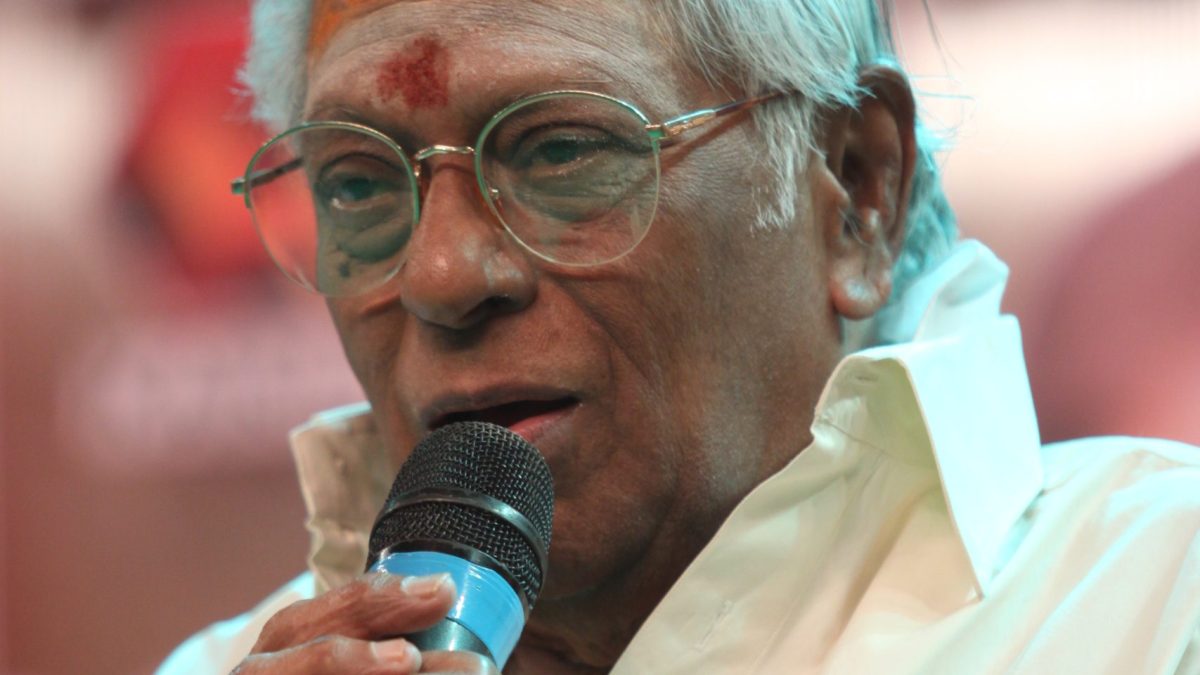
Featured image: M. S. Viswanathan performing in June 2011. Photo by E. P. Sajeevan, licensed under CC BY-SA 4.0, via Wikimedia Commons.