
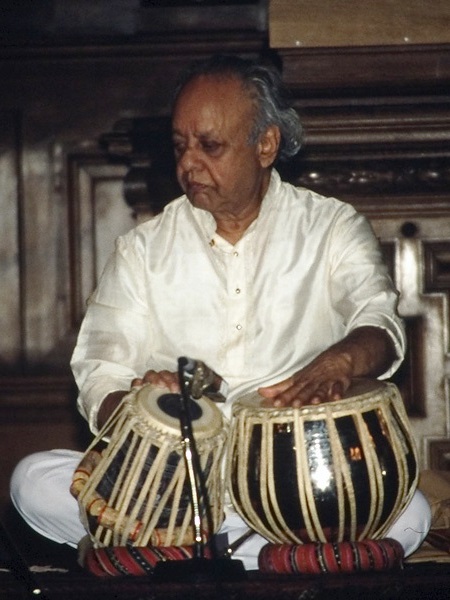
Ustad Alla Rakha Qureshi (29 April 1919 – 3 February 2000), known as Alla Rakha, was an Indian tabla player, the greatest exponent of the Punjab style of the instrument in his time. As the accompanist of Ravi Shankar for nearly thirty years he introduced the tabla to audiences across the world and raised it from an accompanying instrument to an equal partner. He was the father and teacher of Zakir Hussain.
Quick Facts
| Full name | Allarakha Khan Qureshi |
| Born | 29 April 1919, Ghagwal, Jammu |
| Died | 3 February 2000, Mumbai (aged 80) |
| Instrument | Tabla |
| Tradition | Punjab gharana |
| Teacher | Mian Qadir Bakhsh |
| Occupation | Classical musician, film composer |
| Awards | Padma Shri (1977), Sangeet Natak Akademi Award (1982) |
| Children | Zakir Hussain, Fazal Qureshi, Taufiq Qureshi and others |
Early Life
He was born in a village near Jammu, the son of a farmer. There was no music in the family, and his father opposed it. At about twelve, while staying with an uncle at Gurdaspur, he heard the tabla and could think of nothing else.
He ran away from home to Lahore and became a disciple of Mian Qadir Bakhsh, the head of the Punjab school of tabla, who had no son and treated him as one. He also learnt singing from a master of the Patiala school.
Radio and Films
He joined All India Radio at Lahore as an accompanist, moved to Delhi, and in 1940 to Bombay, where he gave what is said to have been the station’s first solo tabla broadcast.
In the 1940s and 1950s he composed music for some two dozen Hindi films under the name A. R. Qureshi, among them Sabak, Bewafa and Maa Baap. He gave it up to return to classical music.
With Ravi Shankar
He began accompanying Ravi Shankar in the 1950s, and from the early 1960s the two toured the world together.
- the Monterey Pop Festival in California in 1967, where their performance closed an afternoon and brought the audience to its feet
- Woodstock in 1969
- the Concert for Bangladesh in New York in 1971, with Ali Akbar Khan
Before him the tabla player in a concert sat back and kept time. Alla Rakha and Ravi Shankar turned the last part of each piece into a conversation, the sitar setting a rhythmic problem and the drums answering, at increasing speed. Audiences that knew nothing of ragas could follow that.
Style
He was a short, round, smiling man who seemed to play without effort. His tone was clear and full, his improvisations were mathematically intricate, and he was a master of the odd rhythmic cycles, of five and a half, nine or eleven beats, as well as the common ones. He had a large store of traditional compositions of the Punjab school and composed many himself.
In 1968 he recorded an album, Rich à la Rakha, with the American jazz drummer Buddy Rich. The drummer of the Grateful Dead, Mickey Hart, who studied with him, called him the Einstein and the Picasso of rhythm.
Teacher
In 1985 he founded an institute of music in Bombay to teach the tabla. His three sons all became percussionists. The eldest, Zakir Hussain, whom he began to teach in infancy by reciting rhythms into his ear, became the most famous tabla player in the world; father and son often performed together. Fazal Qureshi plays the tabla and Taufiq Qureshi is a percussionist and composer.
Honours
- Padma Shri (1977)
- Sangeet Natak Akademi Award (1982)
Personal Life
He married Bavi Begum, a cousin, and had three sons and two daughters with her.
Death
He died of a heart attack at his home in Mumbai on 3 February 2000, a few hours after learning of the death of his daughter Razia.
Legacy
A generation of Western musicians first heard Indian rhythm through him, and the tabla’s present standing as a solo instrument owes more to him than to anyone else. His birthday is marked in Mumbai each year by a day-long concert organised by his sons.
Featured image: Alla Rakha in 1988. Photo by Dia5286 Alla Rakha.jpg: Alephalpha derivative work: Hekerui, licensed under CC BY-SA 3.0, via Wikimedia Commons.



