Deepak Shantilal Parekh (born 18 October 1944) is an Indian banker who led the Housing Development Finance Corporation, HDFC, for more than forty years, as its managing director and then as chairman from 1993 to 2023. Under him it grew from a small experiment into the country’s largest housing finance company, and the home loan became an ordinary part of middle-class life. He also sponsored HDFC Bank, now India’s largest private bank, and governments of every party called on him to sort out financial crises.
Quick Facts
| Full name | Deepak Shantilal Parekh |
| Born | 18 October 1944, Bombay |
| Age | 82 |
| Education | Sydenham College, Bombay (B.Com.); Fellow of the Institute of Chartered Accountants in England and Wales |
| Occupation | Banker |
| Known for | Chairman of HDFC (1993–2023) |
| Awards | Padma Bhushan (2006) |
| Spouse | Smita Parekh |
Early Life
He was born in Bombay into a Gujarati family of bankers. His father worked for a bank; his uncle, Hasmukhbhai Parekh, was a senior executive of the country’s leading industrial lending institution. He took a commerce degree at Sydenham College and qualified as a chartered accountant in London.
Early Career
He worked for an accounting firm in New York and then, back in Bombay, for Grindlays Bank and Chase Manhattan Bank.
HDFC
In 1977 his uncle, on retiring at sixty-six, founded HDFC to do something that did not exist in India: lend money to ordinary salaried people to buy homes. Banks did not give such loans. People built houses with their retirement money, at the end of their working lives, or not at all. Many doubted that Indians would repay a twenty-year loan, or that the courts would enforce a mortgage if they did not.
Deepak Parekh joined in 1978, taking a cut in salary. He became managing director in 1985 and chairman in 1993.
- **Lending to individuals:** loans were assessed on the borrower’s income and character, not on connections; branches were pleasant, and decisions quick
- **Repayment:** losses on loans stayed at a very small fraction of the total throughout, a record that astonished foreign lenders
- **Funds:** the company raised money from international agencies, from deposits by the public and from the markets
- **Scale:** over four and a half decades it financed several million homes
Tax relief for home-loan borrowers, for which he argued for years, and falling interest rates in the early 2000s turned housing finance into a mass business in which the banks then joined.
The Group
When private banks were permitted in 1994, HDFC was among the first to receive a licence. He chose Aditya Puri to run HDFC Bank and left him free to do so. The group added companies in life insurance, general insurance and mutual funds, each with a foreign partner and each among the leaders in its field.
On 1 July 2023 HDFC was merged into HDFC Bank, one of the largest mergers in Indian corporate history, creating one of the biggest banks in the world by market value. He retired the day before, at seventy-eight, with a letter to shareholders saying that it was time to hang up his boots.
Troubleshooter
- **Unit Trust of India:** when the country’s largest mutual fund scheme collapsed in 2001, he helped to devise its rescue
- **Satyam:** after the software company’s founder confessed in January 2009 to falsifying its accounts, the government put Parekh on the new board that kept it running and sold it within months
- **Committees:** on infrastructure finance, on the power sector, on making Mumbai a financial centre, and others
He was a director of many leading companies and was often described as the unofficial ambassador of Indian business. He declined, more than once by repute, offers of office in government.
Honours
- Padma Bhushan (2006)
- Honours from the governments of France and Germany
- Many businessman-of-the-year and lifetime achievement awards
Since Retirement
He remains non-executive chairman of the group’s asset management company and continues to speak on banking and economic policy.
Personal Life
He is married to Smita Parekh. He is known for answering letters and telephone calls himself and for a very wide circle of friends.
Among the bankers who reshaped Indian finance in the same decades were K. V. Kamath and Uday Kotak.
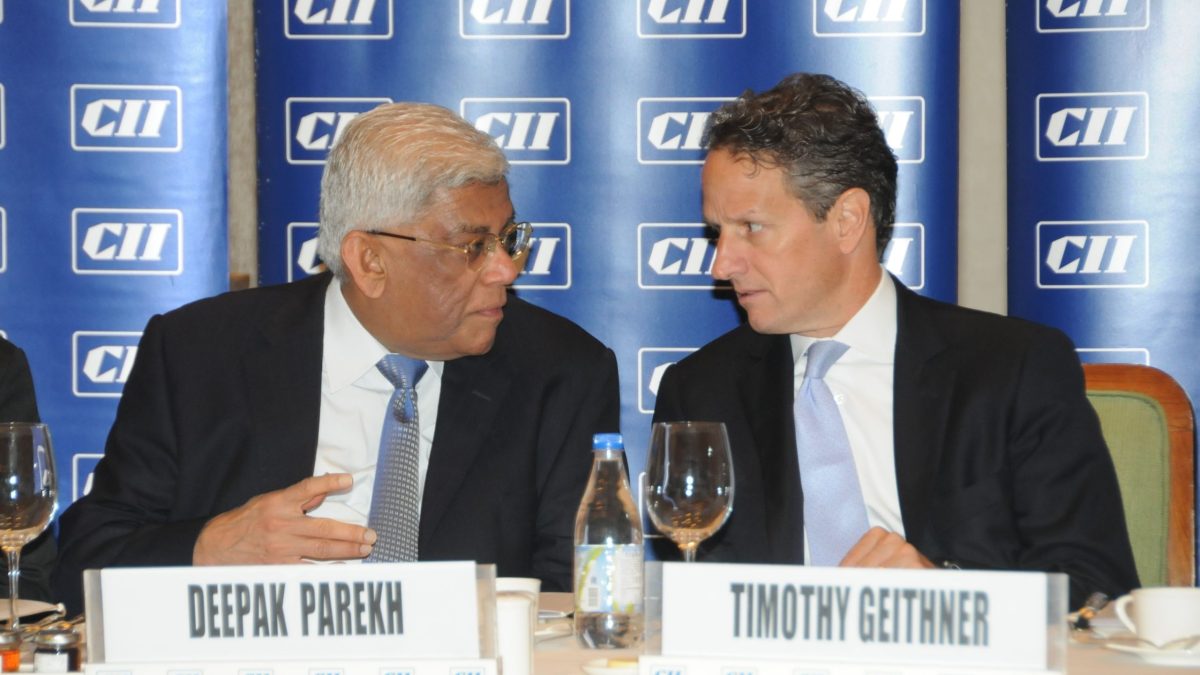
Featured image: Deepak Parekh (left) with the US Treasury Secretary, Timothy Geithner, at a meeting with Indian business leaders, October 2012. Photo by the US Department of the Treasury, in the public domain, via Wikimedia Commons.