Arunachalam Muruganantham (born 1961) is an Indian inventor and social entrepreneur from Coimbatore, Tamil Nadu. A school dropout, he spent years, at the cost of his marriage and his standing in his village, working out how to make a sanitary pad that poor women could afford. The small machine he designed is used by women’s groups across India and in other countries. His story was told in the Hindi film Pad Man.
Quick Facts
| Full name | Arunachalam Muruganantham |
| Born | 1961, Coimbatore, Tamil Nadu |
| Occupation | Inventor, social entrepreneur |
| Known for | A low-cost machine for making sanitary pads |
| Company | Jayaashree Industries |
| Awards | National Innovation Foundation award (2009), Padma Shri (2016) |
| Spouse | Shanthi |
Early Life
He was born into a family of handloom weavers near Coimbatore. His father died in a road accident when he was a boy, and his mother worked as a farm labourer to bring up her children. He left school at fourteen and worked as a machine operator, a welder and at whatever else he could find.
The Question
He married Shanthi in 1998. Soon afterwards he noticed her hiding something from him: the rags she used during her periods. When he asked why she did not buy sanitary pads, she said that if she did, the family would have to cut its milk budget.
He bought a packet and was struck that a few grams of cotton should cost so much. Surveys at the time suggested that only a small proportion of Indian women used sanitary pads; the rest used cloth, which was often not properly washed or dried in the sun because of shame, and in the poorest households ash, husk or sand.
The Experiments
He made a pad from cotton and gave it to his wife, who said it was useless. He needed testers and could find none; menstruation was not a subject a man could raise. His sisters refused. He approached medical students, with little result.
So he tested the pads on himself. He made a bladder from a football, filled it with goat’s blood obtained from a butcher, and wore it under his clothes with a tube, walking and cycling about the village. His clothes were stained and smelt. Neighbours concluded that he was diseased or perverted. His wife left him, and then his mother. The village considered him possessed.
It took him more than two years to discover that commercial pads were made not of cotton but of cellulose fibre from the bark of pine trees, and that the machine to break it down and form it cost a fortune.
The Machine
He set out to build a small version, and after about four and a half years had one: a set of simple machines that grind the fibre, press it into pads, wrap them and sterilise them with ultraviolet light. It cost a tiny fraction of the industrial plant and could be worked by a few women with brief training.
In 2006 he showed it at the Indian Institute of Technology, Madras, which entered it for a national competition. It won, and the President gave him the award in 2009.
A Business Model
He declined to sell the design to a company. Through his firm, Jayaashree Industries, he supplies the machines to women’s self-help groups, schools and non-governmental organisations, who make pads, give them their own brand names and sell them locally at a low price. The aim, he says, is both a product and a livelihood. Machines have been installed in most Indian states and in a number of countries in Asia and Africa.
Recognition
- Time magazine named him among the hundred most influential people in the world in 2014
- Padma Shri, 2016
- The documentary Menstrual Man (2013), and the feature film Pad Man (2018), in which Akshay Kumar played a character based on him
- A documentary about women using his machine in a village near Delhi won an Academy Award in 2019
Personal Life
His wife returned after about five years, having seen him on television. They live in Coimbatore. He speaks to audiences around the world in an English he taught himself, and says that his ambition is to make India a country in which every woman uses a sanitary pad.
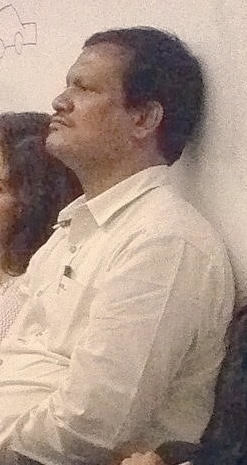
Featured image: Arunachalam Muruganantham in California, 2016. Photo by Afnaan Ali Khan, licensed under CC BY-SA 4.0, via Wikimedia Commons.