
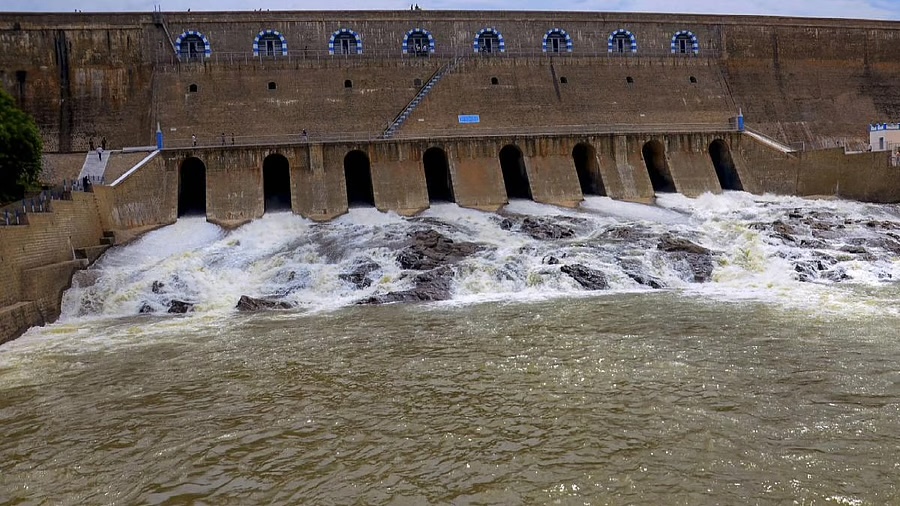
The Supreme Court on Friday, November 20, 2026, dismissed two applications by the Tamil Nadu government that asked it to direct Karnataka to release 11 thousand million cubic feet (TMC) of Cauvery water. The judgment, pronounced by a Bench led by Justice Vikram Nath, brings to a close for now a request that Tamil Nadu had argued was necessary to protect its standing crops, and that Karnataka had resisted on the ground that it is itself struggling with drought. As The Hindu reported, the court rejected Tamil Nadu's claim of a shortfall of 11.719 thousand million cubic feet according to the state's own formula, a figure measured at Billigundulu, the key water-measuring station on the border between the two states.
The pleas were specific. Tamil Nadu wanted the court to make sure that a backlog of 11 TMC, calculated as on October 7, was cleared immediately, and that the water was delivered at the rate of 1.3 TMC a day over ten days at Billigundulu. The top court had reserved its decision on the two applications on October 12. Karnataka's argument against them was procedural as much as practical: it said the Cauvery Water Management Authority, the body that supervises the sharing of the river, had not ordered such a release, and that the Supreme Court should therefore not step in on its own to do so.
Anyone who follows the Cauvery dispute will recognise how old this argument is. The river has been the subject of litigation and negotiation between the two states for decades, and every dry season brings the same questions: how much water is in the reservoirs, how much is owed downstream, and who decides when the numbers do not add up. What made this year's application distinctive was its framing. Tamil Nadu did not ask the court to rewrite the sharing arrangement. It asked it to enforce a shortfall, in cubic feet, that it said had built up.
The court's response, when the matter was heard on October 12, offers the clearest hint of its thinking. A Division Bench headed by Justice Vikram Nath questioned how Karnataka could be expected to make good a backlog when it was itself grappling with water scarcity and drought. "A backlog can be covered only when there is excess water," the Bench observed. "If there is less rainfall and there is scarcity, how do you expect them to fulfil the backlog? They are also reeling from water scarcity. If they have excess water and are not giving it to you, then only can you recover the backlog." That sentence is a compact statement of how courts tend to treat river-sharing disputes in a bad monsoon year: a legal entitlement does not create water that does not exist.
Tamil Nadu's case, as it was presented, did not rest only on arithmetic. The state accused Karnataka of withholding water even though it had sufficient reserves, pointing to a combined reservoir storage of about 49 tmcft, which it maintained was adequate to meet Karnataka's obligations to the lower riparian state. The lower riparian argument carries emotional weight in the delta, where farmers depend on timely releases for the kuruvai and samba crops. Karnataka's affidavit told a mirror-image story. It argued that Tamil Nadu had been allocated the lion's share, 404.25 tmcft, on account of historic irrigation claims, while Karnataka received only 284.75 tmcft out of the 483 tmcft available up to Billigundulu, without adequately accounting for its own drought-prone areas.
The two states have also been dealing with directions from the administrative bodies that sit beneath the court. The Hindu's report notes that the Cauvery Water Management Authority, meeting in Delhi in September 2026, upheld the Cauvery Water Regulation Committee's direction to Karnataka to ensure flows of 6,000 cusecs a day at the Biligundlu inter-state gauge for 15 days, beginning from 8 a.m. on September 9. The total quantum ordered amounted to approximately 7.8 tmcft. Karnataka had challenged that direction before the authority and lost. Karnataka's Water Resources Minister N. Cheluvarayaswamy told reporters on Friday that the current order directs the state to release 2,000 cusecs, and he said he felt pain, not about injustice to Karnataka, but that the committee and the authority had directed it to release more water to Tamil Nadu in the first place.
The political reaction in Chennai was swift and sharp. DMK president M.K. Stalin used the verdict to attack Chief Minister C. Joseph Vijay, accusing him of staying in "silent mode" while crops wither. "Kuruvai is gone, and Samba is withering, and farmers are struggling in their survival mode," Mr. Stalin said, asking what plan the government had to protect crops and what it had done to establish the state's Cauvery water rights. DMK spokesperson T.K.S. Elangovan went further, telling ANI that the state's lawyers had failed to present the case properly. He pointed out that the Cauvery Water Disputes Tribunal had already ordered the release of 177 TMC of water annually to Tamil Nadu and argued, "The lower riparian's rights should not be affected." These are political statements from the opposition and should be read as such, but they show how quickly a legal ruling becomes a campaign issue in a state where the river is a matter of identity as much as irrigation.
In Bengaluru, the tone was one of relief tempered by worry. Mr. Cheluvarayaswamy said the state had escaped the Cauvery problem "at least for now," and described the verdict as "justice to Karnataka rather than a setback to Tamil Nadu." His reasoning was simple: when there is not adequate storage, he asked, how is it possible to release water to Tamil Nadu? Chief Minister D.K. Shivakumar said the verdict was "only a reflection of the ground reality." He added that the state does not even have enough water for drinking purposes, and that it is not holding back water that is available. "If we have water, we will give it to Tamil Nadu," he said, adding that he had told farmers to be careful. In one of the more human details of the day, he said he could not even make the traditional offering of bagina to the Cauvery this year because of the dire water situation. Bagina is the ritual gift of gratitude made to the river when she is full, which makes its absence a telling sign of how low the reservoirs are.
Farmers' voices in Karnataka echoed the government. Kurubur Shanthakumar, president of the Karnataka Sugarcane Growers' Association, welcomed the dismissal, saying, "Even though the ruling has come late, we welcome the Supreme Court's decision." He argued that Karnataka had already released substantial water to the lower riparian state despite deficient rainfall, and described the severe agricultural distress caused by the ongoing drought. "Where is the water in our reservoirs to release? Our crops are withering and drying up," he said. It is worth pausing on the symmetry here: farmers on both sides of the border describe withering crops, and each side holds the other's reading of the numbers in suspicion.
What the ruling does not do is settle the larger questions. It does not change the Cauvery tribunal's allocation, and it does not remove the standing directions of the regulation committee and the management authority. It simply declines to turn a claimed shortfall into a court-ordered release at a time when the upstream state says it has no surplus. The reasoning that a backlog can only be recovered when water is in excess will matter in future years too, because it suggests that the court sees deficit-year shortfalls as something to be handled by the sharing bodies in better years rather than by emergency orders.
Another strand of the dispute continues in the background. Tamil Nadu's latest representation to the Union government on the controversial Mekedatu dam project, The Hindu notes, makes no reference to the demand for a new tribunal to examine the project. Eight months have passed since the state government sent its complaint to the Centre in March and sought the formation of a tribunal, and there has been no reply, nor is any communication said to have gone from the Union government to Karnataka for comments, according to sources in the Tamil Nadu government. Mr. Shivakumar, for his part, asserted on November 14 that Karnataka will go ahead with the Mekedatu balancing reservoir project, calling it the state's right and duty while assuring that Tamil Nadu would receive its stipulated share. He told leaders in Tamil Nadu, including state Congress president Manickam Tagore, that the neighbouring state should send a delegation to Karnataka to understand the project's benefits rather than oppose it.
Karnataka's minister also pointed to a different kind of progress. Mr. Cheluvarayaswamy said he hoped the dialogue started by Mr. Shivakumar with the Chief Ministers of the neighbouring states of Maharashtra, Tamil Nadu, Telangana and Andhra Pradesh to address inter-state river water disputes would bear fruit, noting that earlier, Chief Ministers would not speak to each other on the issue at all. Whether those conversations lead anywhere is an open question, but the fact that they are happening is a change from the pattern of hearing, order and counter-order that has defined the Cauvery for so long.
For Tamil Nadu, the immediate challenge is practical. With the court route closed for this particular claim, the state will have to rely on the monitoring bodies, on whatever rain the remaining season brings, and on negotiation. The opposition's attack suggests the government can expect to be asked repeatedly what its plan is for the samba crop. For Karnataka, the verdict is a reprieve but not a solution: the reservoirs remain low, the farmers are worried, and the directions from the regulation committee still apply.
The larger lesson of this episode is one that water-sharing disputes around the world keep teaching. Legal formulas are only as good as the water that flows through them. When rainfall fails, a decree cannot fill a reservoir, and the courts, as Justice Vikram Nath's Bench signalled, are reluctant to order what cannot be delivered. That leaves the two states with the harder, more political task of building trust and a workable method for sharing scarcity, not only abundance. Until then, every shortfall will be argued in cubic feet and felt, first and hardest, by the farmers who watch their fields dry.

Leave a Reply