
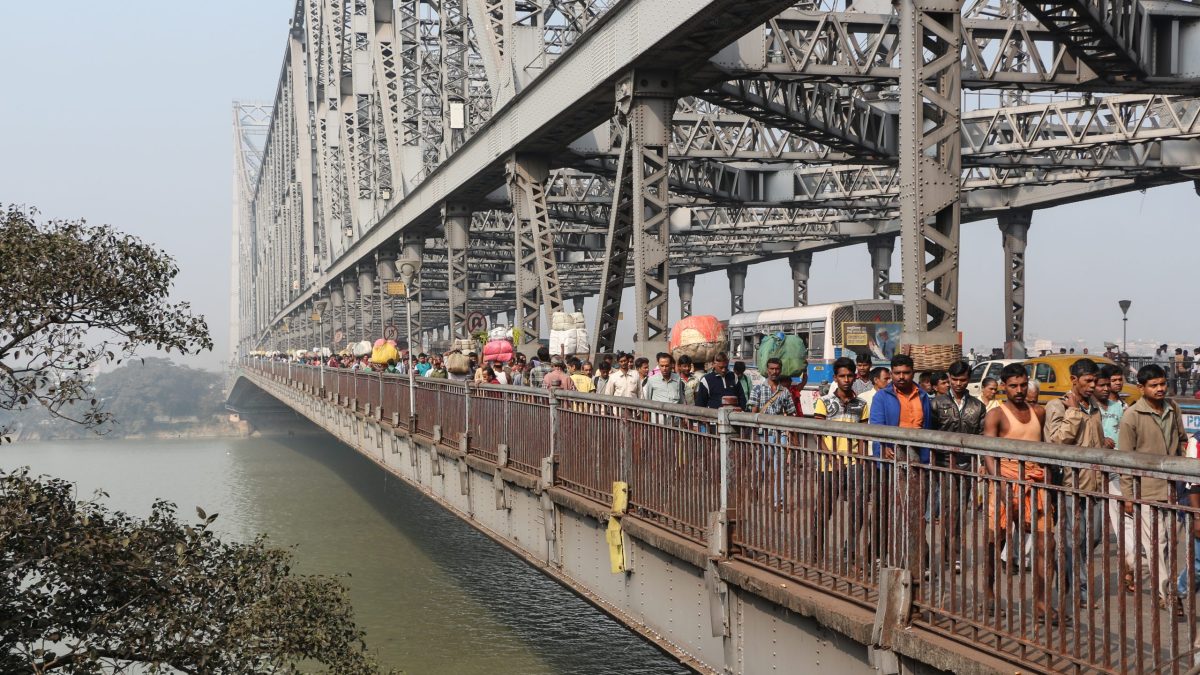
The Howrah Bridge is a balanced cantilever bridge of steel over the Hooghly River, linking Howrah and Kolkata. It was commissioned in 1943, and was originally called the New Howrah Bridge because it replaced an earlier pontoon bridge on the same spot. On 14 June 1965 it was renamed Rabindra Setu after Rabindranath Tagore, but it is still popularly known as the Howrah Bridge.
The first plan dates from 1862, when the Government of India asked George Turnbull, chief engineer of the East Indian Railway Company, to study the feasibility of a bridge. He reported that foundations at Calcutta would be deep and costly because of the mud, that shipping would be obstructed, and that a better site was upstream. In the meantime a pontoon bridge was built after the Howrah Bridge Act of 1871, by Sir Bradford Leslie. It was damaged by the cyclone of 20 March 1874, when a steamer broke loose and sank three pontoons, and it opened on 17 October 1874 at a cost of Rs 2.2 million. It was 1,528 feet long and 62 feet wide.
The pontoon could not cope with traffic. A census on 27 August 1906 found that bullock carts made up eight-thirteenths of vehicular traffic, and the Port Commissioners began planning a new bridge in 1905. The work was delayed by the First World War. A committee in 1921 and a new Howrah Bridge Act in 1926 followed, and a committee formed in 1930 examined the case for a bridge with piers. Wikipedia lists several competing proposals, including a single-span arch from Sir Basil Mott and a suspension design.
The eventual bridge is a cantilever. It does not have nuts and bolts but was made by riveting the entire structure. It used 26,500 tons of steel, of which 23,000 tons was a high-tensile alloy steel called Tiscrom, supplied by Tata Steel. The main towers rest on caissons measuring 55.31 by 24.8 metres with 21 shafts, each 6.25 metres square, which were sunk through soft river deposits to stiff yellow clay 26.5 metres below ground level, with the work done round the clock at a foot or more a day. The sinking was accurate to within 50 to 75 millimetres.
The cantilever arms were started at the end of 1940 and completed in mid-1941. The two halves of the suspended span, each 282 feet (86 metres) long and weighing 2,000 tons, were built in December 1941, and the bridge was erected by starting at the two anchor spans and moving toward the centre with creeper cranes along the top chord. Sixteen hydraulic jacks, each of 800 tons, joined the two halves of the suspended span.
The bridge carries about 100,000 vehicles a day and possibly more than 150,000 pedestrians, which Wikipedia says makes it the busiest cantilever bridge in the world. It was the third-longest cantilever bridge when it was built and is now the sixth-longest of its type. It is one of four bridges on the Hooghly, with the Vidyasagar Setu, the Vivekananda Setu and the Nivedita Setu.
It links Burrabazar with Howrah railway terminus, which is why it has been central to the daily life of the city. Pedestrians walk its footpaths, and the bridge’s steel lattice is a familiar image of Kolkata.
The bridge has two names for two stories. Howrah Bridge describes the structure, while Rabindra Setu records the city’s decision to name its most important crossing after its most celebrated poet.
The story of the structure is therefore one of replacement: a pontoon bridge that opened for ships, then decades of debate, and finally a steel cantilever that needed no moving parts and stood in the middle of the river without a pier.
Featured image: Pedestrians on the Howrah Bridge (Rabindra Setu) in Kolkata (file photo). Photo by Bernard Gagnon, licensed under CC BY-SA 3.0, via Wikimedia Commons.

Leave a Reply