
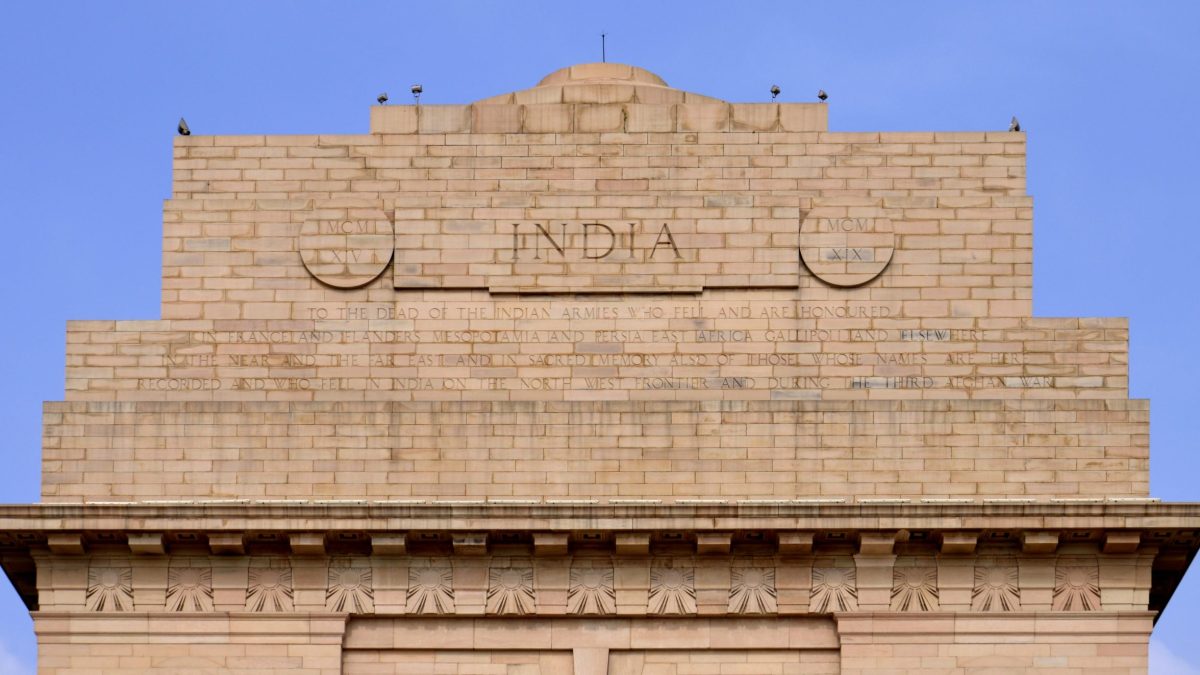
India Gate, originally the All India War Memorial, is a memorial arch on the eastern end of the ceremonial axis of New Delhi, near Kartavya Path. It commemorates exactly 74,187 soldiers of the British Indian Army who died between 1914 and 1921, in France, Flanders, Mesopotamia, Persia, East Africa, Gallipoli, the Near and Far East and in the Third Anglo-Afghan War of 1919. About 13,300 British servicemen’s names are also inscribed.
The memorial was part of the work of the Imperial War Graves Commission, which was formed in December 1917 to build war graves and memorials for those killed in the First World War. The foundation stone of what was then called the All India War Memorial was laid on 10 February 1921 by the Duke of Connaught, with the Viceroy, Lord Chelmsford, and soldiers from regiments of the Imperial Indian Army present. The land was owned by the contractor Sir Sobha Singh, who helped build large parts of New Delhi and was the primary contractor.
Ten years later, on 12 February 1931, the memorial was inaugurated by the Viceroy, Lord Irwin. In the decade between the foundation stone and the inauguration the rail line was moved to run along the Yamuna, and the New Delhi Railway Station opened in 1926.
The design is by Sir Edwin Lutyens, the main architect of New Delhi and a member of the War Graves Commission, who designed sixty-six war memorials in Europe, including the Cenotaph in London in 1919. Like the Cenotaph, the Delhi memorial is secular and free of religious iconography such as crosses. His biographer Christopher Hussey says Lutyens relied on an “elemental mode”, a universal architectural style without religious ornament. The structure evokes the Roman triumphal arches, such as the Arch of Constantine, and is often compared with the Arc de Triomphe and the Gateway of India.
The gate stands 42 metres tall on a low base of red Bharatpur stone, and rises in stages to a large cornice above a frieze with sunburst motifs. Its larger opening spans 30 feet. A shallow domed bowl at the top was meant to be filled with burning oil on anniversaries, though this is rarely done. The memorial complex is a hexagon with a diameter of about 625 metres, covering about 306,000 square metres. The four arches make it technically a tetrapylon.
The meaning of the site changed after independence. Following the Indo-Pakistani war of 1971 a structure called Amar Jawan Jyoti, a black marble plinth with a reversed rifle, a war helmet and four eternal flames, was built beneath the archway. It served as India’s Tomb of the Unknown Soldier from 1971 until 2019, when it was replaced by the National War Memorial.
India Gate is lit every evening from 7 pm to 9.30 pm, and cars no longer pass through it. The Republic Day parade passes around it, and the Prime Minister pays tribute at the national war memorial before it begins. It has also been a venue for civil society protests, including demonstrations in the 2011 anti-corruption movement.
In 2017 India Gate was twinned with the Arch of Remembrance in Leicester, England, another Lutyens war memorial of similar design on a smaller scale, and the two countries’ High Commissioners laid wreaths at the two arches.
Its structure and its purpose are inseparable. A restrained arch without religious symbols was chosen for soldiers of many faiths, and the names cut into its stone remain the reason it exists, long after the empire that commissioned it ended.
Featured image: India Gate in New Delhi (file photo). Photo by Yann, licensed under CC BY-SA 3.0, via Wikimedia Commons.




Leave a Reply