
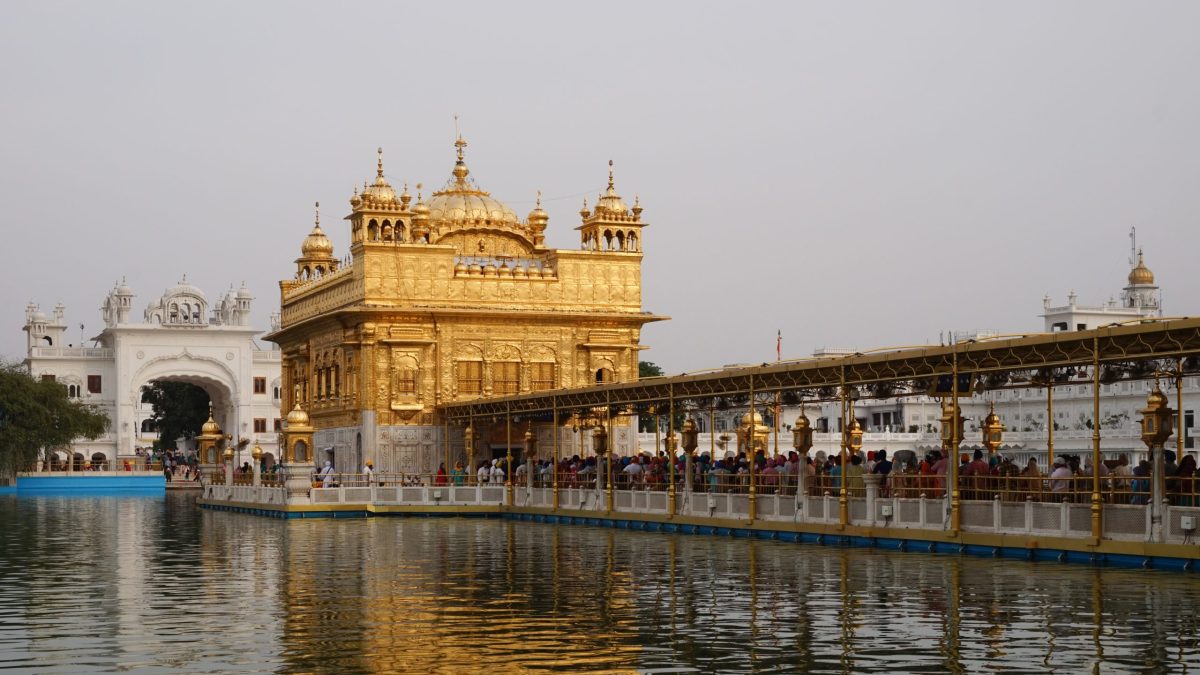
The Golden Temple, or Harmandir Sahib, in Amritsar, Punjab, is the holiest shrine of Sikhism. It is a gurdwara complex arranged around a sanctum standing in the middle of a sacred pool, the Amrit Sarovar. The architecture reflects its history: the building has been destroyed and rebuilt several times, and most of what visitors see dates from the 18th and 19th centuries.
Sikh sources say the site was chosen by the third Guru, Amar Das, who asked his disciple Ram Das to find land for a new town with a man-made pool at its centre. Guru Ram Das, who succeeded him in 1574, founded the town of Ramdaspur and completed the pool in 1577 with the help of Baba Buddha. The early history is hard to reconstruct because few records survive and the surviving Sikh accounts are mainly devotional rather than historical.
Guru Arjan, the fifth Guru, began constructing the temple in 1581, and the first version took about eight years to build. His design carried a message in its structure. He placed the temple at a lower level than the surrounding city to emphasise humility, kept the compound open on all sides to show that it welcomed everyone, and gave the sanctum only one bridge to emphasise that the goal is one. The four entrances are said to symbolise the Sikh belief in equality. In 1604 Guru Arjan installed a copy of the Adi Granth in the temple.
The shrine then became a target. It was seen by the Mughals and Afghan rulers as the centre of the Sikh faith. In 1757 the Afghan ruler Ahmad Shah Durrani attacked Amritsar and desecrated it, and in 1762 he returned and had the temple blown up with gunpowder, after which the Sikhs gathered in the ruins and celebrated Diwali. In 1764 Jassa Singh Ahluwalia collected donations to rebuild it. A new gateway, causeway and sanctum were completed in 1776 and the floor around the pool in 1784, according to the account on Wikipedia, although some sources give slightly different dates.
The gold came later. Maharaja Ranjit Singh, who founded the Sikh Empire, rebuilt the temple in marble and copper in 1809 and overlaid the sanctum with gold leaf in 1830, which gave it the name by which it is known in English. The gilding is described as a 400-kilogram gold dome and 750 kilograms of gold on the upper level. Hari Singh Nalwa, one of Ranjit Singh’s generals, decorated the Akal Takht with gold and added its golden dome.
The sanctum is a two-storey square of 12.25 metres on each side, topped with a gold-leaf dome. It stands on a marble platform inside a nearly square pool that is 5.1 metres deep, and a causeway connects it to the shore. The walls carry marble panels with floral arabesque designs, gold-lettered verses of scripture and frescoes of animals, birds and nature. James Fergusson saw the temple as a specimen of the forms that Hindu temple architecture took in the 19th century, and the building shows both Hindu and Islamic influences.
Around the pool stand structures of different dates. The Akal Takht, which faces the causeway, was established by Guru Hargobind after Guru Arjan’s martyrdom as the chief seat of Sikh religious authority. The red sandstone Ramgarhia Bunga towers, built in the 18th century, served as watchtowers. Three ancient jujube trees, one of them called Dukh Bhanjani Ber, stand in the complex and are linked with the building of the temple and with healing.
Modern history has also left marks. In June 1984 the Indian Army carried out Operation Blue Star to remove Jarnail Singh Bhindranwale and his followers from the complex, which caused deaths and heavy damage, including the destruction of the Akal Takht, and the buildings were rebuilt afterwards. The complex is nominated for UNESCO status and is on India’s tentative list.
What makes the Golden Temple distinctive is that its design expresses its values: a building entered by descending steps, open to all on four sides, that was rebuilt each time it was destroyed. Reported attendance is more than 150,000 visitors a day, and a free community kitchen, the langar, serves a vegetarian meal to all.
Featured image: The Golden Temple (Harmandir Sahib) in Amritsar (file photo). Photo by Bernard Gagnon, licensed under CC BY-SA 4.0, via Wikimedia Commons.


Leave a Reply