
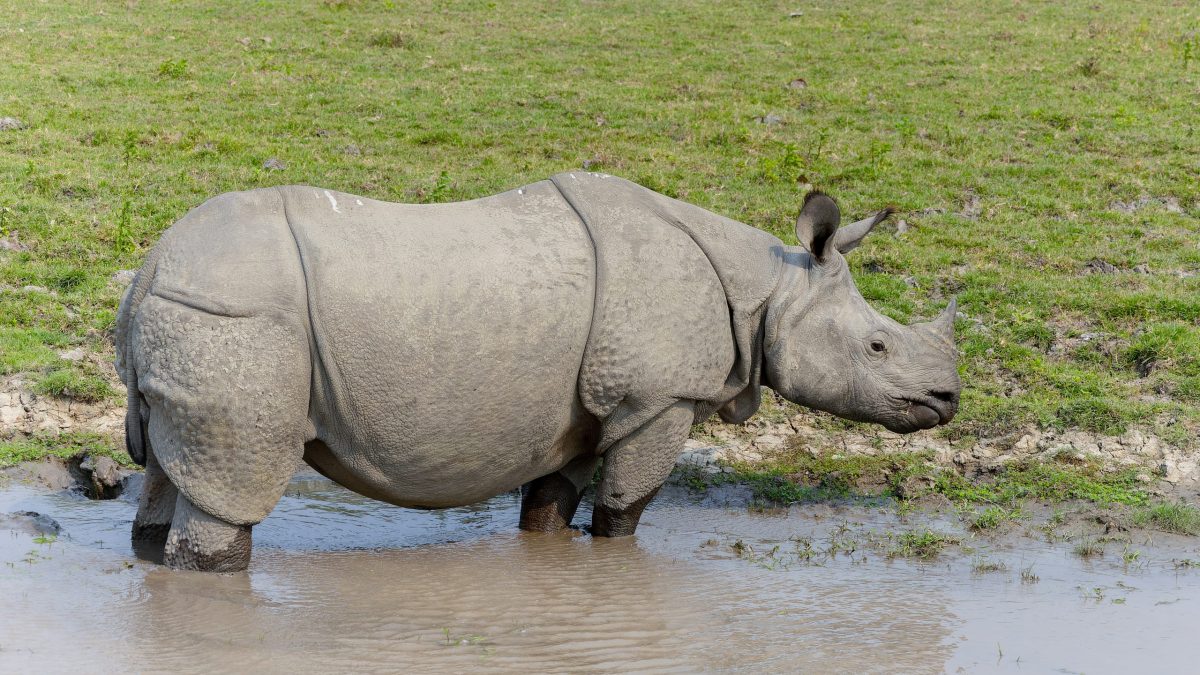
Kaziranga National Park, on the south bank of the Brahmaputra in Assam, is the stronghold of the greater one-horned rhinoceros. A century ago the animal was close to extinction; today about two-thirds of all that survive live here. UNESCO inscribed the park as a World Heritage Site in 1985.
At a glance
- Location: Golaghat and Nagaon districts, Assam
- Inscribed: 1985
- Type: Natural
- Protected since: 1905; national park since 1974
- Known for: the greater one-horned rhinoceros
History
The story usually told is that Mary Curzon, wife of the Viceroy, visited the area in 1904, failed to see a single rhinoceros and urged her husband to protect them. A reserve forest was proposed in 1905, when perhaps only a dozen or so rhinos remained. Kaziranga became a game sanctuary, then a wildlife sanctuary, and in 1974 a national park. It was declared a tiger reserve in 2006.
The landscape
The park lies on the floodplain of the Brahmaputra. Every monsoon the river spills over it, renewing the soil and the shallow lakes called beels. The result is a mosaic of tall elephant grass, marsh, open woodland and patches of evergreen forest, with the Karbi hills to the south, to which the animals retreat in the floods.
The wildlife
- Rhinoceros: more than 2,600 at the last count
- Tiger: one of the highest densities in any protected area in the world, though the tall grass makes them hard to see
- Elephant: large herds
- Wild water buffalo: the largest population anywhere
- Swamp deer: the eastern subspecies, found almost nowhere else
- Birds: nearly 500 species, including the Bengal florican, pelicans, storks and wintering waterfowl
- Others: hoolock gibbons in the forests, and river dolphins in the Brahmaputra
Threats
- Poaching: for rhino horn; armed forest guards have reduced it sharply in recent years
- Floods: necessary to the ecosystem, but severe ones drown animals or drive them on to the highway that runs along the park’s edge
- Erosion: the river eats into the park’s northern boundary
Why it is a World Heritage Site
Kaziranga is one of the last areas in eastern India undisturbed by people, and the largest and most important refuge of the one-horned rhinoceros.
Visiting
The park is open from about November to April and is closed during the monsoon. Visitors go in by jeep or on elephant back, in four ranges, of which the central range at Kohora is the most visited. Guwahati is about 200 kilometres away and Jorhat about 90.
Image: A greater one-horned rhinoceros in Kaziranga National Park, Assam, March 2025. Photo by Tisha Mukherjee, licensed under CC BY-SA 4.0, via Wikimedia Commons.




Leave a Reply