
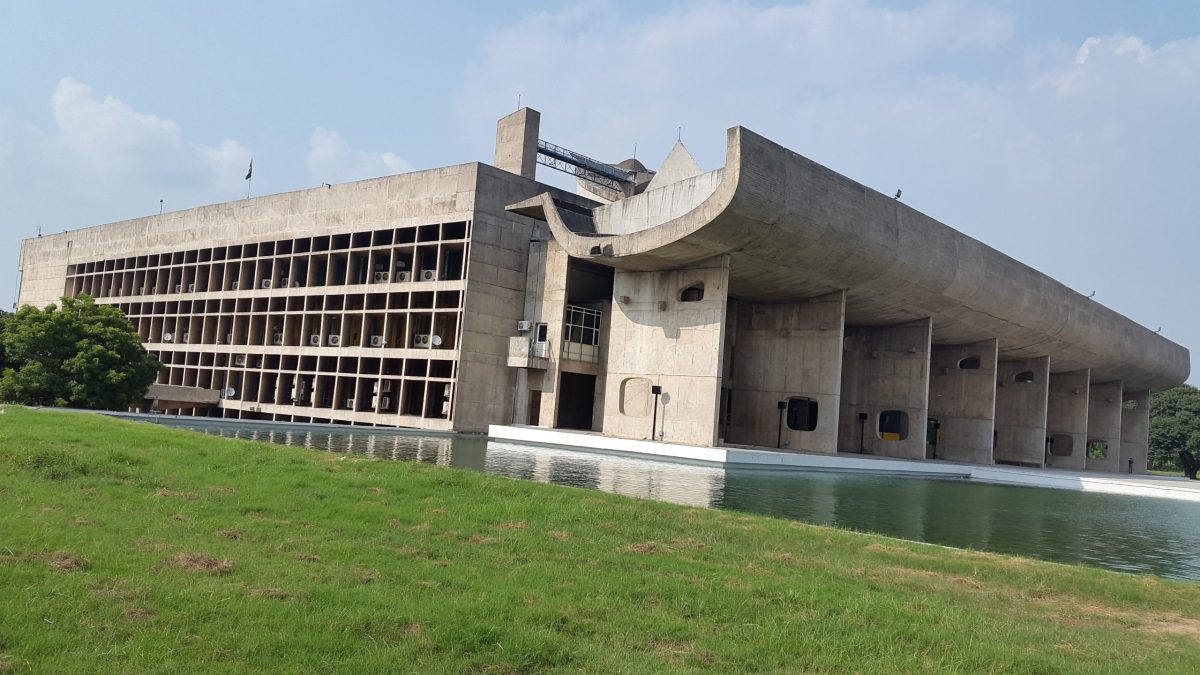
Chandigarh was the first planned city of independent India, and its government buildings are among the most celebrated works of modern architecture in the world. The Capitol Complex, designed by the Swiss-French architect Le Corbusier, was inscribed by UNESCO as a World Heritage Site in 2016.
At a glance
- Location: Sector 1, Chandigarh
- Inscribed: 2016
- Type: Cultural
- Built: 1950s and early 1960s
- Architect: Le Corbusier
A shared listing
The Capitol Complex is one of seventeen sites in seven countries, France, Switzerland, Belgium, Germany, Argentina, Japan and India, inscribed together as “The Architectural Work of Le Corbusier, an Outstanding Contribution to the Modern Movement”.
Why Chandigarh was built
The Partition of 1947 left Lahore, the capital of Punjab, in Pakistan. Indian Punjab needed a new capital. Jawaharlal Nehru wanted a city “unfettered by the traditions of the past, a symbol of the nation’s faith in the future”. After the first planners withdrew, Le Corbusier was engaged in 1951. He worked with his cousin Pierre Jeanneret, the English architects Maxwell Fry and Jane Drew, and a team of young Indians.
He laid out the city on a grid of self-contained sectors, with the Capitol at its head, against the Shivalik hills.
The buildings
- Palace of Assembly: the legislature, with a great upturned portico like a trough and, rising through the roof, a hyperbolic tower over the chamber. Its enamelled door was painted by Le Corbusier himself.
- Secretariat: a slab 254 metres long housing the ministries
- High Court: under a huge parasol roof, with three tall coloured piers at the entrance
All are of rough concrete left bare, the material Le Corbusier called béton brut, shaped to give shade and to catch the breeze.
The monuments
- Open Hand: a metal hand 26 metres high that turns in the wind, the emblem of the city, meaning “open to give, open to receive”
- Tower of Shadows and Geometric Hill: studies in the movement of the sun
Why it is a World Heritage Site
Le Corbusier’s work, UNESCO says, reflects the solutions that the Modern Movement sought to the challenge of inventing new architecture for a new society. Chandigarh is its fullest expression in city planning.
Visiting
The buildings are in use by the governments of Punjab and Haryana, which share the city as their capital. Visitors must join a guided tour arranged through the tourist office.
Image: Le Corbusier’s concrete buildings at the Capitol Complex, Chandigarh. Photo by Lillottama, licensed under CC BY-SA 4.0, via Wikimedia Commons.

Leave a Reply