
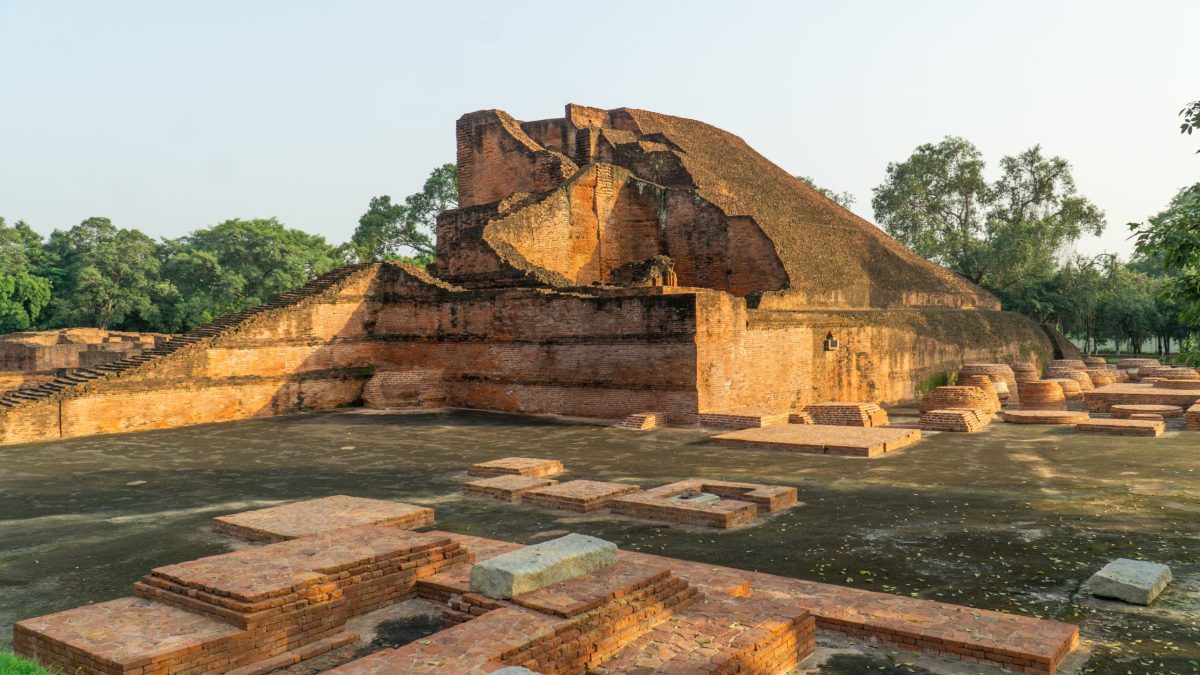
Nalanda, in Bihar, was the most famous seat of learning in ancient Asia. For about eight hundred years monks and students came to it from across India and from China, Korea, Tibet and South-East Asia. UNESCO inscribed the archaeological site of Nalanda Mahavihara as a World Heritage Site in 2016.
At a glance
- Location: Nalanda district, Bihar, about 95 kilometres from Patna
- Inscribed: 2016
- Type: Cultural
- Active: fifth century CE to about 1200
- Founded under: the Gupta emperor Kumaragupta I
History
A monastery was founded here in the fifth century under the Guptas. It grew with the support of later rulers, among them Harsha of Kannauj in the seventh century and the Pala kings of Bengal from the eighth.
The Chinese pilgrim Xuanzang studied here for several years in the 630s under the abbot Shilabhadra. He and a later pilgrim, Yijing, describe a community of several thousand monks, supported by the revenues of a hundred or more villages, where entry was by a difficult oral examination and debate went on all day.
What was taught
Nalanda was a monastery, and the chief study was Buddhist philosophy of all schools. But the monks also learnt logic, grammar, medicine, mathematics and astronomy, and the Vedas. Its library, called Dharmaganja, is said to have occupied three large buildings.
Destruction
Around 1200 the monastery was sacked in the raids of the Turkic commander Bakhtiyar Khalji. Tradition says the library burned for months. A few monks lingered, but Nalanda never recovered, and the site was buried and forgotten until it was identified in the nineteenth century and excavated between 1915 and 1937.
The ruins
- Monasteries: eleven, in a row, each a courtyard surrounded by cells, with a shrine, a well and stairs to upper storeys
- Temples: a line of brick temples facing them across a wide passage
- Temple 3: the great stupa, enlarged seven times, surrounded by smaller votive stupas with stucco images of the Buddha
Only a part of the ancient site has been uncovered.
Why it is a World Heritage Site
Nalanda is the most ancient university of the Indian subcontinent and bears witness to the development of Buddhism and of monastic and educational traditions that spread across Asia.
Today
A new international Nalanda University was established nearby in 2014, and its campus was inaugurated in 2024. The site is usually visited with Rajgir and Bodh Gaya.
Image: The ruins of Temple 3, the Sariputta Stupa, at Nalanda Mahavihara, Bihar. Photo by Sumitsurai, licensed under CC BY-SA 4.0, via Wikimedia Commons.




Leave a Reply