
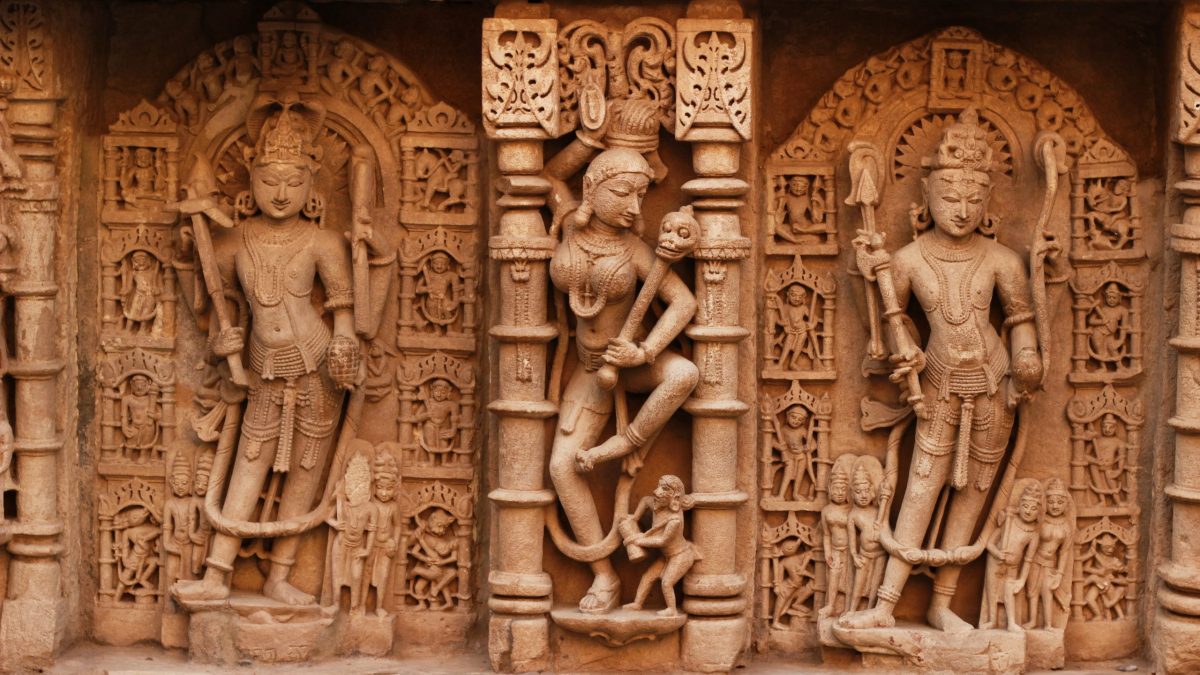
At Patan in northern Gujarat a flight of steps leads down into the earth through seven storeys of carved pavilions to a well. Rani ki Vav, the Queen’s Stepwell, is the grandest of the stepwells for which western India is known. UNESCO inscribed it as a World Heritage Site in 2014.
At a glance
- Location: Patan, Gujarat
- Inscribed: 2014
- Type: Cultural
- Built: about 1063
- Built by: Queen Udayamati, in memory of King Bhima I
History
Patan was the capital of the Chaulukya, or Solanki, dynasty. When King Bhima I died, his widow Udayamati built the stepwell as his memorial; it is one of the few great monuments in India raised by a queen for a king.
Some time later the nearby Saraswati river flooded and filled the well with silt. For centuries only the top was visible. The Archaeological Survey of India excavated it in the 1980s and found the carving, protected by the mud, almost perfectly preserved.
Stepwells
In the dry climate of Gujarat and Rajasthan, wells were dug deep to reach water, and steps were built down to them so that people could reach the water at any level through the year. The cool underground galleries also served as places to rest and to worship.
The structure
- Size: about 64 metres long, 20 metres wide and 27 metres deep
- Plan: a stepped corridor running east to west, divided by pillared pavilions, ending in a tank and a circular well shaft
- Design: conceived as an inverted temple, honouring the sanctity of water
The sculpture
The walls hold more than five hundred principal figures and over a thousand smaller ones.
- Vishnu: in his ten incarnations, and reclining on the serpent Shesha in the well shaft
- Other deities: Parvati, Ganesha, Brahma and many more
- Celestial women: applying make-up, looking in mirrors, playing with children
- Patterns: geometric designs that resemble those of Patan’s famous patola silk
Why it is a World Heritage Site
UNESCO describes Rani ki Vav as an exceptional example of the stepwell and of the craftsmen’s mastery of this form at the height of its development.
Visiting
Patan is about 125 kilometres from Ahmedabad. Visitors may go down to the fourth level; the lower levels are closed for safety. The stepwell is pictured on the Indian 100-rupee note.
Image: Carved figures on the walls of Rani ki Vav, the Queen’s Stepwell, at Patan in Gujarat. Photo by Snehrashmi, licensed under CC BY-SA 4.0, via Wikimedia Commons.


Leave a Reply