
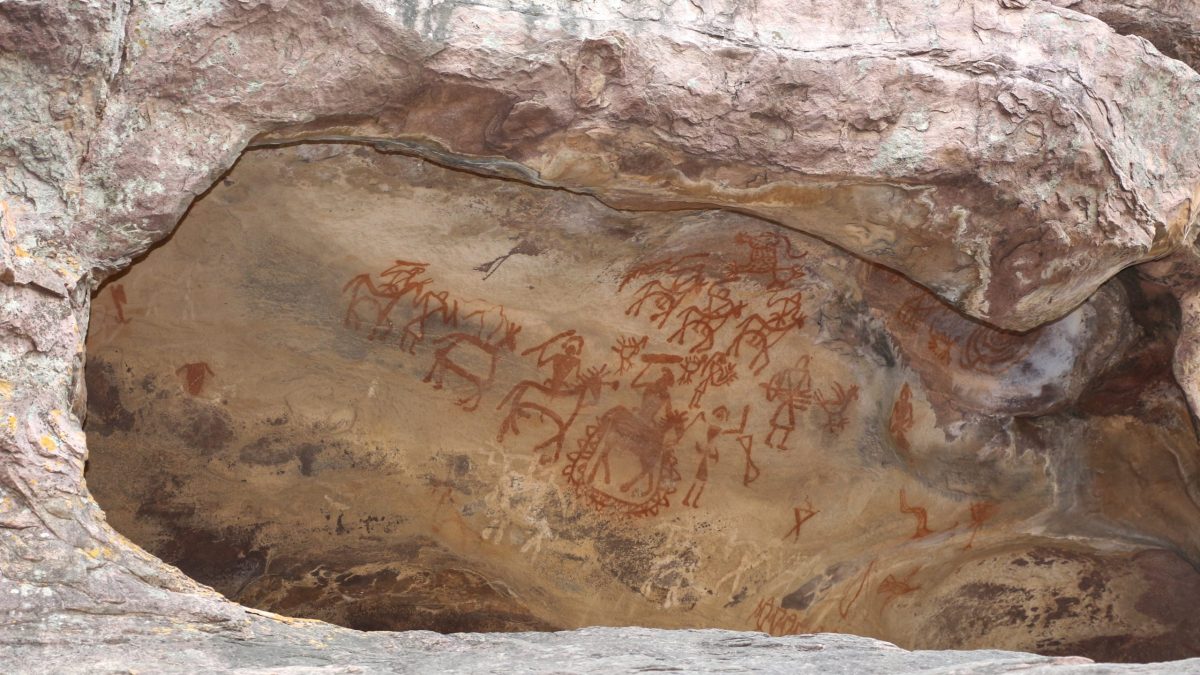
In the forested Vindhya hills, 45 kilometres south of Bhopal, hundreds of natural rock shelters were used by people from the Stone Age onwards. On their walls are paintings that span some ten thousand years. UNESCO inscribed the Rock Shelters of Bhimbetka as a World Heritage Site in 2003.
At a glance
- Location: Raisen district, Madhya Pradesh, inside the Ratapani wildlife sanctuary
- Inscribed: 2003
- Type: Cultural
- Shelters: more than 700, of which about 400 have paintings
- Discovered: 1957, by Dr V. S. Wakankar
Discovery
The archaeologist Vishnu Shridhar Wakankar noticed the rock formations from a train window in 1957, was reminded of painted sites he had seen in Europe, and went to look. He and others excavated the shelters over the following decades.
How old
Stone tools found in the floors of the shelters show that people lived here in the Lower Palaeolithic, more than 100,000 years ago, making Bhimbetka one of the oldest known sites of human life in India. The earliest paintings are thought to belong to the Mesolithic period, about 10,000 years ago, and the latest to medieval times.
The paintings
They are mostly in red and white, made from iron-rich minerals and lime, with some in green and yellow.
- Hunting scenes: men with bows, spears and traps pursuing deer, bison and boar
- Animals: elephants, tigers, rhinoceroses, peacocks and many others; one shelter, known as the Zoo Rock, has more than two hundred
- Community life: dancing in rows, drummers, mothers and children, honey gathering
- Later scenes: horsemen, soldiers with swords and shields, and processions
Later pictures are often painted over earlier ones, which helps in working out their order.
Why it is a World Heritage Site
The paintings record a long interaction between people and the landscape, and the hunting and gathering traditions shown in them are still echoed in the customs of the villages of the area.
The name
The name is explained as “Bhim-baithka”, the seat of Bhima, the strongest of the Pandava brothers of the Mahabharata.
Visiting
Fifteen or so shelters are open to visitors along a marked path. Bhimbetka can be combined with Sanchi, on the other side of Bhopal.
Image: One of the painted rock shelters at Bhimbetka, Madhya Pradesh. Photo by Bernard Gagnon, licensed under CC BY-SA 3.0, via Wikimedia Commons.


Leave a Reply