
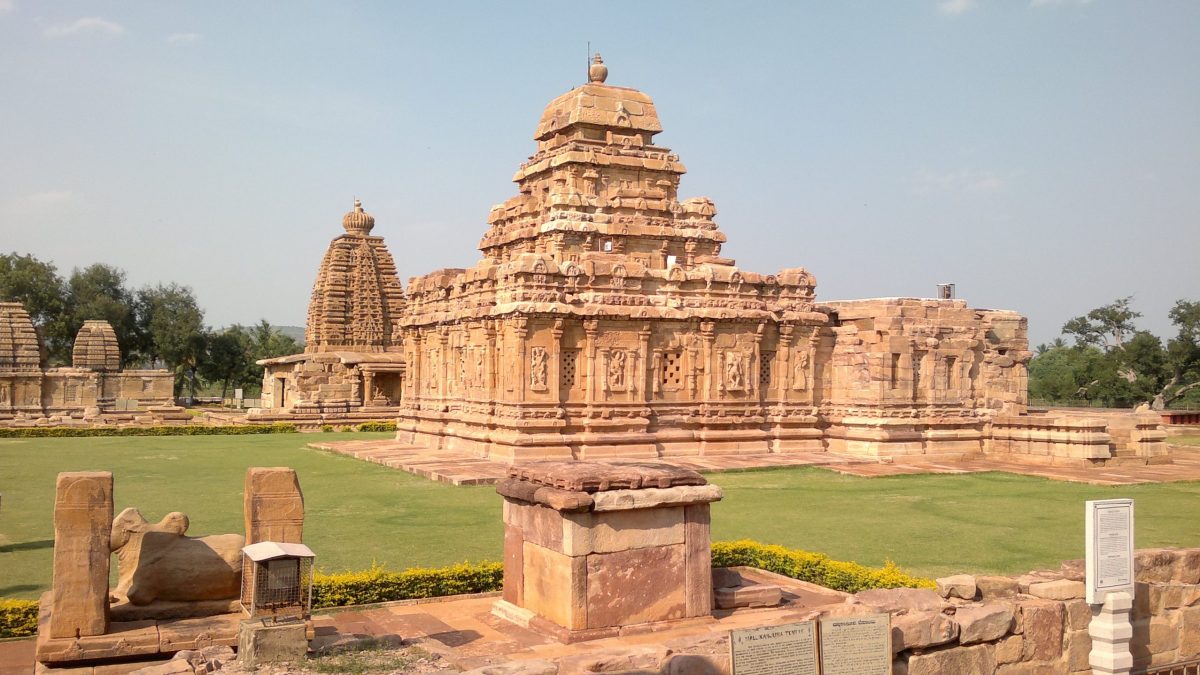
Pattadakal is a village on the Malaprabha river in northern Karnataka where the Chalukya kings were crowned. In the seventh and eighth centuries they built a group of temples there in which the two great traditions of Indian temple design, the northern and the southern, stand side by side. UNESCO inscribed the Group of Monuments at Pattadakal as a World Heritage Site in 1987.
At a glance
- Location: Bagalkot district, Karnataka
- Inscribed: 1987
- Type: Cultural
- Period: seventh and eighth centuries CE
- Built by: the Chalukyas of Badami
History
The Chalukyas ruled the Deccan from Badami, 22 kilometres away. Their architects first experimented at nearby Aihole, sometimes called the cradle of Indian temple architecture, and then at Badami. Pattadakal, whose name means “coronation stone”, shows the mature result. The dynasty’s most famous king was Pulakeshin II.
The temples
There are nine Hindu temples in one enclosure and a Jain temple a short distance away.
- Virupaksha Temple: the largest, built about 740 by Queen Lokamahadevi to commemorate her husband Vikramaditya II’s victory over the Pallavas of Kanchipuram. It is modelled on the Kailasanatha temple of the defeated enemy, and in turn inspired the Kailasa temple at Ellora.
- Mallikarjuna Temple: its smaller twin, built by a second queen
- Sangameshvara Temple: the oldest of the large temples
- Papanatha Temple: combining a northern tower with a southern plan
- Galaganatha, Jambulinga and Kashivishvanatha temples: in the northern style, with curved towers
The walls carry carved episodes from the Ramayana, the Mahabharata and the legends of Krishna.
Why it is a World Heritage Site
UNESCO describes Pattadakal as the high point of an eclectic art which achieved a harmonious blend of architectural forms from northern and southern India.
Visiting
Pattadakal is usually visited together with Badami and Aihole. Badami has the nearest railway station. A dance festival is held among the temples each winter.
Image: One of the eighth-century Chalukya temples at Pattadakal, Karnataka. Photo by rajeshodayanchal, licensed under CC BY 3.0, via Wikimedia Commons.

Leave a Reply