
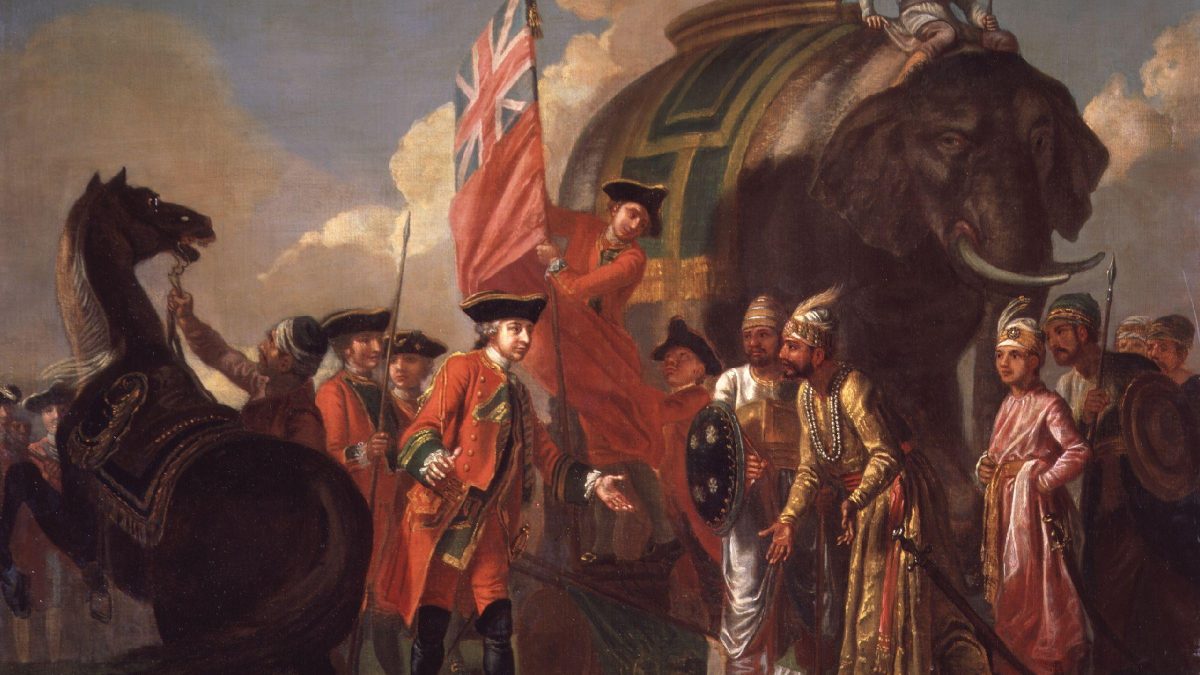
On 23 June 1757, in a mango grove beside the Bhagirathi river in Bengal, a force of the English East India Company under Robert Clive defeated the army of the Nawab, Siraj-ud-Daulah. As a battle Plassey was a small affair, settled as much by treachery as by fighting. As an event it was the beginning of British rule in India.
Bengal
Bengal was the richest province of the Mughal empire, ruled in practice by independent Nawabs from Murshidabad. The European companies traded there from fortified settlements: the English at Calcutta, the French at Chandernagore, the Dutch at Chinsura.
In April 1756 the old Nawab, Alivardi Khan, died and was succeeded by his grandson Siraj-ud-Daulah, aged about twenty-three. The succession was resented by rivals in his own family and by powerful men at court.
The quarrel
The new Nawab had three complaints against the English: they were strengthening the defences of Calcutta without permission, they abused their trade privileges to evade duties, and they sheltered a fugitive from his justice. When they defied him, he took Calcutta in June 1756. A number of English prisoners died overnight in a small cell, the incident known as the Black Hole, which the Company afterwards used as a rallying cry.
A relief force under Colonel Robert Clive and Admiral Charles Watson came from Madras and retook Calcutta in January 1757. Britain and France were at war, and Clive next seized French Chandernagore.
The conspiracy
Clive concluded that the Company would not be safe while Siraj ruled. He found allies at Murshidabad:
- Mir Jafar, the commander of the Nawab’s army, who was promised the throne
- The Jagat Seths, the bankers who financed the state
- Rai Durlabh and other officers
- Omichand, a merchant go-between, who demanded a huge share and was tricked by Clive with a forged copy of the agreement
The battle
Clive marched north with about 3,000 men, some 900 Europeans and 2,100 Indian sepoys, and a few light guns. The Nawab awaited him at Palashi, anglicised as Plassey, with about 50,000 men and heavy artillery, some of it served by French gunners. Most of that army was commanded by the conspirators.
The battle began with a cannonade on the morning of 23 June. Clive kept his men sheltered behind the mud bank of the grove. About noon a heavy shower fell. The Nawab’s gunners had not covered their powder and it was soaked; the British had used tarpaulins. When the Nawab’s cavalry advanced, supposing the British guns were silenced too, they were met with grapeshot, and Mir Madan, the most loyal of the Nawab’s commanders, was killed.
Siraj, shaken, appealed to Mir Jafar, who advised him to withdraw to the camp for the day. As the army began to pull back, the British advanced. The divisions of Mir Jafar and Rai Durlabh stood aside. The remainder broke and fled.
British losses were about twenty killed and fifty wounded; the Nawab’s, about five hundred.
Aftermath
Siraj-ud-Daulah fled, was captured some days later, and was killed on 2 July on the orders of Mir Jafar’s son. Mir Jafar was installed as Nawab by Clive. In return the Company received the territory of the 24 Parganas near Calcutta and vast sums in “compensation”, and its officers took personal presents on an enormous scale; Clive’s own share made him one of the richest men in Britain.
Why it mattered
- The Company became the maker of Nawabs in Bengal. When Mir Jafar could not pay, it replaced him, and when his successor resisted, it fought and won the larger battle of Buxar in 1764.
- The revenues of Bengal paid for the armies that conquered the rest of India.
- In Bengal itself, misrule and extortion were followed by the famine of 1770.
The name of Mir Jafar became, in Indian languages, a word for traitor.
Image: Robert Clive and Mir Jafar after the Battle of Plassey, painted by Francis Hayman about 1760. Photo by Francis Hayman, in the public domain, via Wikimedia Commons.

Leave a Reply