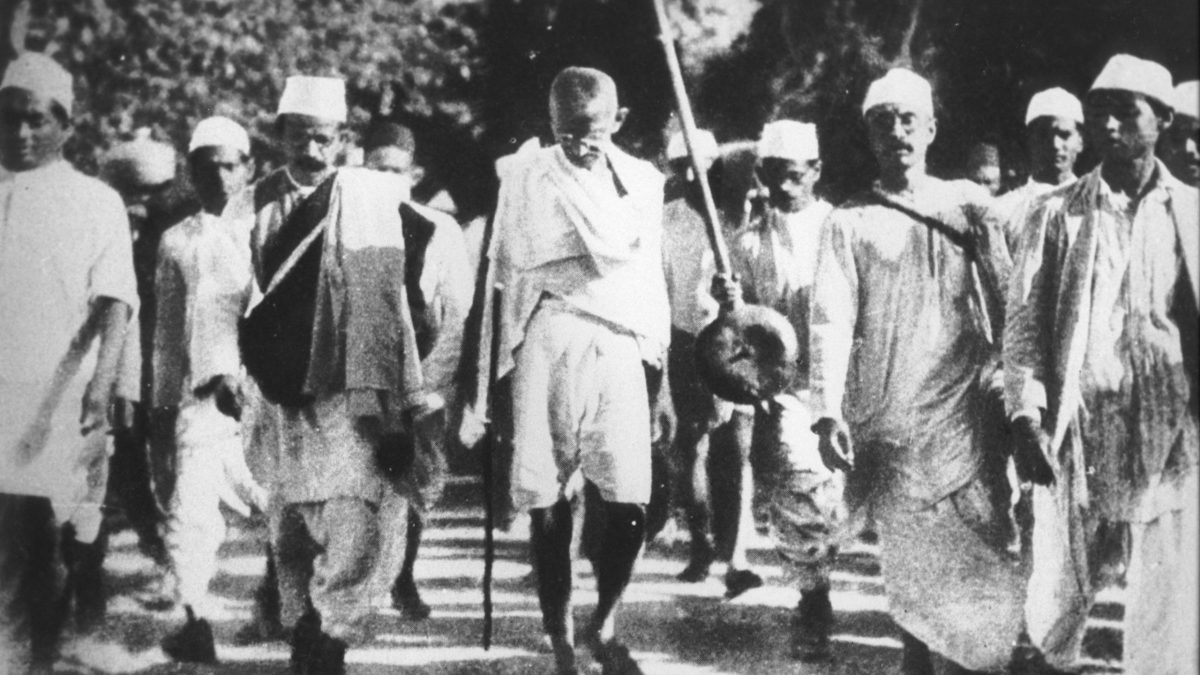
On 12 March 1930, Mahatma Gandhi set out on foot from his ashram at Sabarmati in Ahmedabad for the coastal village of Dandi. Twenty-four days later he picked up a handful of salt there and broke the law. The act launched the Civil Disobedience Movement.
Why salt
The colonial government held a monopoly over the making and sale of salt and taxed it. Everyone, however poor, needed salt, and so everyone paid. Gandhi saw that a protest against the salt law would be understood in every village and would unite people across religion, caste and class. Many of his colleagues doubted the idea at first; so did the Viceroy, Lord Irwin, who did not think it a serious threat.
The Congress had declared complete independence, Purna Swaraj, as its goal at Lahore in December 1929, and had observed 26 January 1930 as Independence Day. The march was the first step in acting on that pledge.
The march
- Start: 12 March 1930, Sabarmati Ashram
- Marchers: 78 volunteers chosen by Gandhi, joined by thousands on the way
- Distance: about 385 kilometres through the villages of Gujarat
- Arrival: 5 April at Dandi, on the Arabian Sea
- Breaking the law: early on 6 April, Gandhi lifted a lump of natural salt from the shore
Gandhi was 60. He walked some fifteen kilometres a day and spoke in the villages each evening. Reporters from around the world followed.
What followed
- Across India: People made salt illegally on the coasts, boycotted foreign cloth and refused to pay taxes. C. Rajagopalachari led a march to Vedaranyam in the south, and Khan Abdul Ghaffar Khan’s followers protested in the North-West Frontier.
- Gandhi’s arrest: He was arrested on the night of 4-5 May.
- Dharasana: On 21 May, volunteers led by Sarojini Naidu advanced on the Dharasana salt works and were beaten down by police without raising a hand. The American journalist Webb Miller’s account was printed in newspapers across the world.
- Arrests: More than 60,000 people were jailed.
The outcome
The salt law was not repealed. But in March 1931 the Viceroy signed the Gandhi-Irwin Pact, releasing prisoners and allowing people on the coast to make salt for their own use, and Gandhi went to London for the Round Table Conference. For the first time, the British had negotiated with the Congress as an equal.
Why it matters
The march showed that non-violent defiance by ordinary people could shake an empire’s authority, and it drew women into the movement in large numbers. It later inspired others, among them Martin Luther King Jr. A memorial to the march stands at Dandi, and the route is marked as a heritage path.
Image: Mahatma Gandhi and his companions during the Salt March, March 1930. Photo by an unknown photographer, in the public domain, via Wikimedia Commons.