
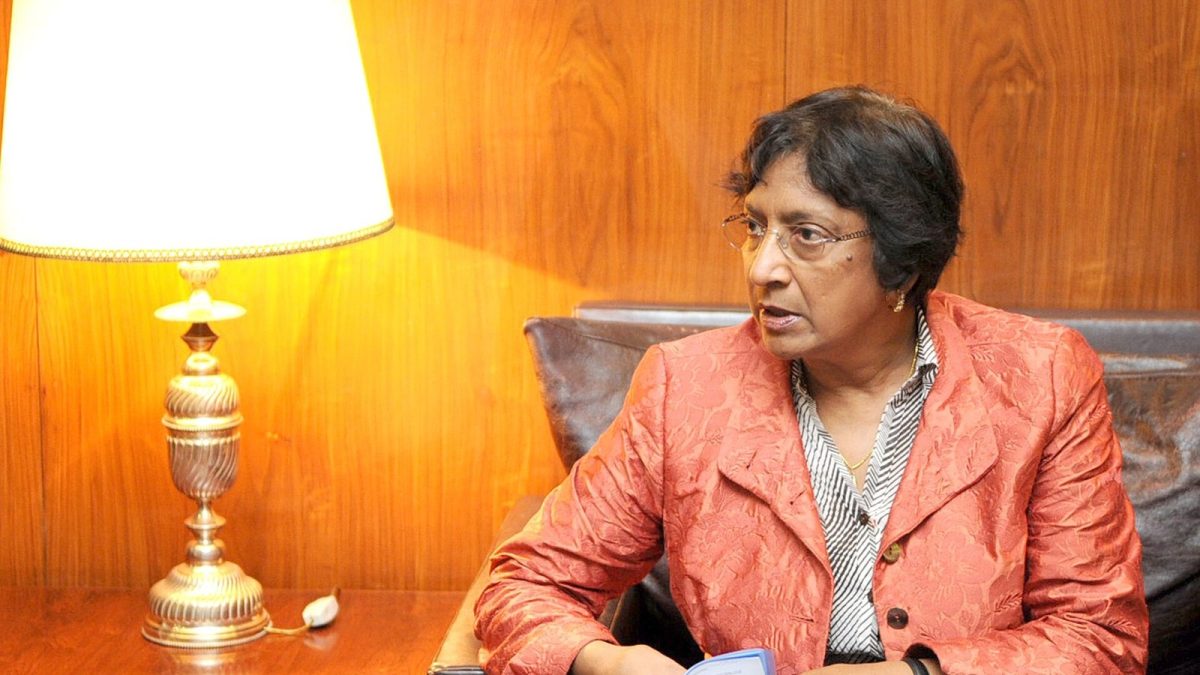
The Norwegian Nobel Committee announced on 9 October 2026 that the Nobel Peace Prize goes to Navi Pillay, a South African jurist, “for her efforts to promote peace and international law”. The prize of 12 million Swedish kronor will be presented in Oslo on 10 December.
Pillay was born in Durban in 1941 to a family of Indian Tamil descent. She opened her own law firm in 1967 and defended anti-apartheid activists, and earned a doctorate in juridical science from Harvard in 1988. She was appointed to the High Court of South Africa in 1995. In 1999 she became a judge and later President of the International Criminal Tribunal for Rwanda, where she helped establish that sexual violence can constitute genocide and crimes against humanity.
She later served as a judge of the International Criminal Court and as UN High Commissioner for Human Rights from 2008 to 2014. In 2019 she sat as an ad hoc judge at the International Court of Justice in the Rohingya genocide case against Myanmar. From 2021 to 2025 she chaired the UN Independent International Commission of Inquiry on the Occupied Palestinian Territory.
South African President Cyril Ramaphosa congratulated her and called her the country’s fifth Nobel laureate. UN Secretary-General António Guterres said the award honoured those who uphold international law and human rights. Hamas welcomed the decision.
The award was criticised by the governments of the United States and Israel. President Donald Trump said the committee had “shamed itself beyond repair” and called Pillay an “unabashed hater of America and Israel”, and his administration then announced more sanctions on the International Criminal Court. Israeli Prime Minister Benjamin Netanyahu said the committee had “lost its moral compass”. The commission Pillay chaired had reported that Netanyahu’s government displayed genocidal intent in Gaza.
Sources: Wikipedia: 2026 Nobel Peace Prize; The Nobel Peace Prize.
Featured image: Navi Pillay, a former UN High Commissioner for Human Rights (cropped). Photo by Antônio Cruz (Agência Brasil), licensed under CC BY 3.0 br, via Wikimedia Commons.


Leave a Reply