
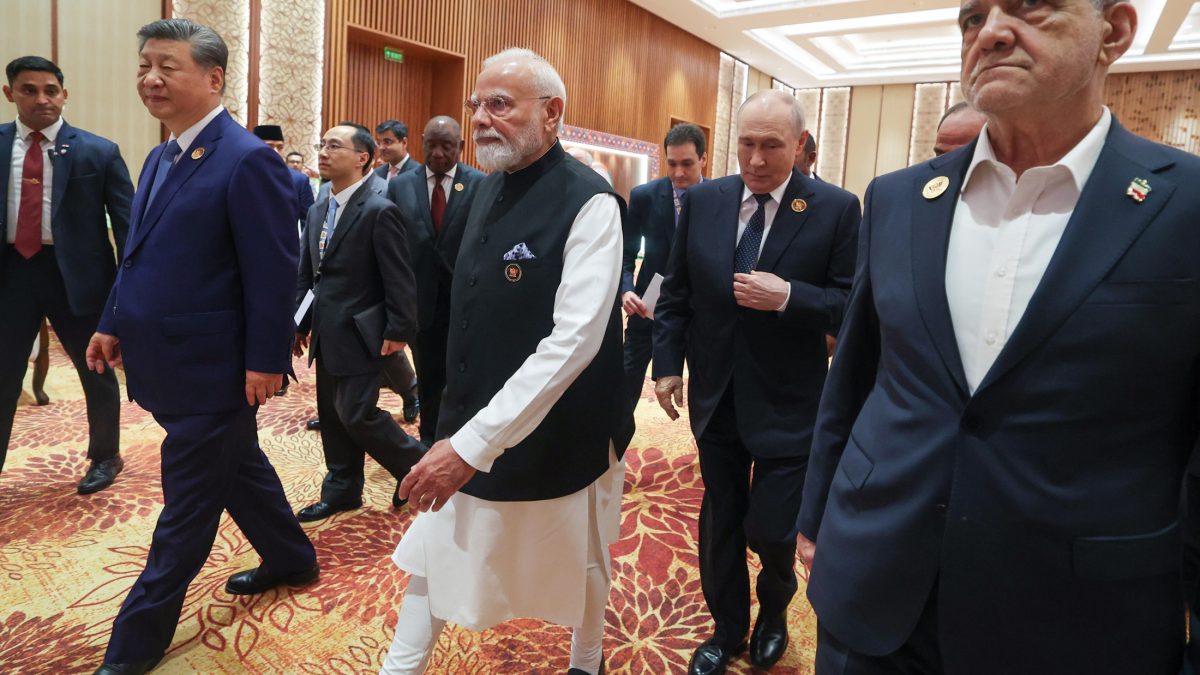
Strategic autonomy is the principle that India decides its foreign policy in its own interest and does not join a bloc or follow a single great power. It has guided Indian diplomacy since the Cold War, when India led the Non-Aligned Movement, and today it describes a policy some call multi-alignment: close ties with the United States through the Quad and defence cooperation, with Russia through energy and arms, and with the Global South through BRICS. External Affairs Minister S Jaishankar has defended the approach, arguing that India’s size and needs make dependence on any one partner impossible.
India held the BRICS chair in 2026 and hosted the 18th summit at Bharat Mandapam in New Delhi on 12 and 13 September. Chinese President Xi Jinping and Russian President Vladimir Putin attended, according to reports. Members adopted the New Delhi Declaration, a 140-paragraph consensus document covering global governance, trade and finance, energy, technology and conflicts, after overcoming sharp differences between the UAE and Iran. Earlier, BRICS ministers had warned that trade-restrictive measures used as coercion threaten global trade, a statement widely read as a criticism of US tariffs, though it did not name the United States.
Washington has been wary of the grouping. In February 2026, according to reports, Trump told reporters that BRICS “is dead” and warned that countries seeking to challenge the dollar would face a 100 percent tariff. Even so, a bloc that includes Russia and China, hosted by India while it negotiates a trade deal with the United States, is awkward for both capitals, and it is one reason some US commentators question how reliable a partner India will be. Both governments continue to describe the broader relationship as important, and the trade talks are still ongoing.
For India, the reasoning is straightforward. Its trade with the United States is large, its defence and technology links are growing, and the Indian diaspora in America is influential. But India also shares a long and tense border with China, buys energy and arms from Russia and wants a voice in institutions where the West is not dominant. Jaishankar has said BRICS must defend the multilateral trading system at a time of rising protectionism and tariff volatility. Indian officials insist that this is not an anti-American stance, but an expression of a world with several centres of power.
The question for the coming years is whether Washington accepts that model. The US relationship with India has survived tariffs, visa fees and disagreements over Russia and Pakistan, and both governments still describe the partnership as vital. The record suggests that India will keep its options open while avoiding a clean break with either side, and that US pressure has more often produced adjustments, such as lower Russian oil purchases, than a change in basic orientation. Whether that balance holds will depend on the trade agreement, on events in the Middle East and on how far each side is willing to compromise.
Featured image: Leaders including China’s Xi Jinping, India’s Narendra Modi and Russia’s Vladimir Putin arrive at Bharat Mandapam for the 18th BRICS Summit in New Delhi, 12 September 2026. Photo by Prime Minister’s Office, licensed under Government Open Data License – India, via Wikimedia Commons.

Leave a Reply