Raghunath Anant Mashelkar (born 1 January 1943) is an Indian chemical engineer and science administrator. A polymer scientist who rose from extreme poverty, he was director of the National Chemical Laboratory and then, from 1995 to 2006, Director General of the Council of Scientific and Industrial Research, whose forty laboratories he turned towards earning patents and working with industry. He led India’s successful challenges to foreign patents on turmeric and basmati rice. He holds all three Padma awards and is a Fellow of the Royal Society.
Quick Facts
| Full name | Raghunath Anant Mashelkar |
| Born | 1 January 1943, Mashel, Goa |
| Age | 83 |
| Education | University Department of Chemical Technology, Bombay (B.Chem.Eng., 1966; Ph.D., 1969) |
| Occupation | Chemical engineer, science administrator |
| Offices | Director, National Chemical Laboratory (1989–1995); Director General, CSIR (1995–2006); President, Indian National Science Academy (2005–2007) |
| Awards | Padma Shri (1991), Padma Bhushan (2000), Padma Vibhushan (2014); Fellow of the Royal Society (1998) |
| Spouse | Vaishali Mashelkar |
Early Life
He was born in the village of Mashel in Goa, then under Portuguese rule. His father died when he was six, and his mother, Anjani, took him to Bombay, where they lived in a tenement in Girgaum and she did whatever work she could find. He went to a municipal school barefoot until he was twelve and studied under street lamps.
His mother, who had no schooling, was determined that he should have it. A teacher at his secondary school, who used a magnifying glass to burn paper with sunlight and told the boy that he could achieve anything if he focused his energies, turned him towards science. He was placed high in the state in the school-leaving examination, and a scholarship from a Tata trust allowed him to go to college.
Education
He studied chemical engineering at the University Department of Chemical Technology in Bombay and took his doctorate there in 1969 under Professor M. M. Sharma. He did research at the University of Salford in England and taught in the United States.
National Chemical Laboratory
He returned to India in 1976 to join the National Chemical Laboratory at Pune. His own research was in the behaviour of polymers and of complex fluids, in which he made an international name. He became director in 1989.
He told the laboratory’s scientists that it must earn its living from its knowledge. It began to patent its work abroad and to license it to multinational companies, something no Indian public laboratory had done.
CSIR
As Director General of the Council of Scientific and Industrial Research from 1995 he applied the same idea to the whole chain. His slogan was “patent, publish, prosper”. The number of American patents granted to the laboratories each year rose many times over, and earnings from industry multiplied.
Turmeric
In 1995 the United States patent office granted two researchers at an American university a patent on the use of turmeric powder to heal wounds. Every Indian household knew of that use. Mashelkar decided to fight. The Council produced ancient Sanskrit texts and a paper published in an Indian medical journal in the 1950s, and in 1997 the patent was cancelled, the first time a patent based on the traditional knowledge of a developing country had been successfully challenged.
A similar challenge narrowed an American company’s patent on basmati rice. To prevent such grants in future he initiated the Traditional Knowledge Digital Library, a database in which the formulations of Ayurveda, Unani and Siddha are recorded in the languages and format used by patent examiners.
Ideas
He has argued for what he calls Gandhian engineering: getting more performance from fewer resources for more people, so that advanced products reach those with very little money. He chaired the National Innovation Foundation, which searches out and supports inventions by farmers, artisans and schoolchildren, and has headed a large number of official committees, on subjects from fuel policy to drug regulation.
Controversy
In 2007 a report on patent law by a committee he chaired was found to contain passages taken without acknowledgment from a paper written by a lawyer for an industry-funded body. He called it a technical lapse by those who drafted it and withdrew the report, which was later resubmitted.
Honours
- Shanti Swarup Bhatnagar Prize (1982)
- Fellow of the Royal Society (1998); foreign member of the national academies of science and engineering of the United States
- Padma Shri (1991), Padma Bhushan (2000), Padma Vibhushan (2014)
- More than forty honorary doctorates
Personal Life
He lives in Pune with his wife, Vaishali; they have three children. He has founded a prize for innovation in memory of his mother.
The council he led was created by Shanti Swarup Bhatnagar.
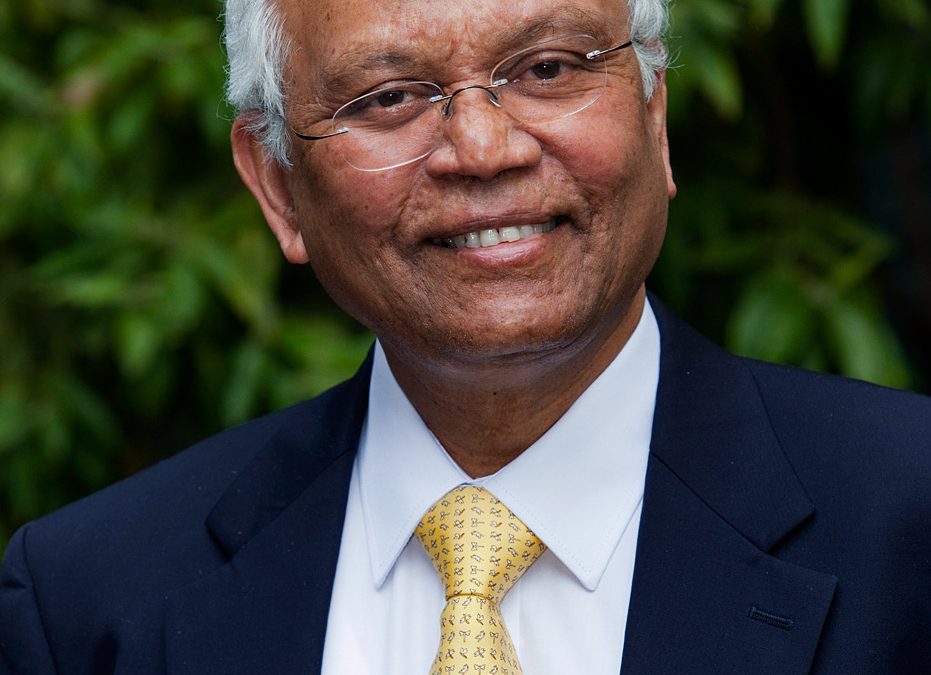
Featured image: R. A. Mashelkar in April 2008. Photo by Fir0002, licensed under GFDL 1.2, via Wikimedia Commons.