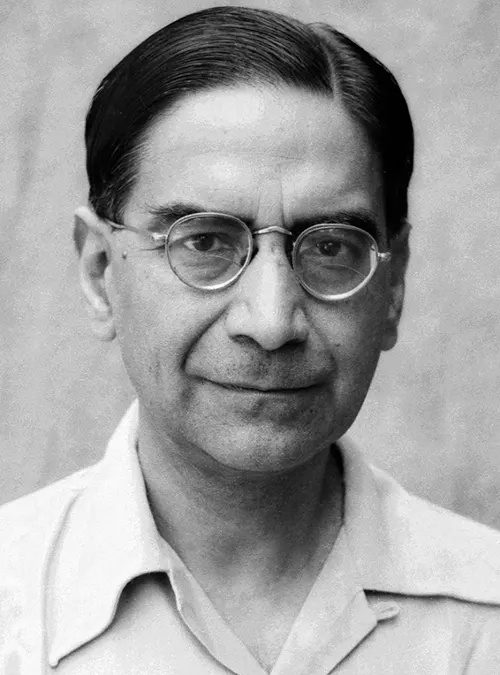
Prasanta Chandra Mahalanobis (29 June 1893 – 28 June 1972) was an Indian scientist and statistician. He devised the statistical measure known as the Mahalanobis distance, pioneered large-scale sample surveys, founded the Indian Statistical Institute, and designed the strategy of the Second Five-Year Plan. His birthday is observed in India as National Statistics Day.
Quick Facts
| Full name | Prasanta Chandra Mahalanobis |
| Born | 29 June 1893, Calcutta |
| Died | 28 June 1972, Calcutta (aged 78) |
| Field | Statistics, physics, economic planning |
| Education | Presidency College, Calcutta (B.Sc., 1912); King’s College, Cambridge |
| Known for | Mahalanobis distance; sample surveys; Indian Statistical Institute; the Mahalanobis model of planning |
| Positions | Founder, Indian Statistical Institute (1931); Member, Planning Commission (1955–1967) |
| Honours | Fellow of the Royal Society (1945), Padma Vibhushan (1968) |
| Spouse | Nirmal Kumari (Rani) Mahalanobis (m. 1923) |
Early Life
He was born in Calcutta into a prosperous family active in the Brahmo Samaj, the reform movement. He studied at the Brahmo Boys’ School and at Presidency College, where Jagadish Chandra Bose and Prafulla Chandra Ray taught, graduating with honours in physics in 1912.
Cambridge
He went to England in 1913 and, after missing a train, was persuaded by a friend to apply to King’s College, Cambridge. He took the Tripos in mathematics and physics with first-class honours in the latter. Waiting for a ship home, he came upon volumes of the statistical journal Biometrika in the college library, bought a complete set and read it on the voyage. It turned him towards statistics.
Career
Presidency College
He taught physics at Presidency College for three decades, becoming its principal. Statistics he pursued in a room of the physics department, which he called the Statistical Laboratory.
The Mahalanobis distance
Asked to analyse body measurements of the Anglo-Indians of Calcutta, he developed a way of measuring how far apart two groups are when many characteristics are considered together. Published in its general form in 1936, the Mahalanobis distance is now a standard tool in statistics and in machine learning.
The Indian Statistical Institute
He founded the Indian Statistical Institute on 17 December 1931 and started its journal, Sankhya, in 1933. It moved to Baranagar on the edge of Calcutta, drew students and visitors from around the world, and in 1959 was declared an institution of national importance by Parliament.
Sample surveys
He showed that well-designed random samples could give reliable estimates at a fraction of the cost of a full count. His surveys of the jute crop in Bengal introduced the pilot survey and other methods that were adopted worldwide. He also analysed sixty years of flood and rainfall records for the Orissa rivers, work that led to the Hirakud dam. In 1950 he set up the National Sample Survey, which has measured Indian living standards ever since.
Planning
A friend and adviser of Jawaharlal Nehru, he joined the Planning Commission in 1955. His model for the Second Five-Year Plan (1956–61) put investment in heavy industry such as steel and machine building first, on the argument that a poor country must make its own capital goods to grow. It shaped Indian economic policy for three decades and has been both admired and blamed for the neglect of agriculture and consumer goods.
Tagore
He was close to Rabindranath Tagore, served as secretary of Visva-Bharati for a decade and travelled with the poet abroad.
Personal Life
He married Nirmal Kumari, known as Rani, in 1923, against the wishes of her father. They had no children. He died in Calcutta in 1972, a day before his seventy-ninth birthday.
Featured image: Prasanta Chandra Mahalanobis. Photo by an unknown photographer, in the public domain, via Wikimedia Commons.