
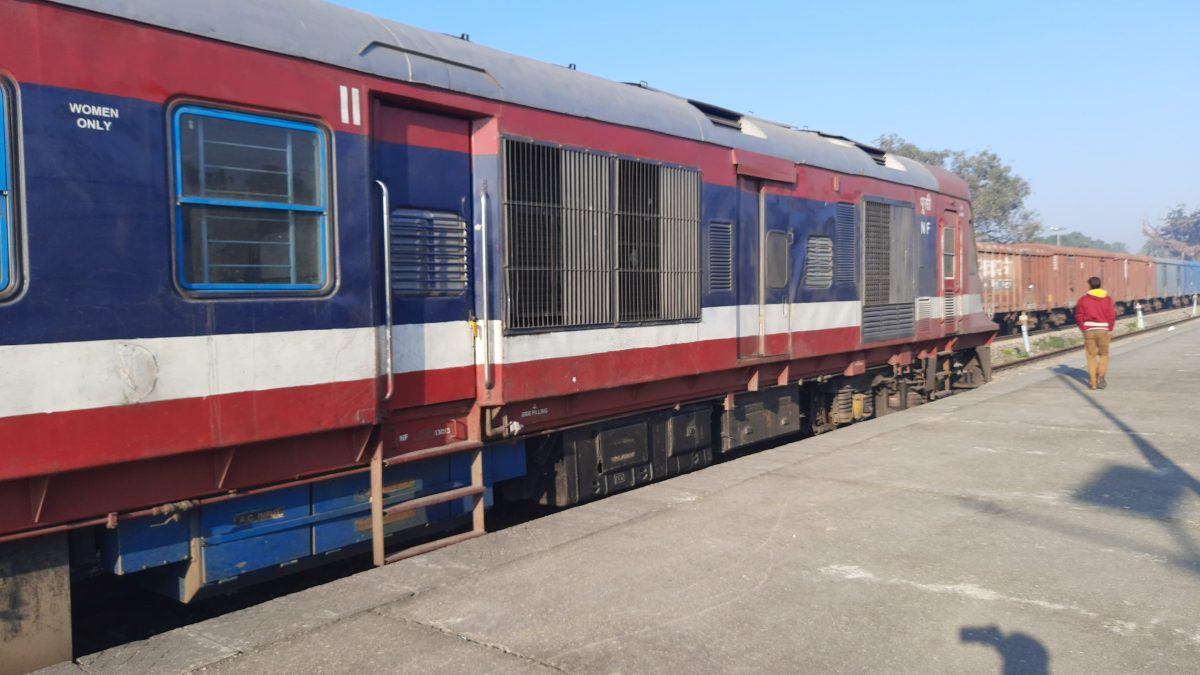
Indian Railways has put into service the country’s first train powered partly by liquefied natural gas. The eight-coach train was flagged off by the Union Home Minister, Amit Shah, from Sabarmati station in Ahmedabad on 27 September 2026, and runs between Sabarmati and Mahesana Junction in Gujarat.
What kind of train it is
The train is a diesel-electric multiple unit, or DEMU, the self-propelled type used on many short-distance passenger routes. Its two driving power cars, each of 1,400 horsepower, have been converted to run on a mixture of LNG and diesel, an arrangement known as dual-fuel.
How it works
- Natural gas is cooled until it becomes liquid, which makes it compact enough to carry on a train. Each power car has a tank holding about 2,200 litres of LNG.
- The engine burns gas together with a smaller quantity of diesel. According to the published specifications, LNG replaces about 40 per cent of the diesel the train would otherwise use, with no loss of engine power.
- If LNG is not available, the train can run on diesel alone.
What it saves
The Railways estimate the saving in fuel cost at about Rs 11.9 lakh a year for each power car, or roughly Rs 23.9 lakh a year for an eight-coach train with two converted cars. Natural gas also produces less carbon dioxide, soot and nitrogen oxides than diesel when burned.
The two converted power cars were tested over more than 2,000 kilometres before being cleared for passenger service.
Why bother, when the network is electrified?
Indian Railways has electrified almost all of its broad-gauge network. But a fleet of diesel trains and locomotives remains in use, on branch lines, for shunting and as a reserve, and these will run for years to come. Converting them to dual fuel is a way of cutting their fuel bill and emissions without replacing them.
Further conversions are expected to depend on how the first train performs. Gujarat, which has LNG import terminals at Dahej, Hazira and Mundra and an extensive gas grid, was a natural place to begin.
Other clean-fuel projects
The Railways are also testing a hydrogen-powered train and have set a target of becoming a net-zero carbon emitter by 2030.
Technical details and savings estimates are as reported by Indian Infrastructure, ESG News and HelloRail from the Railways’ announcement.
Image: A diesel-electric multiple unit (DEMU) power car of Indian Railways (file photo; not the LNG train). Photo by 2006nishan178713, licensed under CC BY-SA 4.0, via Wikimedia Commons.

Leave a Reply