Dutee Chand (born 3 February 1996) is an Indian sprinter from Odisha, the holder of the national record in the women’s 100 metres. She won silver medals in the 100 and 200 metres at the 2018 Asian Games. She is known as much for a legal battle as for her running: barred from competition in 2014 under rules on naturally high testosterone, she challenged them at the Court of Arbitration for Sport and won. She is serving a four-year suspension for a doping offence.
Quick Facts
| Full name | Dutee Chand |
| Born | 3 February 1996, Chaka Gopalpur, Jajpur district, Odisha |
| Age | 30 |
| State | Odisha |
| Sport | Athletics (100 metres, 200 metres) |
| National record | 100 metres, 11.17 seconds (2021) |
| Major medals | Asian Games silver, 100 m and 200 m (2018); World University Games gold, 100 m (2019) |
| Olympics | 2016, 2020 |
| Awards | Arjuna Award (2020) |
Early Life
She was born in the village of Chaka Gopalpur, on the bank of the Brahmani river, the third of seven children of a couple who wove cloth on handlooms and lived below the poverty line. Her elder sister, Saraswati, a runner, took her to train on the riverbank, barefoot, when she was about four. Sport, the sister told her, was a way to a government job.
She was admitted to a government sports hostel in 2006.
Career
Junior success
She became the national under-18 champion in the 100 metres in 2012 and, in 2013, the first Indian sprinter to reach the final of a global athletics event, at the World Youth Championships. She won two gold medals at the Asian Junior Championships in 2014.
The case
In July 2014, days before the Commonwealth Games, she was dropped from the Indian team. Tests had shown that her body naturally produced testosterone above the limit then set for women by the international athletics federation. She was told she could return only if she lowered it by medication or surgery.
She refused, and appealed to the Court of Arbitration for Sport. In July 2015 the court suspended the rule, finding that the federation had not shown that naturally high testosterone gave women the degree of advantage that would justify excluding them. She was free to run. The federation later brought in new rules confined to certain middle-distance events, which did not cover hers.
Medals
- **2016:** she qualified for the 100 metres at the Rio Olympics, the first Indian woman to do so in thirty-six years
- **2018:** silver medals in the 100 and 200 metres at the Asian Games in Jakarta, India’s first medal in the women’s 100 metres in twenty years
- **2019:** gold in the 100 metres at the World University Games in Naples, the first Indian woman to win a track gold medal at those Games
- **2021:** a national record of 11.17 seconds, and a place at the Tokyo Olympics
Personal Life
In May 2019 she said publicly that she was in a relationship with a woman from her village, becoming the first Indian sportsperson to speak openly of being in a same-sex relationship. Members of her family opposed it, and she spoke of pressure and threats. She has continued to speak for the rights of gay people in India.
Doping Ban
Samples taken from her out of competition in December 2022 were found to contain prohibited substances of the class known as selective androgen receptor modulators. She said she had taken them unknowingly, on medical advice for an injury. In August 2023 the national anti-doping agency’s disciplinary panel suspended her for four years, counted from 3 January 2023, and her appeal was dismissed. The suspension runs until January 2027.
Place in Sport
Her case changed the rules of world athletics and began an argument, still unsettled, about how sport should classify women athletes with natural variations in sex characteristics. In India she showed that a girl from a weaver’s hut could reach an Olympic start line.
Odisha’s other sporting names include the hockey player Dilip Tirkey.
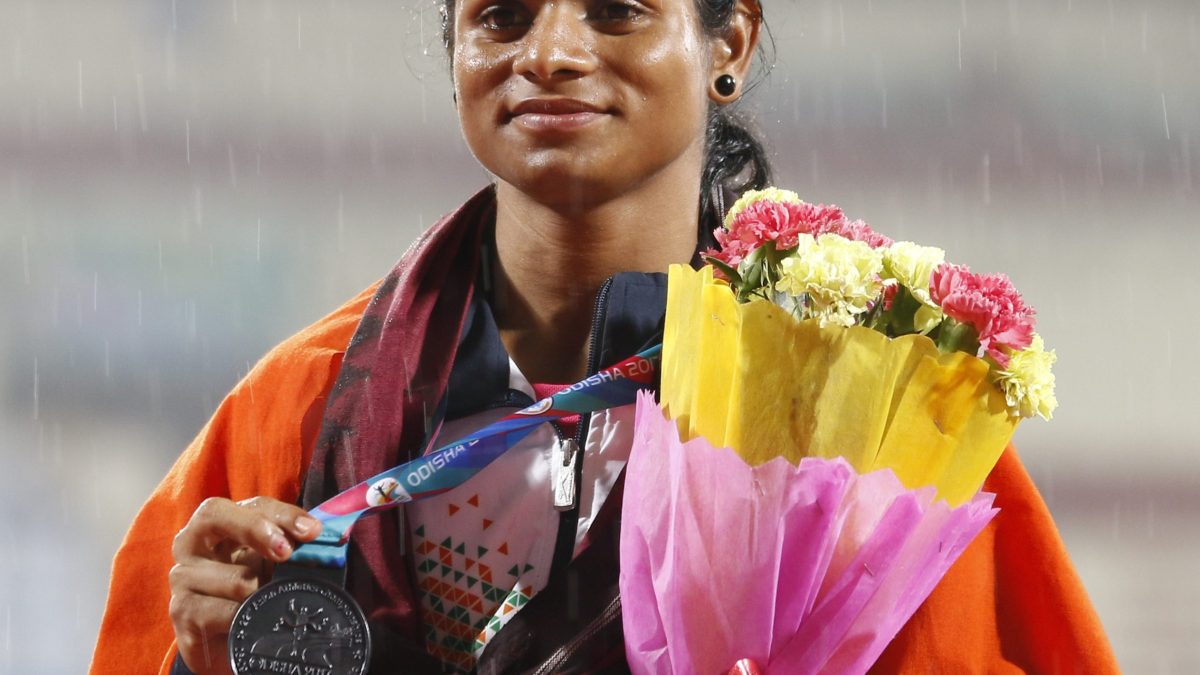
Featured image: Dutee Chand at the Asian Athletics Championships in Bhubaneswar, July 2017. Photo by Athletics Federation of India, licensed under CC BY-SA 4.0, via Wikimedia Commons.