Bhaichung Bhutia (born 15 December 1976) is a former Indian footballer who captained the national team for more than a decade and is widely regarded as the face of Indian football of his era. A quick, sharp striker nicknamed the “Sikkimese Sniper”, he was the first Indian to sign a professional contract with a European club when he joined Bury FC in England in 1999. He was the first Indian to play 100 international matches and led India to three Nehru Cup and AFC Challenge Cup titles between 2007 and 2009.
Quick Facts
| Full name | Bhaichung Bhutia |
| Born | 15 December 1976, Tinkitam, South Sikkim, India |
| Age | 49 |
| Position | Striker |
| India career | 1995–2011 |
| Clubs | East Bengal, JCT Mills, Bury FC, Mohun Bagan, Perak FA, Selangor MK Land, United Sikkim |
| Known as | Sikkimese Sniper |
| Children | 3 |
| Honours | Arjuna Award (1998), Padma Shri (2008), Banga Bhushan (2014) |
Early Life
Bhutia was born in Tinkitam, a village in South Sikkim, to a farming family. He played football, badminton, basketball and athletics at school. At nine he won a Sports Authority of India scholarship to the Tashi Namgyal Academy in Gangtok. His performance at the 1992 Subroto Cup, where he was named best player, brought him to the notice of the former India goalkeeper Bhaskar Ganguly, who helped him move to Calcutta.
Club Career
Bhutia joined East Bengal in 1993 at 16. He moved to JCT Mills in Punjab in 1995 and helped them win the first National Football League in 1996–97, finishing as top scorer. Back at East Bengal, he scored a hat-trick against Mohun Bagan in the 1997 Federation Cup semi-final, the first in the Kolkata derby. In 1999 he signed for Bury in England’s third tier, playing there for three seasons. He later had spells with Mohun Bagan and with clubs in Malaysia, and he led East Bengal to the ASEAN Club Championship in 2003. He founded the club United Sikkim in 2011.
International Career
Bhutia made his India debut in the Nehru Cup in 1995, aged 18, and scored against Uzbekistan in the same tournament. He became captain and the team’s main goalscorer, a role later taken over by Sunil Chhetri. Under the English coach Bob Houghton, India won the Nehru Cup in 2007 and 2009 and the AFC Challenge Cup in 2008, which took them to the 2011 Asian Cup, their first in 27 years. Bhutia played his 100th international in 2009 and retired from the national team in August 2011. In 2008 he refused to carry the Olympic torch in India in support of the Tibetan cause.
After Football
He runs the Bhaichung Bhutia Football Schools, a network of academies across India. In 2009 he won the television dance contest Jhalak Dikhhla Jaa. He entered politics with the Trinamool Congress, contesting the 2014 Lok Sabha election from Darjeeling, and in 2018 he founded the Hamro Sikkim Party; he has contested several elections in West Bengal and Sikkim without winning. In 2022 he stood for president of the All India Football Federation and lost to Kalyan Chaubey.
Personal Life
Bhutia married Madhuri Tipnis in 2004; they have three children and divorced in 2015. A stadium in Namchi, Sikkim, is named after him.
Awards and Honours
Frequently Asked Questions
When and where was Bhaichung Bhutia born?
Bhaichung Bhutia was born on 15 December 1976 in Tinkitam, South Sikkim, India and is 49 years old.
What honours has Bhaichung Bhutia received?
Arjuna Award (1998), Padma Shri (2008), Banga Bhushan (2014).
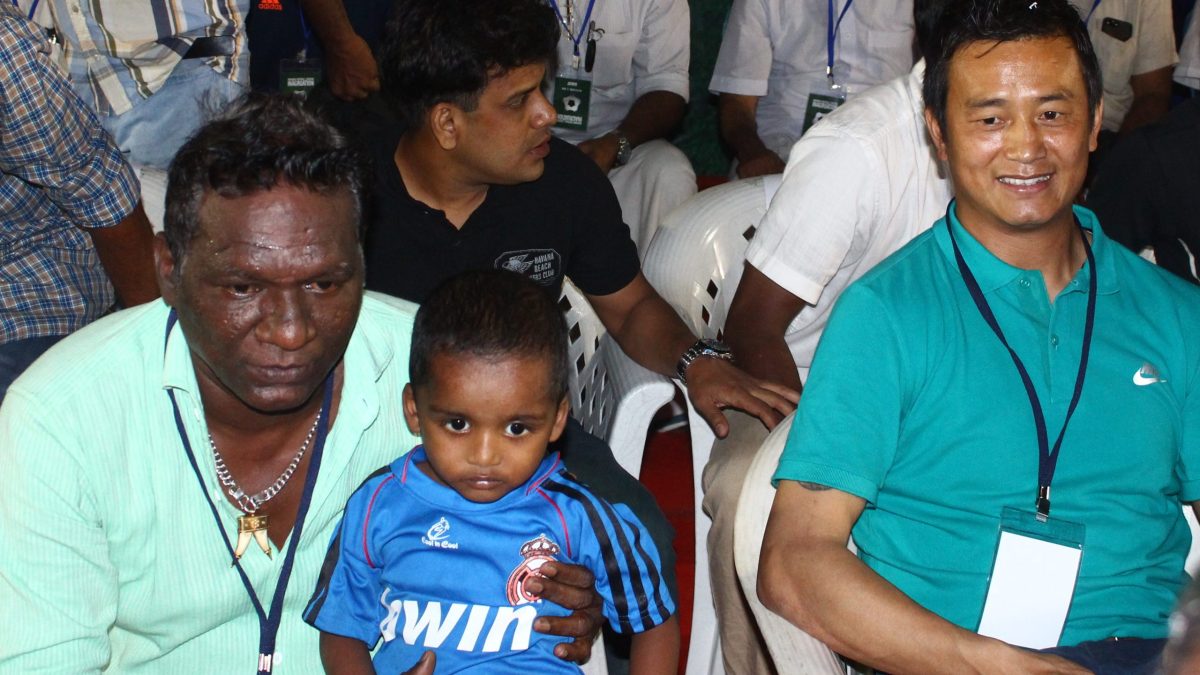
Featured image: Bhaichung Bhutia (right) with former India striker I. M. Vijayan (left) at the inauguration of a football stadium in Palakkad, Kerala, April 2017. Photo by Arkarjun, licensed under CC BY-SA 4.0, via Wikimedia Commons.