
The Rajya Sabha, India’s upper house, has 245 members, and a share of them retire every two years, so each year brings a series of elections held in rounds as terms end. The 2026 cycle, as listed by Wikipedia, has four rounds: 16 March, 18 June, 24 July and 16 October. A separate search summary says that the elections cover 72 of the 245 members, while another page on the 2026 elections in India puts the number of seats contested at 74, so the total depends on how by-elections and vacancies are counted.
The March round covered 37 seats in 10 states, including Bihar, Haryana and Odisha where polling was held, and the rest were elected unopposed, with 26 of the 37 seats going without a contest, according to Wikipedia. Other states mentioned in a Quint report on that round include Maharashtra, Tamil Nadu, West Bengal, Assam, Chhattisgarh, Telangana and Himachal Pradesh. In the contests, the BJP gained seats in Bihar and Odisha, the Trinamool Congress lost West Bengal seats to the BJP and an independent, Dilip Ray, won a seat in Odisha.
A search summary of another report says that the NDA won 8 of 11 contested seats in Bihar and Odisha in March and that counting for two Haryana seats was put on hold. This detail comes from a single summary that was not read in full, and it should be checked against the Election Commission’s results.
The June round was for 24 seats across 10 states, and the 24 July round was for three by-elections, all of which were elected without a contest. The final round is on 16 October, with 11 regular seats from Uttar Pradesh and Uttarakhand and a by-election in West Bengal, which IndiaX24 covers in a separate article.
The party position is given in a tally that Wikipedia lists after these elections. The NDA is shown with 137 seats, which is a gain of 54 in the cycle according to the article, with the BJP on 38 seats in the cycle’s count, a gain of 8, and allied parties holding 16. The INDIA bloc is shown with 62 seats, a gain of 19, including the Congress with 11, a gain of 3, and the Trinamool Congress with 4, a loss of 3. Others are shown with 6 seats, a loss of 7. The article does not state the date of the tally, and the figures for the BJP and allies appear to be the seats won in the cycle and not the total strength of the house, so they should be read with care.
Another page on the 2026 elections says that the NDA maintained control of the house and gained 13 net seats across 74 contested seats. The two descriptions are not the same and the sources reviewed do not reconcile them, so the net gain of 13 and the gain of 54 should not be mixed up. The first measures the change in the NDA’s seats in the house, while the second seems to measure seats won in the cycle.
The Rajya Sabha is not elected directly by voters. Its members are chosen by the members of state assemblies, and the party strength in each assembly largely decides the result. That is why the state elections in the spring of 2026, in West Bengal, Tamil Nadu, Kerala and Assam, matter for the upper house in the coming years, as seats fall vacant and new assemblies elect the successors.
For the government, a majority in the upper house is needed for ordinary legislation, but a constitutional amendment needs a two-thirds majority in both houses. The failure of the 131st Amendment Bill in the Lok Sabha in April shows that a majority in one house is not enough.
The figures in the tally will change as the October results are declared, and readers should consult the Rajya Sabha Secretariat’s party position for the exact numbers.
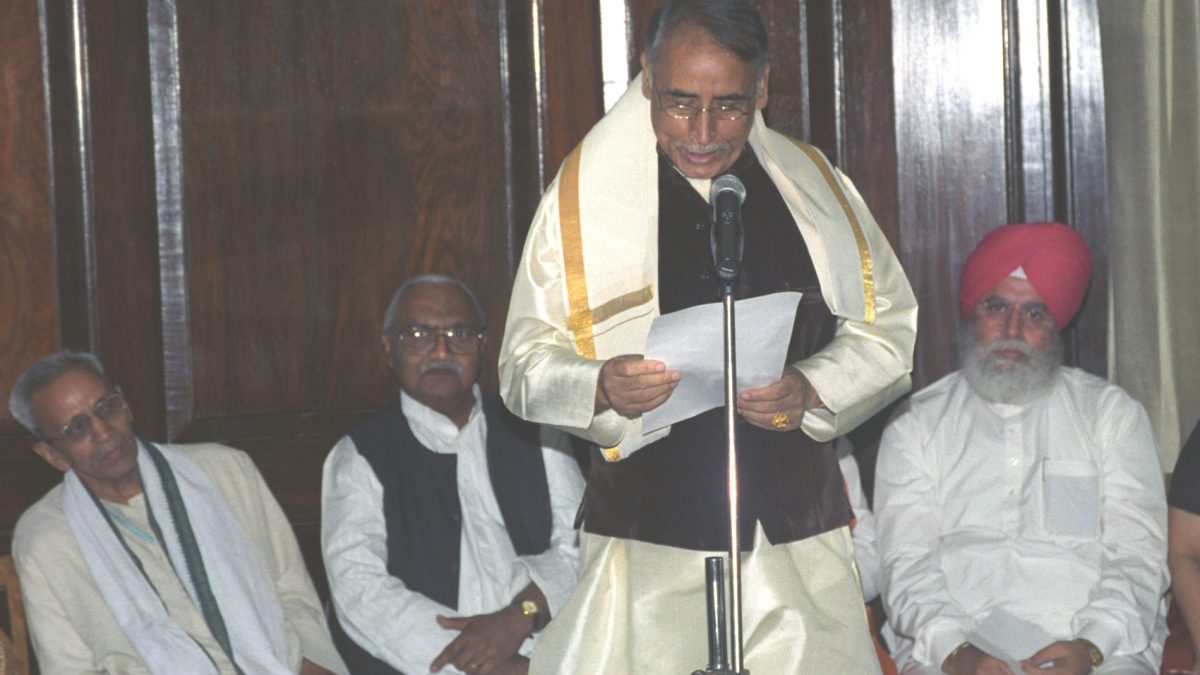
Featured image: A newly elected Rajya Sabha member taking oath at Parliament House, New Delhi, April 2006 (file photo). Photo by Ministry of Parliamentary Affairs, licensed under Government Open Data License – India, via Wikimedia Commons.




Leave a Reply