
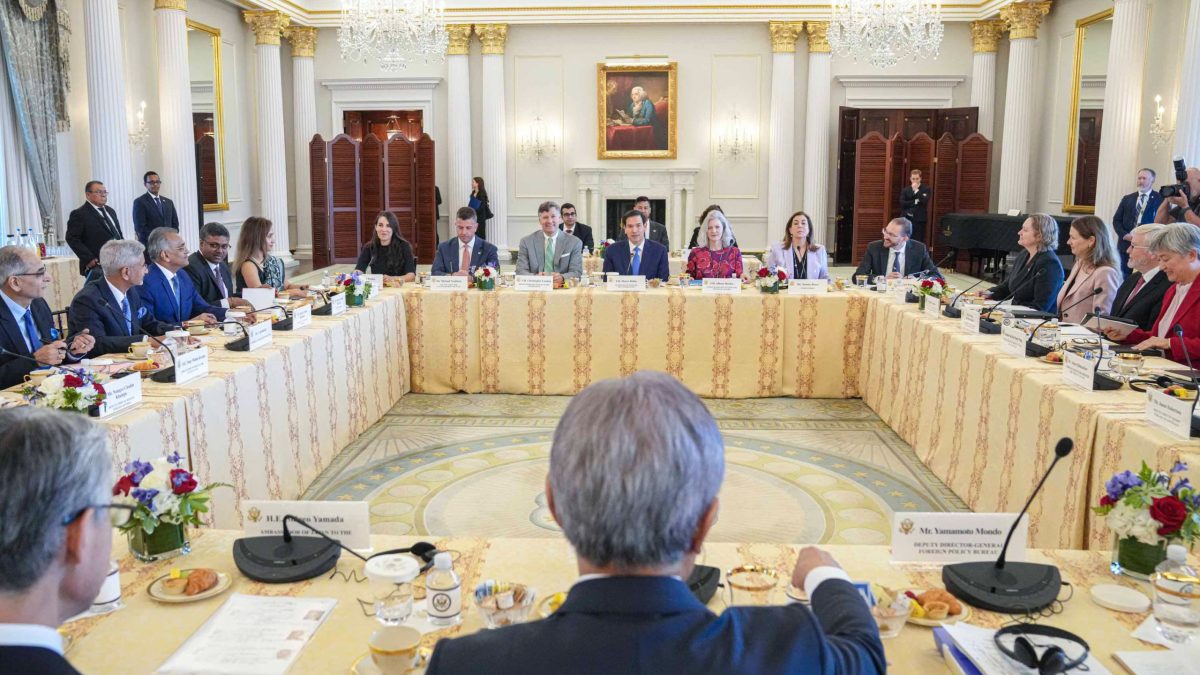
India was due to host the leaders’ summit of the Quad, the grouping of India, the United States, Japan and Australia, in 2025, but the meeting did not take place. Foreign Policy reported in April 2026 that President Donald Trump had refused to take part in the Quad since returning to office, and that his decision to skip the Indian summit involved demands for a new US-India trade agreement and personal grievances with Prime Minister Narendra Modi. The Quad was created largely to balance China in the Indo-Pacific, so a grouping without its most powerful member at the top level loses much of its weight.
The friction between the partners helps to explain the silence. According to Foreign Policy, Japan faced unexpected 24 percent US tariffs and demands to spend 3.5 percent of its gross domestic product on defence, Australia expressed disappointment over tariffs despite a US trade surplus, and India faced a tariff dispute and differences over Washington’s Pakistan policy. Japan’s then prime minister said in May 2025 that its defence budget should not be decided on what others tell it to do. The Conversation argued that tariffs and warmer India-China ties had silenced the partnership for now.
The grouping has not collapsed. On 26 May 2026, foreign ministers of Australia, India and Japan, and US Secretary of State Marco Rubio, met in New Delhi at India’s invitation. According to the joint statement published by the US State Department, they discussed the Middle East, navigation rights in the Strait of Hormuz and the Red Sea, undersea cable security, biomanufacturing, pharmaceutical supply chains and humanitarian assistance. The Stimson Center described the outcome as a more streamlined and focused Quad. A maritime awareness initiative was also reported to be operating at India’s Information Fusion Centre in Gurugram.
Whether leaders will meet is still unclear. Australia holds the 2026 rotating chair and was reported to be considering hosting a summit later in the year, but Foreign Policy warned that if Trump declines again the Quad could be left with little geopolitical importance. India has an interest in keeping the format alive, since it is one of the few platforms where it sits alongside Washington, Tokyo and Canberra as an equal. At the same time, New Delhi has strengthened its other relationships, including with China and Russia, and does not want to rely on any one partner.
For India, the Quad’s recent history is a lesson in how a security partnership can be affected by trade disputes. The joint statement of the foreign ministers’ meeting shows continued practical cooperation, but it is not a substitute for a leaders’ summit that signals political commitment. Both can be true: the practical programmes on maritime awareness, cables and supply chains continue, while the leader-level momentum that marked the Quad’s early years has not returned. The coming months will show whether Washington wants that momentum back, and whether Australia can bring the four leaders together at last.
Featured image: US Secretary of State Marco Rubio meets the foreign ministers of the Quad at the State Department in Washington, 1 July 2025. Photo by U.S. Department of State, in the public domain, via Wikimedia Commons.




Leave a Reply