
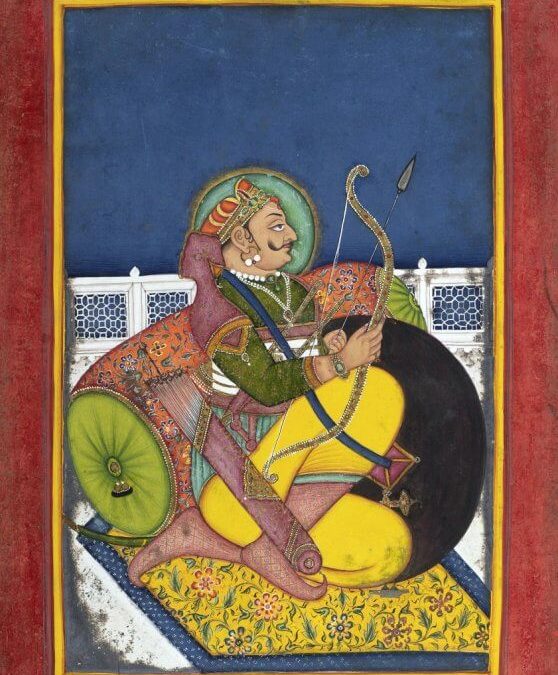
Prithviraj Chauhan (about 1166 – 1192), known to historians as Prithviraja III, was a king of the Chahamana, or Chauhan, dynasty who ruled a large part of north-western India from Ajmer. He defeated the invading army of Muhammad of Ghor in 1191 and was defeated by it in 1192, a battle that opened north India to Turkish rule. In legend and popular memory he is the last great Hindu king of Delhi.
Quick Facts
| Also known as | Prithviraja III; Rai Pithora |
| Born | about 1166 |
| Died | 1192 |
| Dynasty | Chahamana (Chauhan) of Shakambhari |
| Reign | about 1177–1192 |
| Capital | Ajmer |
| Father | Someshvara |
| Known for | The Battles of Tarain (1191, 1192) |
| Sources | Prithviraja Vijaya; Prithviraj Raso |
Early Life
He was the son of King Someshvara and Queen Karpuradevi, a princess of the Kalachuri family, and was born in Gujarat, where his father was then living at the Chaulukya court. Someshvara became king at Ajmer and died about 1177. Prithviraj, a boy of about eleven, succeeded him, with his mother as regent and a council of ministers.
A Sanskrit poem written at his court, the Prithviraja Vijaya, says he mastered several languages and was skilled in archery, a point on which all the traditions agree.
The Kingdom
The Chahamanas had risen over two centuries to rule much of what is now Rajasthan, Haryana and Delhi; an ancestor had taken Delhi from the Tomaras. The fort in Delhi called Qila Rai Pithora bears his name.
Early Wars
- **A rebel cousin:** on taking power he put down a revolt by his cousin Nagarjuna
- **The Bhadanakas:** he subdued this people in the region south-west of Delhi
- **The Chandelas:** around 1182 he invaded the Chandela kingdom of Bundelkhand and sacked Mahoba. The defence by the brothers Alha and Udal is the subject of a famous cycle of Hindi ballads.
- **The Chaulukyas:** an inconclusive war with Gujarat ended in a treaty about 1187
- **The Gahadavalas:** he was on bad terms with Jayachandra, king of Kannauj, his neighbour to the east
These wars among the Rajput kingdoms left them unwilling to combine when a greater danger appeared.
Tarain
Muhammad of Ghor, having taken Punjab from the last Ghaznavid ruler, seized a fort in Prithviraj’s territory. In 1191 Prithviraj met him at Tarain, in present-day Haryana, routed his army and nearly killed him. He did not follow up the victory. In 1192 Muhammad returned with a larger and better-organised force and new tactics, and the Chauhan army was destroyed. The fighting is described in the Battles of Tarain.
Death
Prithviraj was captured as he fled. Coins exist that carry his name on one side and the sultan’s on the other, which suggests that he was at first kept on his throne as a vassal. He was soon accused of conspiracy and put to death. His son Govindaraja was installed at Ajmer under Ghurid authority and later moved to Ranthambore, where the family ruled for another century.
The Legend
The Prithviraj Raso, a long Hindi poem attributed to his court bard Chand Bardai but composed in its present form centuries later, tells a different story: his love for Samyukta, the daughter of Jayachandra, whom he carried off from her father’s court; Jayachandra’s revenge in inviting the invader; and the blinded king, taken to Ghazni, killing the sultan with an arrow aimed by sound before dying with his bard. None of this is supported by contemporary evidence, and Muhammad of Ghor in fact died in 1206.
Legacy
The legend proved stronger than the history. Rajput houses traced their honour to him, and in the nineteenth and twentieth centuries he became a national hero. Historians see a brave and energetic king who underestimated his enemy. His memorial stands at Ajmer.
Featured image: Prithviraj Chauhan, in a later painting from Kota. Photo by an unknown artist, in the public domain, via Wikimedia Commons.



