
Shammi Kapoor, born Shamsher Raj Kapoor on 21 October 1931 and died on 14 August 2011, was an Indian actor known for his work in Hindi cinema. In a career of more than five decades he worked in over 100 films and received three Filmfare Awards, including one for Best Actor. He is regarded as one of the greatest actors in the history of Indian cinema and was widely considered among the best dancers of his time.
He was born in a Punjabi Hindu family in Bombay to Prithviraj Kapoor and Ramsharni Mehra Kapoor, and was the second of three sons, with Raj Kapoor and Shashi Kapoor as his brothers. His nephews include Randhir, Rishi and Rajiv Kapoor, and his grand-nephew is Ranbir. Though born in Mumbai, he spent much of his childhood in Calcutta, where his father worked at New Theatres Studios, and he did his Montessori education and kindergarten there. After returning to Bombay, he went to St. Joseph’s Convent in Wadala, Don Bosco School and New Era School.
After a short stint at Ramnarain Ruia College, he joined his father’s theatre company, Prithvi Theatres. He entered cinema in 1948 as a junior artiste on a salary of Rs 50 a month, stayed with Prithvi Theatres for four years and collected his last paycheck of Rs 300 in 1952. His debut in Hindi films came in Jeewan Jyoti (1953), directed by Mahesh Kaul, with Chand Usmani as his first heroine.
His early career was unsuccessful. He played second fiddle to established actresses, with Madhubala in Rail Ka Dibba and Naqab, with Nutan in Laila Majnu, with Shyama in Thokar and Mirza Sahiban, with Suraiya, and with Meena Kumari in Mem Sahib (1956). None of his films from 1953 to 1957 made him popular. His first major success was Nasir Hussain’s Tumsa Nahin Dekha (1957), and with Dil Deke Dekho (1959) he acquired the image of a light-hearted, stylish playboy. The blockbuster Junglee (1961) cemented it.
Through the 1960s he was one of Bollywood’s most marketable stars, in romantic comedies and musical thrillers such as Professor, Dil Tera Diwana, China Town, Rajkumar, Kashmir Ki Kali, Bluff Master, Janwar and Teesri Manzil (1966), as well as An Evening in Paris (1967), Brahmachari (1968) and Prince (1969). Mohammed Rafi was frequently his playback voice and contributed to the success of his films. He was paired with newcomers such as Asha Parekh, Saira Banu, Sharmila Tagore and Sadhana, who all went on to successful careers. In 1968 he won the first Filmfare Award for Best Actor of his career for Brahmachari.
He was the only dancing hero in Hindi films from the late 1950s to the early 1970s. He composed the dance steps for his songs and reportedly never needed a choreographer, which earned him the name “Elvis Presley of India”. In the 1970s his weight became an obstacle to romantic roles, and Andaz (1971), with Rajesh Khanna and Hema Malini, was his last such film. Chhote Sarkar (1974) was his last lead.
He became a successful supporting actor, playing Saira Banu’s father in Zameer (1975), though he had been her leading man in Junglee and Bluff Master, and Vinod Khanna’s father in Parvarish (1977). He directed Manoranjan (1974), inspired by Irma la Douce, and Bundal Baaz (1976), which were commercially unsuccessful but won praise as ahead of their time. In the 1980s he appeared in Prem Rog, Hero, Betaab and Vidhaata, which won him the Filmfare Award for Best Supporting Actor, and his final film was Rockstar (2011), the year he died.
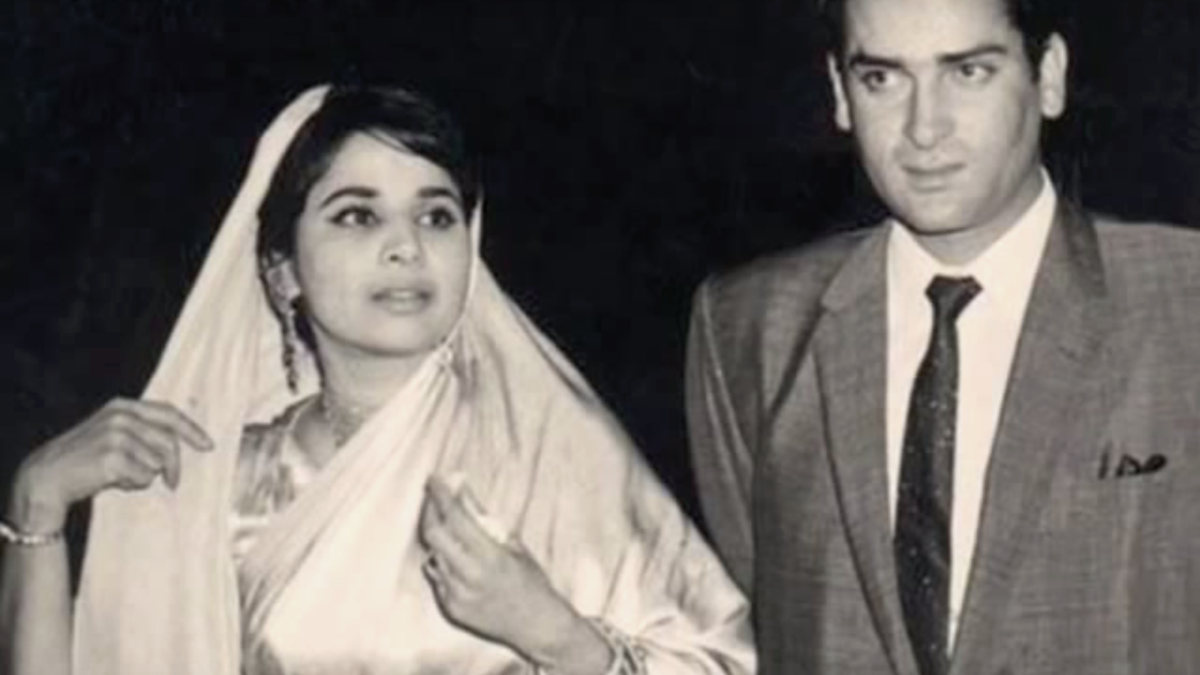
Featured image: Shammi Kapoor with Geeta Bali, whom he married in 1955 (file photo). Photo by Amarjit Chandan, licensed under CC BY 4.0, via Wikimedia Commons.



