
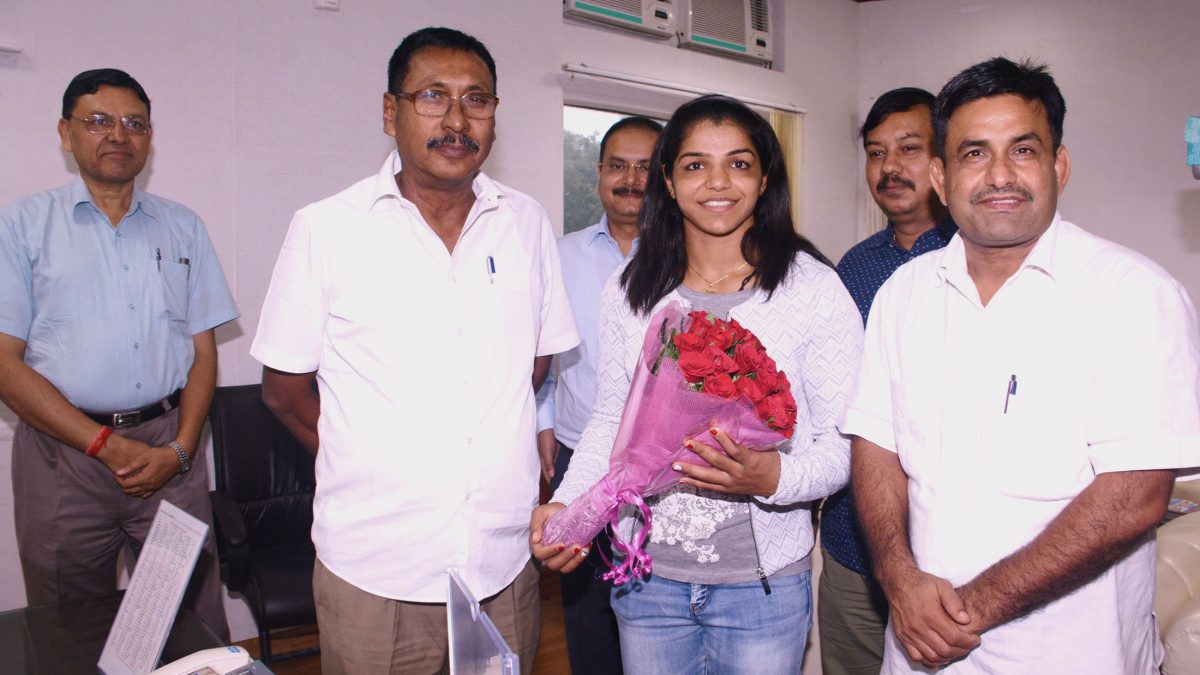
Sakshi Malik, born on 3 September 1992 in Mokhra village in Haryana’s Rohtak district, is a former Indian freestyle wrestler. At the 2016 Rio Olympics she won the bronze medal in the 58 kg category, becoming the first Indian woman wrestler to win an Olympic medal. She received the Khel Ratna, India’s highest sporting honour, in 2016, and the Padma Shri in 2017, and in 2024 she became the first Indian wrestler to feature in Time magazine’s list of the 100 most influential people.
Her father, Sukhbir, was a bus conductor with the Delhi Transport Corporation, and her mother, Sudesh, was a supervisor at a local health clinic. According to her father, she was inspired to take up wrestling by her grandfather, Badlu Ram, who was also a wrestler. She began training at 12 under the coach Ishwar Dahiya at an akhara in the Chhotu Ram Stadium in Rohtak. Her first international success came in 2010, when she won bronze in the 58 kg freestyle at the Junior World Championships, and in 2014 she won gold in the 60 kg category at the Dave Schultz International Tournament.
At the 2014 Glasgow Commonwealth Games, she won her quarter-final against Edwige Ngono Eyia of Cameroon 4–0 and her semi-final against Canada’s Braxton Stone 3–1, before losing the final 4–0 to Nigeria’s Aminat Adeniyi, which gave her a silver medal. At the 2014 World Championships in Tashkent, she won her Round-of-16 bout against Senegal’s Anta Sambou but then lost 1–3 to Finland’s Petra Olli. In 2015, at the Asian Championships in Doha, she took a bronze medal in the 60 kg category after losing her first bout but fighting back.
She qualified for Rio by defeating China’s Zhang Lan in the semi-final of the Olympic World Qualifying Tournament in May 2016. In Rio she beat Sweden’s Johanna Mattsson in the Round of 32 and Moldova’s Mariana Cherdivara in the Round of 16, and lost the quarter-final to Russia’s Valeria Koblova, the eventual finalist, which sent her to the repechage. There she beat Mongolia’s Purevdorjiin Orkhon, and in the bronze-medal match she beat the reigning Asian champion Aisuluu Tynybekova of Kyrgyzstan 8–5, after trailing 0–5 at one stage. It was India’s first Olympic medal in women’s wrestling.
After Rio she played for Colors Delhi Sultans in the 2017 Pro Wrestling League and appeared in a women’s day campaign called #EveryWomanStrong for her sponsor JSW Group. She married the wrestler Satyawart Kadian on 2 April 2017. She works for Indian Railways in the commercial department of its Delhi division, where she was promoted from senior clerk to a gazetted officer after Rio. She has a master’s degree in physical education from Maharshi Dayanand University in Rohtak, and in September 2016 was named the university’s wrestling director.
In 2022 she won a bronze medal at the Tunis Ranking Series and then the gold medal at the Birmingham Commonwealth Games. In January 2023 she joined other wrestlers, including Vinesh Phogat, in a protest in which they accused Brij Bhushan Sharan Singh, a Lok Sabha member and the president of the Wrestling Federation of India, of sexual and mental harassment. The government promised an oversight committee, which led the wrestlers to end the protest in January 2023. They returned to protests in April 2023, claiming that nothing was being done. In December 2023, after a close associate of Singh was elected head of the federation, Malik announced her retirement from wrestling. In November 2024 she gave birth to a daughter.
Her honours include the Khel Ratna, the Padma Shri and cash prizes totalling more than Rs 5.7 crore. She remains a symbol of what women’s wrestling achieved after Rio, and her bronze medal opened the way for many younger wrestlers from Haryana.
Featured image: Sakshi Malik meeting Minister of State for Railways Rajen Gohain after her Rio Olympic bronze medal, August 2016 (file photo). Photo by Ministry of Railways, licensed under Government Open Data License – India, via Wikimedia Commons.



