



The Pallavas ruled much of southern India from Kanchipuram between the third and ninth centuries CE. They rose after the fall of the Satavahanas, whom they had served as feudatories, and for about six centuries they were a major power in the Telugu country and the northern Tamil region. They are remembered above all for the rock-cut temples and sculptures of Mahabalipuram, which are now a World Heritage Site.
Quick Facts
| Period | c. 275–897 CE |
| Capital | Kanchipuram |
| Great rulers | Mahendravarman I, Narasimhavarman I (Mamalla), Narasimhavarman II (Rajasimha) |
| Famous for | Mahabalipuram monuments, Kailasanathar temple, Pallava script |
| Rivals | Chalukyas of Badami; Cholas and Pandyas |
| End | Defeated by the Chola ruler Aditya I in the 9th century |
Rise to Power
The origins of the dynasty are debated. Copper-plate grants of Sivaskandavarman from the early fourth century, issued from Kanchipuram, are among the first records. The Pallavas became a major southern power during the reign of Mahendravarman I (600–630) and Narasimhavarman I (630–668), and remained in conflict with the Chalukyas of Badami to the north and the Chola and Pandya kingdoms of the Tamil south.
Mahendravarman and Narasimhavarman
Mahendravarman I was a soldier, a poet and a playwright, who wrote the satire Mattavilasa Prahasana and cut the first rock-cut temples in the Tamil country. His son Narasimhavarman I, known as Mamalla, “the great wrestler”, defeated the Chalukya king Pulakeshin II and took his capital, Vatapi, in about 642. He is the founder of the port town of Mamallapuram, now Mahabalipuram.
Architecture
- **Rock-cut caves and rathas:** at Mahabalipuram, monolithic temples carved from single rocks, known as the five rathas, in a form that influenced later temples
- **Descent of the Ganga:** a vast relief panel on a rock face at Mahabalipuram
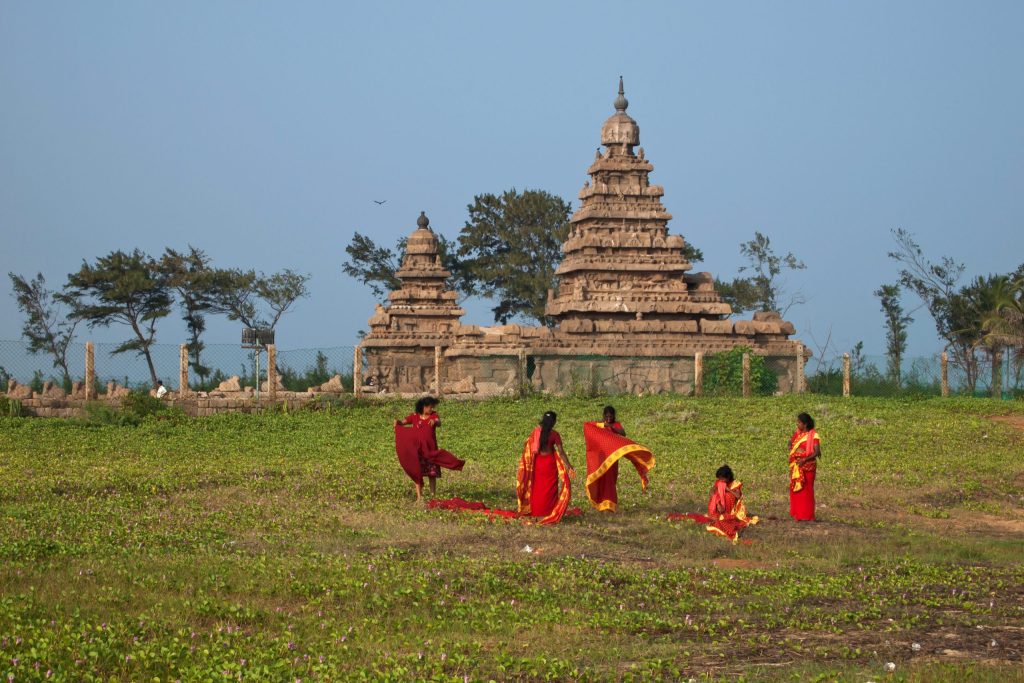
- **Shore Temple:** a structural stone temple on the coast, built under Narasimhavarman II Rajasimha, and a UNESCO World Heritage Site along with the other monuments
- **Kailasanathar Temple:** a major Shiva temple at Kanchipuram, also of Rajasimha’s time
These monuments are regarded as the foundations of medieval South Indian temple architecture, an inheritance continued in the Chola temples.
Script and Learning
The Pallava script developed into the Tamil and Grantha scripts and later gave rise to several scripts of South-East Asia, including Khmer. The Chinese Buddhist traveller Xuanzang visited Kanchipuram in the seventh century and praised the kingdom. Kanchipuram was a seat of Sanskrit learning and of Buddhist, Jain and Hindu schools.
End of the Dynasty
Constant warfare with the Chalukyas, the Pandyas and later the Rashtrakutas weakened the kingdom. In the ninth century the Chola ruler Aditya I defeated the last Pallava king, and the Cholas became the dominant power in the south, as told in the story of Rajendra Chola’s expedition.
Featured image: The Shore Temple at Mamallapuram (Mahabalipuram), built under the Pallava king Narasimhavarman II. Photo by Vyacheslav Argenberg, licensed under CC BY 4.0, via Wikimedia Commons.