



In the early seventh century two of the most powerful kings India had seen met in battle on the banks of the Narmada. Harsha, master of the north, tried to push into the Deccan. Pulakeshin II of the Chalukya dynasty stopped him. The river remained the frontier between their empires.
The two kings
- Harsha (reigned about 606 to 647) came to the throne of Thanesar at sixteen after his brother was murdered, and moved his capital to Kannauj. In a few years he brought most of the Ganga plain under his control. The Chinese pilgrim Xuanzang, who stayed at his court, and his court poet Bana describe a generous, energetic ruler who was also a playwright.
- Pulakeshin II (reigned about 610 to 642) won the Chalukya throne at Vatapi, the modern Badami in Karnataka, after a civil war against his uncle. He then subdued his neighbours one by one and made the Chalukyas the leading power of the Deccan.
Why they fought
Harsha’s expansion to the south-west brought him to the kingdoms of Malwa and Gujarat, whose rulers looked to Pulakeshin for protection. The Narmada valley was the natural road between north and south. A clash was likely.
The battle
The date is uncertain; historians have placed it between about 612 and 634, with around 618 to 619 often favoured. Nor is the exact place known, beyond that it was on the Narmada. There is no account of the fighting itself. What survives is the result.
The evidence
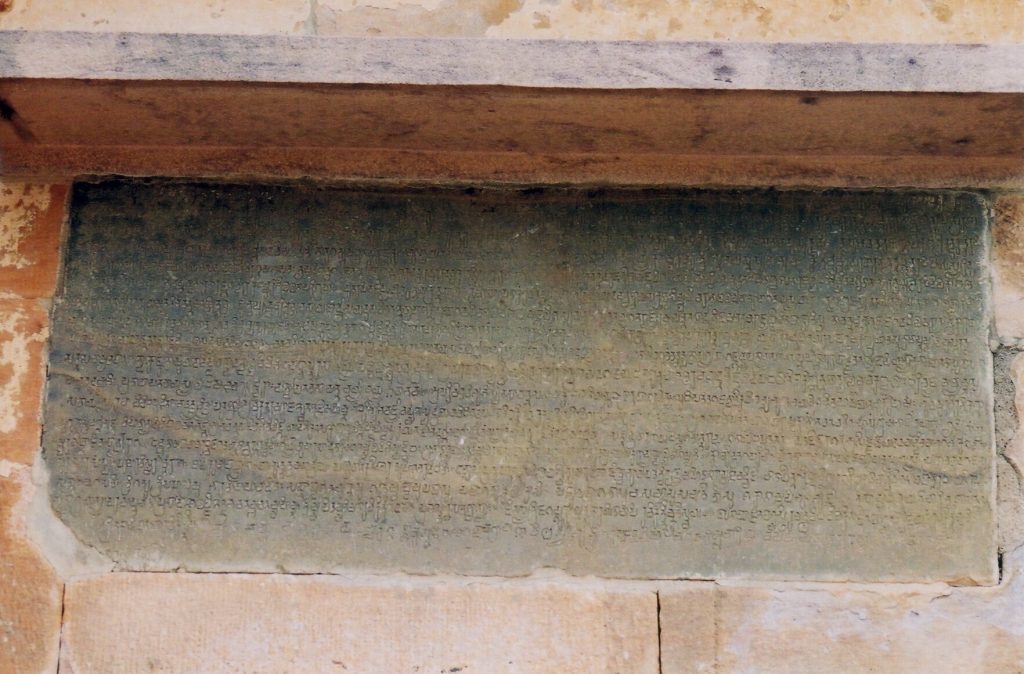
- The Aihole inscription: In 634 the poet Ravikirti composed a Sanskrit eulogy of Pulakeshin, carved on the wall of the Meguti Jain temple at Aihole. It says that Harsha, whose feet were worshipped by an army of vassal kings, lost his “harsha”, his joy, when his elephants fell in battle. The line is a pun on the emperor’s name.
- Xuanzang: The Chinese monk, who admired Harsha, admits that the king gathered troops from the five regions of India and led them himself against Pulakeshin, but could not subdue him. He adds that the people of Pulakeshin’s country were proud and warlike and that their warriors and elephants went into battle drunk.
- Titles: After the victory Pulakeshin took the title Parameshvara, supreme lord, and later Chalukya records keep recalling that their ancestor had defeated “the lord of the whole north”.
That Harsha’s own admirer confirms the failure is the strongest proof.
What it meant
Harsha did not try again. His empire remained a northern one, and it fell apart soon after his death in 647. The Narmada became accepted as the boundary between the powers of the north and those of the Deccan, a division that reappears through later Indian history.
The fate of Pulakeshin
The victor did not end well. Pulakeshin fought a long war with the Pallavas of Kanchipuram. In 642 the Pallava king Narasimhavarman I invaded, captured Vatapi and took the title Vatapikonda, conqueror of Vatapi. Pulakeshin is believed to have died in the fighting. The Chalukyas recovered their capital only thirteen years later.
Why it is remembered
The battle is one of the few events of early medieval India attested by two independent sources from opposite sides, an Indian inscription and a foreign traveller. It also shows how much of that history must be pieced together from a line of verse and a pilgrim’s notes.
Image: The Aihole inscription of 634 CE, composed by the poet Ravikirti, which records Pulakeshin II’s victory over Harsha. Photo by Dineshkannambadi (talk) 12:36, 1 August 2008 (UTC), licensed under CC BY-SA 3.0, via Wikimedia Commons.