
Naushad Ali, born on 25 December 1919 and died on 5 May 2006, was an Indian composer for Hindi films and is widely considered one of the greatest music directors of Hindi cinema. He is remembered as “Moseeqar-e-Azam”, the great musician, and was particularly known for popularising the use of classical music in films. He received the Dadasaheb Phalke Award in 1981 and the Padma Bhushan in 1992.
He was born and raised in Lucknow, a city with a long tradition as a centre of Indian Muslim culture. His father, Wahid Ali, was a munshi, or court clerk. As a child he visited the annual fair at Deva Sharif in Barabanki, about 25 kilometres from Lucknow, where great qawwals and musicians performed. He studied Hindustani music under Ustad Ghurbat Ali, Ustad Yusuf Ali, Ustad Babban Saheb and others, and he repaired harmoniums.
He joined a junior theatrical club and became its music maestro, and he watched silent films at the Royal Theatre in Lucknow, where hired musicians played live accompaniment. He learned how to build a score from them. He formed his own group, Windsor Music Entertainers, named after a word he had seen around Lucknow, which led to the Indian Star Theatrical Company. He trained under Laddan Khan and picked up folk music from Punjab, Rajasthan, Gujarat and Saurashtra on the company’s travels. His father opposed his interest in music, but he moved to Mumbai in late 1937 to become a musician.
In Mumbai he was initially staying with an acquaintance and slept on the footpath opposite the Broadway theatre in Dadar. He assisted the music director Ustad Jhande Khan for a monthly salary of Rs 40, worked as a pianist in Ustad Mushtaq Hussain’s orchestra, and then became assistant to Khemchand Prakash at Ranjit Studios for Rs 60 a month, whom he later called his guru in interviews. The lyricist D. N. Madhok introduced him to producers. He was assistant music director on the Punjabi film Mirza Sahib (1939).
His first independent film was Prem Nagar in 1940, for which he researched the folk music of Kutch, and with A. R. Kardar’s Nayi Duniya (1942) he got his first credit as “music director”. He first got noticed with Sharda (1942), in which the 13-year-old Suraiya made her debut with the song “Panchhi Ja”. Rattan (1944) took him to the top, when the company earned Rs 3 lakh in gramophone royalties in the first year, and he was able to charge Rs 25,000 a film.
From 1942 to the late 1960s he was one of the top music directors in Hindi films. He composed for 65 films in his lifetime, of which 26 celebrated silver jubilees, eight golden jubilees and four diamond jubilees. His lyricists included Shakeel Badayuni, Majrooh Sultanpuri, D. N. Madhok, Zia Sarhadi and Khumar Barabankvi. Mother India (1957), for which he composed the music, was the first Indian film nominated for an Oscar.
A story told about him shows the pressure he worked under: when he married, a band played the hit songs of Rattan, while his father and father-in-law condemned the composer, and he dared not tell them that he had written them. His career, from a Lucknow harmonium repairer to the “great musician” of the Hindi screen, helped to put classical ragas and folk tunes at the centre of film music.
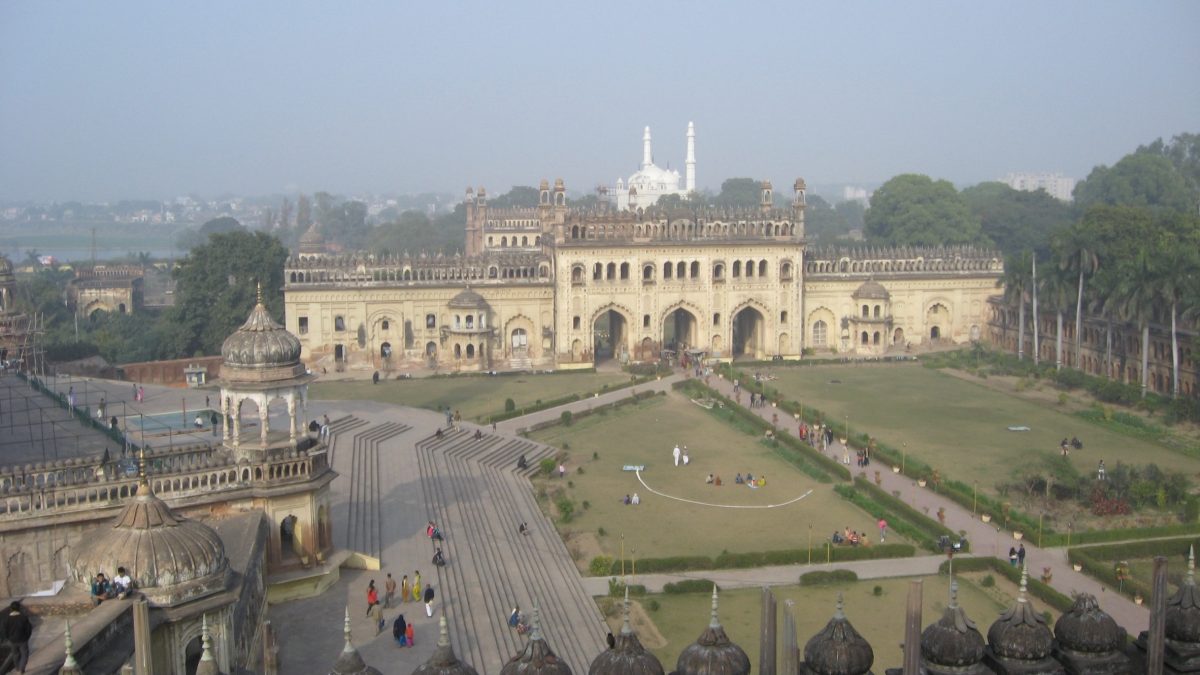
Featured image: The Bara Imambara in Lucknow, Naushad’s home city (file photo, 2010; not a photo of Naushad). Photo by Slyronit, licensed under CC BY-SA 4.0, via Wikimedia Commons.



