



Jaipur, the capital of Rajasthan, was one of the first planned cities of modern India. Laid out in 1727 on a grid of wide straight streets, it remains a busy centre of trade and craft. UNESCO inscribed the walled city as a World Heritage Site in 2019.
At a glance
- Location: Jaipur, Rajasthan
- Inscribed: 2019
- Type: Cultural
- Founded: 1727
- Founded by: Maharaja Sawai Jai Singh II
The plan
Sawai Jai Singh, ruler of the hill fortress of Amber, decided to build a new capital on the plain to the south. He was a mathematician and astronomer, and his city reflected it. With his planner, the Bengali scholar Vidyadhar Bhattacharya, he laid out a grid of nine squares, following the traditional Indian treatises on town planning while also drawing on Mughal and Western ideas.
- Main streets: very wide and straight, meeting at large public squares called chaupars
- Bazaars: lines of uniform shops with covered arcades along the main streets, each market assigned to a trade
- The centre: the palace quarter, occupying two of the nine squares
- Walls: with seven gates
Why pink
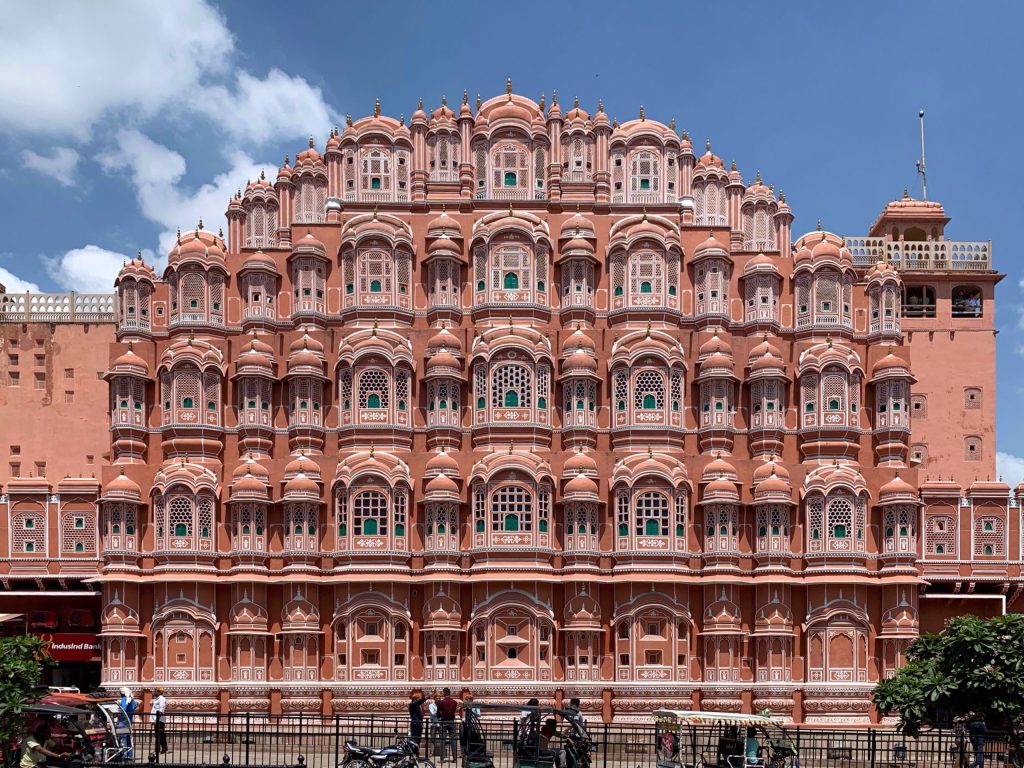
The buildings were originally of varied colours. In 1876 Maharaja Ram Singh II had the city painted a uniform terracotta pink, the colour of welcome, for the visit of the Prince of Wales. The colour has been kept ever since by regulation.
What to see
- City Palace: still partly the home of the former royal family, with museums of textiles and arms
- Hawa Mahal: the Palace of the Winds, built in 1799, a five-storeyed screen of 953 small windows from which the women of the court could watch the street
- Jantar Mantar: the royal observatory, a World Heritage Site in its own right
- Govind Dev Temple
- Johari Bazaar and Bapu Bazaar: for jewellery, textiles and crafts
Crafts
The founder invited merchants and craftsmen to settle, and the city is still known for gem cutting, enamelled jewellery, block-printed cloth, blue pottery and marble carving.
Why it is a World Heritage Site
Jaipur is an outstanding example of an eighteenth-century planned city in which ancient Hindu, Mughal and contemporary Western ideas were brought together, and which was designed from the start as a commercial capital.
Visiting
Jaipur is about 280 kilometres from Delhi. Amber Fort, one of the Hill Forts of Rajasthan, is eleven kilometres from the centre.
Image: The Hawa Mahal, the Palace of the Winds, in Jaipur. Photo by Chainwit., licensed under CC BY-SA 4.0, via Wikimedia Commons.