


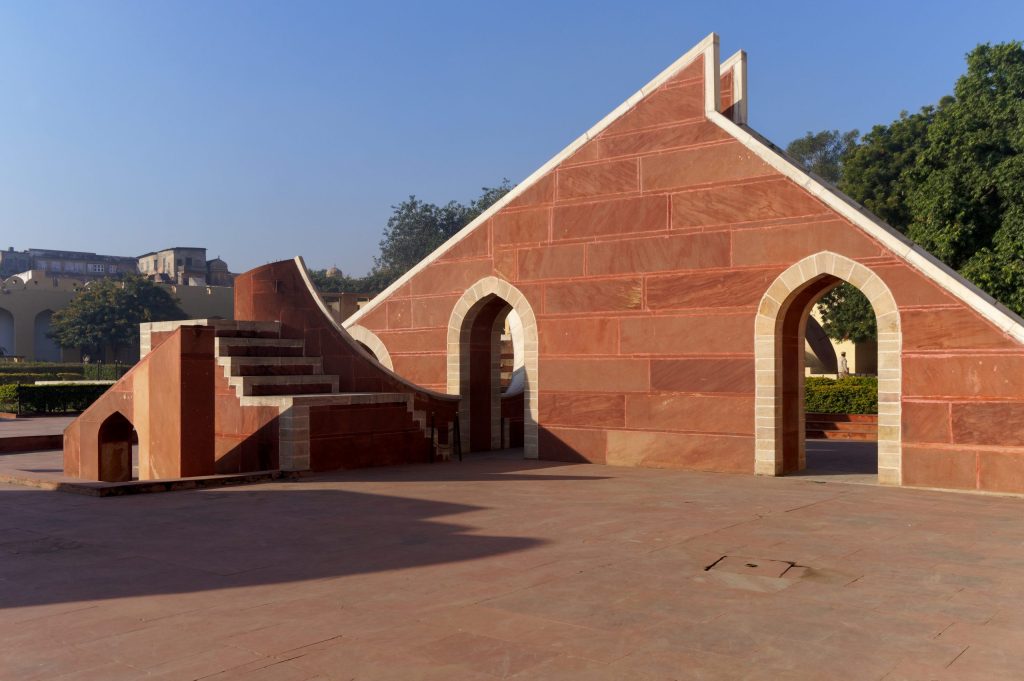

Beside the City Palace in Jaipur stands a collection of strange geometric structures in stone and plaster: ramps that lead nowhere, sunken bowls, rings and arcs. They are the instruments of an astronomical observatory built nearly three hundred years ago. UNESCO inscribed the Jantar Mantar, Jaipur, as a World Heritage Site in 2010.
At a glance
- Location: Jaipur, Rajasthan
- Inscribed: 2010
- Type: Cultural
- Built: completed about 1734
- Built by: Maharaja Sawai Jai Singh II
The builder
Sawai Jai Singh II, ruler of Amber and founder of Jaipur, was a serious student of astronomy. He found that the tables then used to predict the positions of the sun, moon and planets did not agree with what was observed. He collected the astronomical works of Hindu, Islamic and European scholars and decided that the fault lay in small brass instruments, which were not precise enough. His answer was to build instruments of masonry on a very large scale.
He built five observatories, at Delhi, Jaipur, Ujjain, Varanasi and Mathura. The one at Jaipur is the largest and best preserved; the one at Mathura no longer exists. The name comes from the Sanskrit yantra, instrument, and mantra, calculation.
The instruments
There are about twenty, all designed for observation with the naked eye.
- Samrat Yantra: the “supreme instrument”, a sundial 27 metres high, the largest in the world. The shadow of its sloping wall, which points to the celestial pole, moves across curved scales on either side at about a hand’s breadth a minute, and tells the local time to within two seconds.
- Jai Prakash Yantra: two sunken marble hemispheres mapping the sky upside down; the shadow of a ring hung over the centre shows the position of the sun
- Rama Yantra: paired open cylinders for measuring the altitude and direction of stars
- Rashivalaya Yantra: twelve small dials, one for each sign of the zodiac
- Chakra Yantra and others: for finding the coordinates of heavenly bodies
Why it is a World Heritage Site
The observatory is the most complete and best-preserved of India’s historic observatories and an expression of the astronomical skills and ideas of a scholarly prince at the end of the Mughal period.
Visiting
It is open daily. A guide or audio guide is helpful, since the purpose of the instruments is not obvious. The Samrat Yantra is still consulted each year by local astrologers to forecast the monsoon.
Image: The masonry instruments of the Jantar Mantar observatory, Jaipur. Photo by Jakub Hałun, licensed under CC BY-SA 4.0, via Wikimedia Commons.