


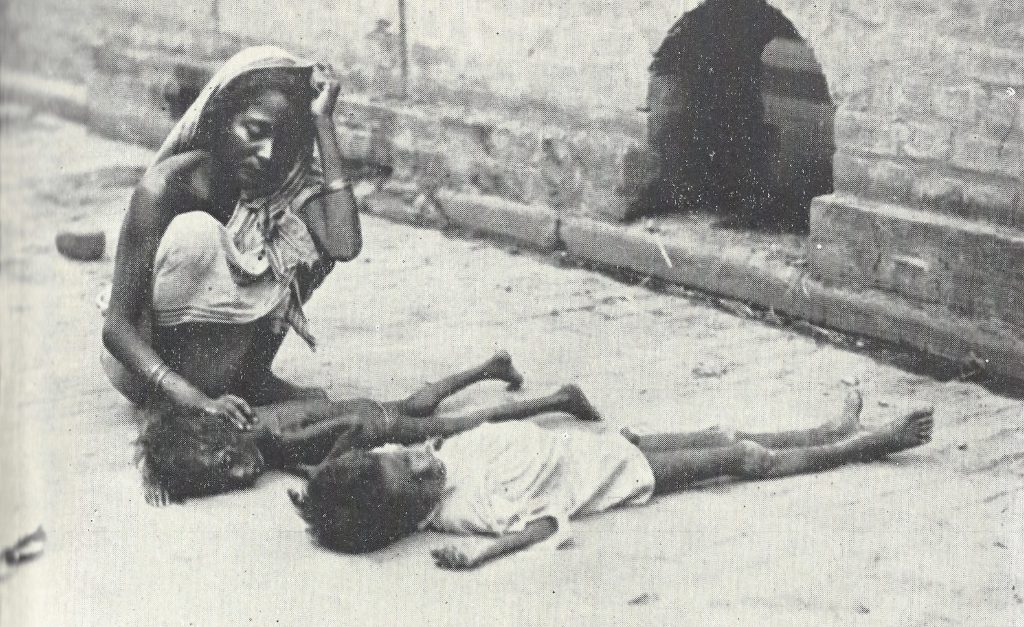

The Bengal famine of 1943 was one of the worst disasters of the Second World War, yet it happened far from the battlefield. An estimated 800,000 to 3.8 million people died in Bengal and parts of Orissa, from starvation and from diseases such as malaria that follow hunger. The wide range reflects poor records, and the causes are still debated by historians.
Quick Facts
| Years | 1942–44, peak in 1943 |
| Region | Bengal Province and parts of Orissa, British India |
| Estimated deaths | 0.8 to 3.8 million (estimates vary widely) |
| Main factors | Wartime inflation, loss of Burmese rice, denial policies, 1942 cyclone, hoarding, transport priorities |
| Inquiry | Famine Inquiry Commission (1944–45) |
A Fragile Economy
Bengal was an agrarian province with about 60 million people in 1941, and between half and three-quarters of the rural poor were reported to live in a semi-starved condition. Rice yields had been stagnant since the early twentieth century while the population rose, and millions held little or no land and lived in chronic debt. A province already close to the margin was then hit by the war.
What Went Wrong
- **The fall of Burma (1942):** Japan’s conquest cut off rice imports and sent a flood of refugees into Bengal and Assam
- **Denial policies:** to deny resources to a possible Japanese invasion, the authorities removed or destroyed rice stocks and boats in coastal districts, which hurt fishermen and traders
- **Inflation:** the cost of financing the war pushed prices up faster than wages, and many workers were paid in cash
- **Military build-up:** airfields and camps displaced tens of thousands of families from their land
- **The October 1942 cyclone:** it hit Midnapore and the 24 Parganas, killing about 14,500 people and 190,000 cattle and destroying stored rice
- **Hoarding and speculation:** traders held back supplies as prices rose, and officials were slow to act
The Response
Procurement and relief were inadequate, and priority went to workers in war industries and to Calcutta. Requests for shipping to import grain were refused or reduced because of the demands of the war. Winston Churchill’s role is a subject of dispute: critics argue that he and his advisers gave too little priority to Bengal, while others point to the shortage of ships and the military emergency. The Viceroy, Lord Wavell, who took office in October 1943, ordered the army to move grain and open relief. The 1945 Famine Inquiry Commission blamed the shortfalls and the failure of the Bengal government, and estimated about 1.5 million deaths.
Explaining the Famine
The economist Amartya Sen argued in 1981 that food availability alone did not explain it, and that people lost the means to buy food as prices rose against stagnant wages, so that the poorest rural labourers and fishermen starved while grain was still in the market. Other scholars stress the shortfall in the rice crop and the effect of the denial policies. Both views agree that policy decisions made the disaster worse.
Legacy
The famine left deep marks on Bengal’s society and on its politics, and on the cultural memory shown in the photographs of Sunil Janah and the paintings of Chittaprosad. It strengthened the case against colonial rule in the last years of the Raj, which ended in the Partition of 1947. Famine was not new to the region: the earlier great famine of 1770 followed the Company’s takeover of Bengal after Buxar.
Featured image: Starving children on a Calcutta street during the Bengal famine, in a photograph published by The Statesman on 22 August 1943. Photo by The Statesman, Calcutta, India, in the public domain, via Wikimedia Commons.