


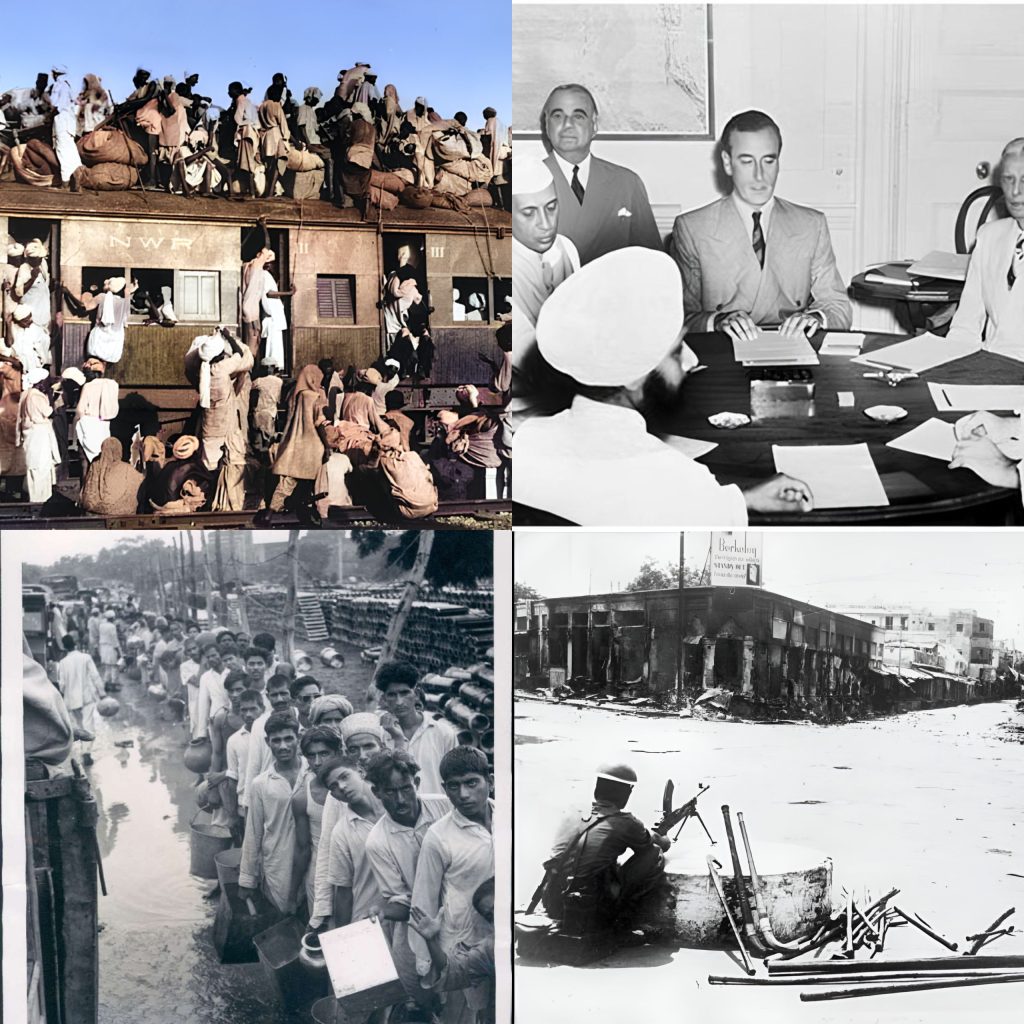

In August 1947 British India became two independent countries, India and Pakistan. The division, known as Partition, set off one of the largest migrations in human history and violence that killed hundreds of thousands of people.
How it came about
- The two-nation theory: The Muslim League under Muhammad Ali Jinnah argued that Muslims were a separate nation, and in its Lahore Resolution of 1940 demanded separate states.
- The 1946 elections: The League won the great majority of seats reserved for Muslims.
- The Cabinet Mission: A British plan in 1946 for a loose federation, which would have kept India united, broke down.
- Direct Action Day: On 16 August 1946 the League’s call for “direct action” led to days of killing in Calcutta. Riots spread to Noakhali, Bihar and Punjab.
- A hurried exit: Britain, exhausted by the war, wanted to leave. Lord Mountbatten arrived as the last Viceroy in March 1947 and brought the date of departure forward.
The plan
On 3 June 1947 Mountbatten announced that British India would be divided. The Congress leaders, including Jawaharlal Nehru and Vallabhbhai Patel, accepted it as the only way to avoid civil war. Mahatma Gandhi opposed it to the end. The British Parliament passed the Indian Independence Act in July.
The Radcliffe Line
Punjab and Bengal, which had mixed populations, were each to be divided. The task was given to a British lawyer, Sir Cyril Radcliffe, who had never been to India and was allowed about five weeks. His boundary award was published on 17 August 1947, two days after independence, so millions did not know on 15 August which country they were in.
Independence
Pakistan came into being on 14 August 1947 and India on 15 August. In Delhi, Nehru spoke of India’s “tryst with destiny”. Gandhi spent the day in Calcutta, fasting and working to stop the riots.
The human cost
- Displaced: between 10 and 15 million people crossed the new borders, Hindus and Sikhs moving east and Muslims moving west.
- Killed: estimates range from about 2,00,000 to 20 lakh.
- Women: tens of thousands were abducted or assaulted.
- Refugees: trains arrived full of the dead; camps sprang up in Delhi, Punjab and Bengal.
Punjab suffered the worst violence. In Bengal migration continued for years.
The legacy
- Kashmir: The dispute over the princely state led to war between India and Pakistan within months.
- Bangladesh: East Pakistan broke away in 1971.
- Memory: Families divided in 1947 remain so. Since 2021 India has observed 14 August as Partition Horrors Remembrance Day, and a Partition Museum stands in Amritsar.
Image: Scenes from 1947: refugee trains, a refugee column and the negotiations that led to Partition. Photo by Captain AmericanBurger1775, licensed under CC0, via Wikimedia Commons.