


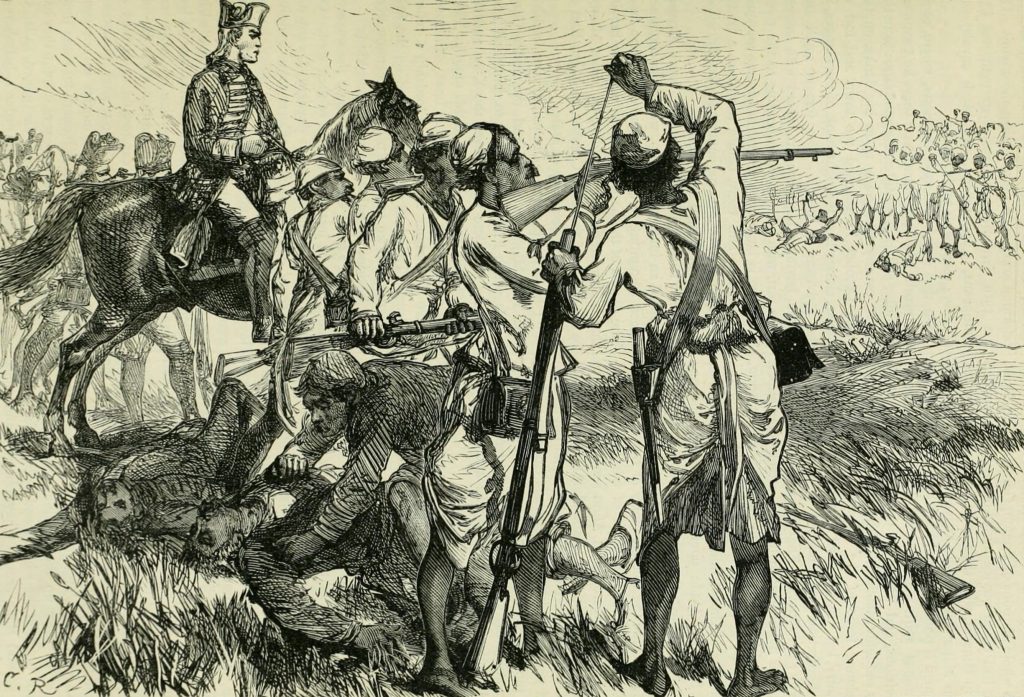

On 22 October 1764, at Buxar on the Ganga in Bihar, the army of the English East India Company defeated the combined forces of three Indian rulers, one of them the Mughal emperor himself. Plassey had been won by intrigue. Buxar was won by fighting, and it gave the Company legal control of the richest part of India.
After Plassey
The Company had made Mir Jafar Nawab of Bengal in 1757. When he could not meet its demands for money, it replaced him in 1760 with his son-in-law, Mir Qasim, who paid for the favour with three districts and large presents.
Mir Qasim
Mir Qasim proved abler than expected. He moved his capital from Murshidabad to Munger, away from Calcutta, put the finances in order, and raised an army drilled in the European manner, with a factory for muskets and cannon.
The breaking point was trade. The Company’s servants used its exemption from duties for their own private business and sold the privilege to Indian agents, ruining local merchants who had to pay. When his protests were ignored, Mir Qasim abolished the duties for everyone. The Company’s council in Calcutta treated this as an attack on its rights.
War began in 1763. Mir Qasim was beaten in a series of battles, and in his rage had about 150 English prisoners put to death at Patna. He fled west into Awadh.
The alliance
In Awadh he joined two others:
- Shuja-ud-Daula, the Nawab of Awadh and the most powerful ruler in north India
- Shah Alam II, the Mughal emperor, a wanderer without a capital, who hoped to recover Bengal for the empire
The three had different aims and little trust in one another; Shuja at one point arrested Mir Qasim and seized his treasure.
The battle
The Company’s army was commanded by Major Hector Munro, who had just restored discipline after a mutiny by blowing twenty-four ringleaders from guns. He had about 7,000 men, of whom some 850 were Europeans and the rest Indian sepoys, with twenty-eight guns. The allies had perhaps 40,000.
The armies met outside the town of Buxar on the morning of 22 October. Shuja’s cavalry attacked boldly and for a time threatened the Company’s rear and baggage. But the allied forces acted without a common plan, and the emperor’s contingent took little part. The steady musketry and artillery of the Company’s line held, and then advanced. By midday the allied army was in retreat across a stream, where a bridge of boats was cut and many were drowned.
The Company lost about 850 killed and wounded, far more than at Plassey. The allies lost some 2,000 dead and more than a hundred guns.
The Treaty of Allahabad
Mir Qasim fled and died in poverty years later. Shah Alam came over to the British camp. Shuja fought on until 1765 and then submitted.
Robert Clive, sent back to India as governor, made the settlement at Allahabad in August 1765.
- The Diwani: The emperor granted the Company the right to collect the revenues of Bengal, Bihar and Orissa. In return he received an annual tribute of 26 lakh rupees and the districts of Kora and Allahabad.
- Awadh: Shuja was given back his kingdom on payment of 50 lakh rupees and became a dependent ally, a buffer between Bengal and the Marathas.
- Bengal: The Nawab was left with the title and the responsibility for order, while the Company took the money. This “dual government” gave power without accountability.
Why it mattered
A trading company now held, by imperial grant, the revenue of some twenty million people. It no longer needed to ship silver from Britain to buy Indian goods; Bengal’s own taxes paid for them, and for the armies that carried the Company across India. The cost to Bengal was shown in the famine of 1770, in which perhaps a third of the population died.
For this reason many historians date the real foundation of British rule in India not to Plassey but to Buxar.
Image: Company sepoys at Buxar, in an illustration published about 1879. Photo by C. R., in the public domain, via Wikimedia Commons.