
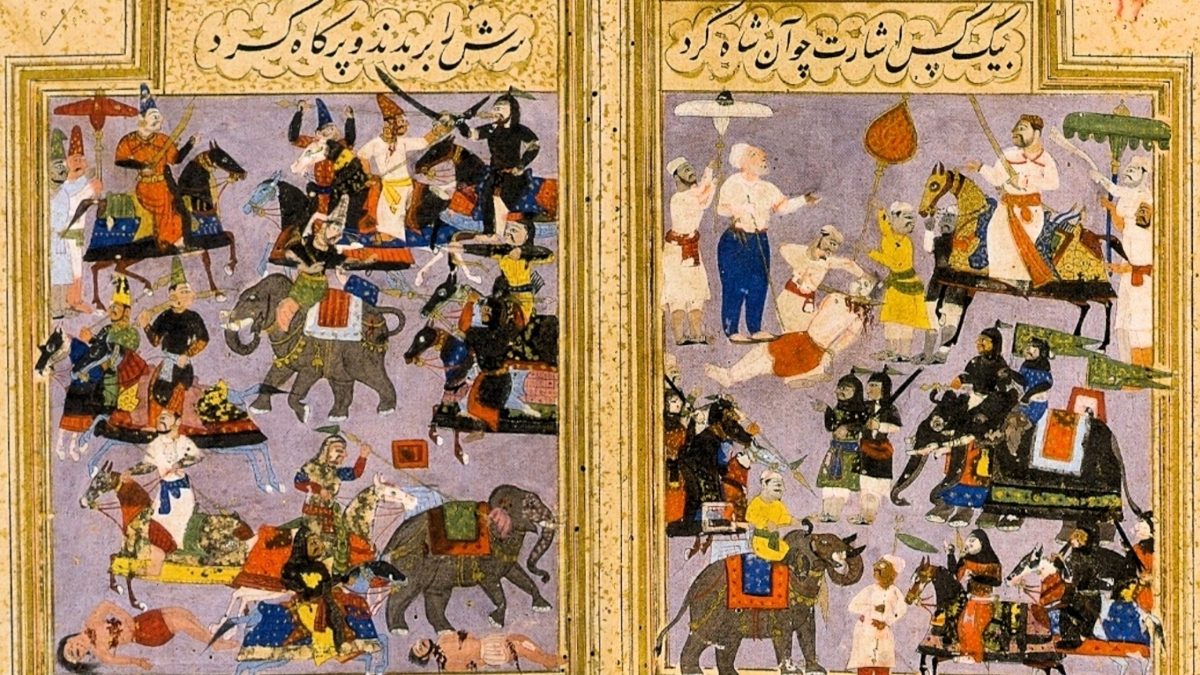
On 23 January 1565 the army of Vijayanagara, the empire that had dominated south India for two centuries, was destroyed by an alliance of the Deccan sultanates. Within days its capital, one of the largest and richest cities in the world, was sacked. The battle is known as Talikota, or Rakkasagi-Tangadagi after the two villages nearest the field.
Vijayanagara
Founded in the 1330s on the Tungabhadra river, Vijayanagara reached its height under Krishnadevaraya, who reigned from 1509 to 1529. Portuguese visitors described a capital larger than Rome, with markets full of jewels and silk.
By the 1560s real power lay with Rama Raya, a son-in-law of Krishnadevaraya, who ruled as regent in the name of the emperor Sadasiva Raya, whom he kept confined. His brothers Tirumala and Venkatadri commanded with him.
The sultanates
To the north, the Bahmani kingdom had broken into five states: Ahmadnagar, Bijapur, Golconda, Bidar and Berar. They fought one another constantly. Rama Raya exploited this, joining one sultan against another and taking territory as his price. His armies, on campaign in Ahmadnagar, were accused of insulting mosques and the population, and his manner towards the sultans’ envoys was arrogant.
In time the sultans concluded that he was the greater danger. Hussain Nizam Shah of Ahmadnagar and Ali Adil Shah of Bijapur sealed an alliance with marriages between their families, and Ibrahim Qutb Shah of Golconda and Ali Barid Shah of Bidar joined them. Berar stayed out.
The battle
The allies assembled near Talikota in December 1564 and crossed the Krishna by a feint. The armies met south of the river.
Vijayanagara’s army was the larger. Rama Raya, said to be well over seventy, commanded the centre from a litter, with his brothers on the wings. The allies had the better artillery, managed by a gunner called Rumi Khan, and cavalry mounted on fine horses.
At first Vijayanagara’s wings drove the enemy back. Then the Ahmadnagar guns in the centre, loaded with bags of copper coin, fired into the advancing infantry at close range, and the allied cavalry charged. Some accounts add that two Muslim commanders in Rama Raya’s service changed sides; historians disagree on whether this happened.
In the confusion Rama Raya was thrown from his litter, captured and brought before Hussain Nizam Shah, who had him beheaded on the spot. His head was raised on a spear. The army, seeing it, fled. Venkatadri was killed or blinded; Tirumala escaped.
The sack of Hampi
Tirumala rode to the capital, loaded the treasury on hundreds of elephants and left with the captive emperor for the fortress of Penukonda. The city was left undefended. Robbers from the countryside looted it first. Then the victorious armies arrived and spent about five months plundering and burning. The traveller Cesare Federici, who saw it two years later, found the houses standing but empty, inhabited by tigers and other wild beasts.
The aftermath
- Vijayanagara: Tirumala founded a new dynasty, the Aravidu, which ruled a shrunken kingdom from Penukonda and later Chandragiri for another eighty years. The capital was never reoccupied.
- The south: The governors of Madurai, Thanjavur, Gingee and Mysore became independent rulers.
- The sultanates: They soon resumed their quarrels, and were absorbed one by one by the Mughals in the following century.
The ruins
The site lay forgotten until Robert Sewell’s book A Forgotten Empire drew attention to it in 1900. The ruins at Hampi, spread over many square kilometres of granite hills, have been a UNESCO World Heritage Site since 1986.
Image: The Battle of Talikota, from a manuscript made at Ahmadnagar about 1565. Photo by an unknown Deccani artist, in the public domain, via Wikimedia Commons.




Leave a Reply