
In 1671, on the Brahmaputra river near Guwahati, the forces of the Ahom kingdom of Assam defeated a large Mughal army and fleet. The Battle of Saraighat was fought mainly on water, and it was won by a general so ill that he had to be carried to his boat. It ended the last serious Mughal attempt to conquer Assam.
The Ahom kingdom
The Ahoms, a Tai people who had entered the Brahmaputra valley in the thirteenth century, ruled Assam for nearly six hundred years. Their state was organised around the paik system, in which every adult man owed service to the king as a labourer or soldier, and it kept a strong fleet of war boats.
The Mughal wars
The Mughals, having taken Bengal, fought the Ahoms repeatedly from 1615. In 1662 Aurangzeb’s general Mir Jumla invaded with a great force and occupied the Ahom capital, Garhgaon. The king was forced to sign the treaty of Ghilajharighat in 1663, giving up western Assam, a large indemnity and a princess for the imperial harem.
The humiliation was not accepted. King Chakradhwaj Singha rebuilt the army and appointed Lachit, a son of the statesman Momai Tamuli Borbarua, as Borphukan, the governor and commander of the west. In 1667 Lachit recaptured Guwahati and the fort of Itakhuli and drove the Mughals back to the Manas river.
Ram Singh’s expedition
Aurangzeb sent Raja Ram Singh of Amber to recover the lost ground. He arrived in 1669 with an army that the chronicles put at about 30,000 infantry, 18,000 cavalry and 15,000 archers, with artillery and a fleet.
Lachit could not match such a force on open ground, where Mughal cavalry was supreme. He chose to fight at Guwahati, where hills press close to the river on both banks and the Brahmaputra narrows to about a kilometre. He ringed the place with earthen ramparts, and held the Mughals off for many months with fortifications, night raids and drawn-out negotiations. When the king, impatient, ordered an attack in the open at Alaboi in 1669, the Ahoms lost about ten thousand men.
Discipline
The story is told that Lachit, inspecting the building of a rampart by night, found the work behind schedule because the officer in charge, his own maternal uncle, had let the men rest. He beheaded him on the spot, saying, “My uncle is not greater than my country.” The wall was finished by dawn.
The battle
In March 1671 Ram Singh decided to force the river. Mughal boats carrying guns and soldiers advanced up the Brahmaputra towards Guwahati, where the defences had a gap at the sandbank of Andharubali.
Lachit was seriously ill with fever. The Ahom boats, seeing the size of the Mughal fleet and their commander absent, began to fall back. Lachit had himself carried to a boat and with a handful of vessels made straight for the enemy, calling out that the king had placed the people in his hands and that the others could go home and tell him his general had died fighting.
The retreating boats turned. The Ahoms, in smaller, faster craft, closed in from both banks in the narrow stretch between Itakhuli, Kamakhya and Aswaklanta. They lashed boats together into a bridge across the river and attacked the larger Mughal vessels from every side. The Mughal admiral was killed, and the fleet was driven back with heavy loss. Ram Singh withdrew down the river.
Aftermath
Lachit Borphukan died about a year later, in 1672. Ram Singh is said to have praised the Ahom soldiers as men each of whom could row a boat, shoot arrows, dig trenches and handle guns. The Mughals held Guwahati again briefly from 1679, but were expelled for good at the battle of Itakhuli in 1682, and the Manas remained the border.
Remembrance
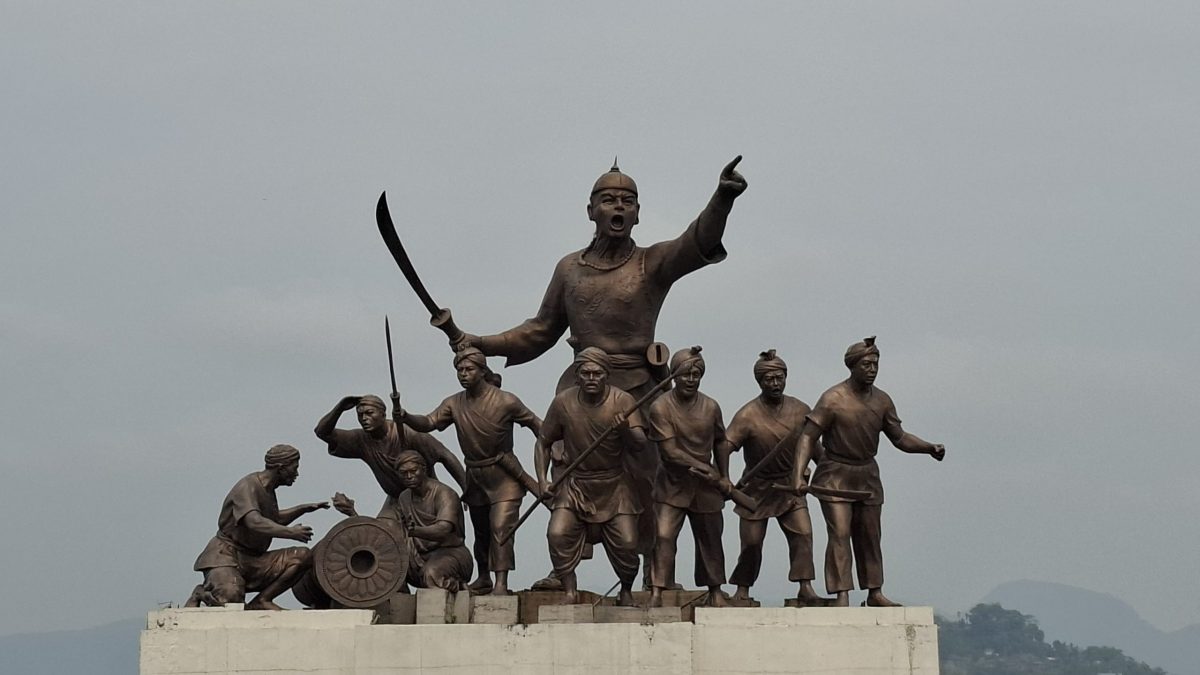
Assam observes 24 November as Lachit Divas. Since 1999 the best cadet passing out of the National Defence Academy has received the Lachit Borphukan Gold Medal, and a large statue of the general was unveiled at Jorhat in 2024.
Image: The statue of Lachit Borphukan and his soldiers at Lachit Ghat on the Brahmaputra in Guwahati. Photo by Pinakpani, licensed under CC BY 4.0, via Wikimedia Commons.

Leave a Reply